Alan Jacobson - False accusations
Здесь есть возможность читать онлайн «Alan Jacobson - False accusations» весь текст электронной книги совершенно бесплатно (целиком полную версию без сокращений). В некоторых случаях можно слушать аудио, скачать через торрент в формате fb2 и присутствует краткое содержание. Жанр: Триллер, на английском языке. Описание произведения, (предисловие) а так же отзывы посетителей доступны на портале библиотеки ЛибКат.
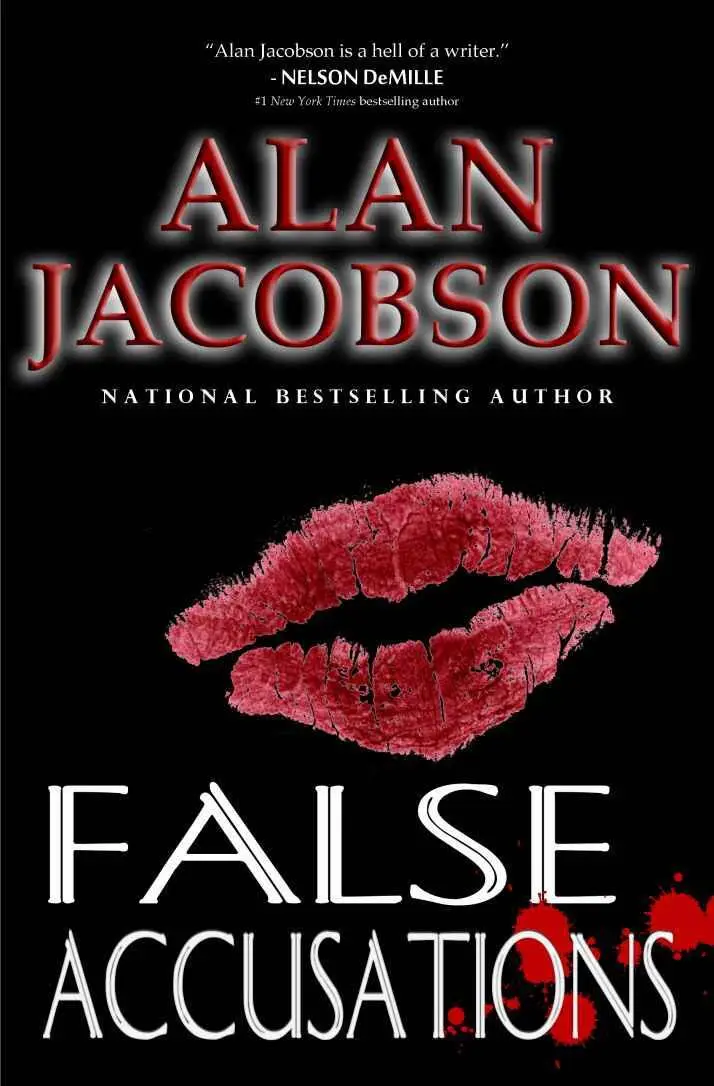
- Название:False accusations
- Автор:
- Жанр:
- Год:неизвестен
- ISBN:нет данных
- Рейтинг книги:4 / 5. Голосов: 1
-
Избранное:Добавить в избранное
- Отзывы:
-
Ваша оценка:
False accusations: краткое содержание, описание и аннотация
Предлагаем к чтению аннотацию, описание, краткое содержание или предисловие (зависит от того, что написал сам автор книги «False accusations»). Если вы не нашли необходимую информацию о книге — напишите в комментариях, мы постараемся отыскать её.
False accusations — читать онлайн бесплатно полную книгу (весь текст) целиком
Ниже представлен текст книги, разбитый по страницам. Система сохранения места последней прочитанной страницы, позволяет с удобством читать онлайн бесплатно книгу «False accusations», без необходимости каждый раз заново искать на чём Вы остановились. Поставьте закладку, и сможете в любой момент перейти на страницу, на которой закончили чтение.
Интервал:
Закладка:
“Then there is the issue of the market incident. Ronald Norling, the grocery clerk, was only interested in telling the truth of what he had seen and heard. He doesn’t know Dr. Madison or Miss Harding-he has no ax to grind, no bias, if you will, whatsoever. We know why the defendant did what she’s accused of doing because, aside from the physical evidence implicating her, she told us what she was going to do. She made her intentions quite clear. The last time she threatened to do something-when she accused Dr. Madison of rape and screamed that she was going to go to the police and make him pay-she did just that. And when she screamed at him in a crowded market that she would make him pay and get even with him-she did just that. Or tried to.
“Ladies and gentlemen, what more do we need? I would submit that we don’t need anything more to establish guilt on the part of the defendant.
“But we do have more. We have scientific evidence that underscores her involvement in this act of violence. Oh, the defendant’s attorney will tell you that just because her genetic fingerprints are on the beer cans found in the car does not mean she was driving it. That’s true. But I ask you, who else would have been driving it? Why would the defendant’s genetic fingerprints be found on beer cans inside the car if she were not a party to this crime?
“And I remind you that the only eyewitness to the aftermath of this murder said that he saw a Chicago Cubs hat on the driver of the vehicle as it passed by him. Such a hat was found in the defendant’s home, because she’s a longtime fan of the team. And I remind you, this is not Chicago. There aren’t a plethora of Cubs fans in Sacramento, California.”
Denton paused, walked a few steps over to the prosecution table. He leaned back against the front edge of it and crossed his arms on his chest. “In my opening statement, I asked you all to concentrate on the facts of the case and on what the witnesses had to say. I told you that if you did that, and did not allow yourselves to be swayed by fantasies, far-reaching theories, or confusing curves that the defense attorney would throw at you, then the answer to your question of guilt will be black and white. It would be simple, I told you.” He stood up straight and began to walk toward them again. “It is simple, ladies and gentlemen. I didn’t say easy, because it’s never easy to find someone guilty of murder. But simple, because the facts so clearly support it.”
He stopped in front of the jury box, rested his hands on the railing. Looked at each of them, making eye contact as he spoke. “Mr. Warwick, in his opening, said that he didn’t need to prove anything to you-which is good for him, because he didn’t prove anything. Because he couldn’t.” Denton leaned forward. “But we did. We proved our case, met our burden of proof. You must tell everyone in this great nation that murder for revenge will not go unpunished. Ladies and gentlemen, do your duty. Find the defendant guilty, as charged. Thank you.”
A low-level murmur erupted from the gallery; the reporters were writing furiously, phone sat the ready. As soon as Warwick finished his statement, the journalists covering the trial for radio would call in and report live, while those handling it for television would choose an appropriate backdrop for filming their remote spot. Bloggers and local print journalists would begin transmitting their bytes from their laptops, tablets, and smartphones within seconds.
Calvino cracked his gavel and asked for quiet. He nodded to Warwick. The lanky public defender stood, buttoned his sport coat, and approached the jury box. He stopped, and smiled. “Good morning. Ladies and gentlemen of the jury, as you have surmised, we have now reached that part of the case known as closing argument in which each of the lawyers has an opportunity to tell you what his case is about. You’ve already heard the district attorney’s position.
“In my opening, I told you that the evidence that the prosecution had against my client was circumstantial. Not the best type of evidence. In fact, none of it is direct evidence. Because there is no direct evidence linking my client to this crime. No one saw her commit the crime.
“Oh, yeah, there’s a witness who saw someone wearing a Cubs cap. Well, the last time I looked, being a Cubs fan did not make someone a murderer. And we also must remember that based upon this same witness’s description, the police arrested a male initially, not a female.
“My client is not an angel. She’s not a model citizen. I won’t insult your intelligence by standing up here and saying that she is. But her past actions were not precursors to murder. Poor judgment, misguided ethics, for sure. But murder?” He spread his arms out, palms up, pleading his case. “I think not. I know not.”
“And this incident in the market. My client has what some call ‘verbal diarrhea.’ She runs off at the mouth,” he clarified, to some stifled laughter. “But again, I ask you…does this make her a murderer? It does not. She was angry, she was frustrated-whether you feel she was right or justified is irrelevant. But when she came face-to-face with the man who represented her frustrations, she yelled something at him. Did she really mean what she said? Of course not. We all, at one time or another, say things that we regret, that we don’t mean. We’ve all said things that we wish we could, take back because they were said in the heat of the moment. The DA wants you to believe that she was announcing to a crowded market her intentions to commit murder. My client may not be an angel, but she is certainly not stupid.
“At the start of this trial, I asked you to remember three things: reasonable doubt, circumstantial evidence, and burden of proof. Burden of proof,” Warwick said, walking the length of the jury box and letting his left hand drag along the railing, “means that it is the prosecution’s responsibility to make a compelling case against my client. But all they did was to throw a bunch of circumstances at you and ask you to make a leap of faith. They gave you nothing concrete except a contrived theory.
“They didn’t mean for their case to be so indirect and weak-it’s not their fault. They didn’t have a choice. But ask yourselves,” he said, slapping his right hand, karate-chop style, into his left palm for emphasis, “did they actually prove anything to you, or did they merely set the stage and ask you to imagine that you’ve seen the play?
“You have to admit that their case may, in, fact, be interesting, but it’s not conclusive. Certainly not beyond a reasonable doubt. Which is the standard against which, you must judge my client. Reasonable doubt means that if you have any doubts about the innocence or guilt of my client, if there’s something bothering you about all of this in the back of your mind, something that just doesn’t feel right, you must vote not guilty. That’s not my invention, it’s the law.
“As for Mr. Denton thinking that the matter of imprisoning someone for perhaps the rest of her life is a simple decision…well, maybe where he comes from, it is. From where you and I come from, it is not. It’s never easy to make such drastic decisions regarding another human being’s life. I’m sure you feel that in order to do so, you must be absolutely sure of the facts. Absolutely sure!”
As Warwick’s voice rose, in the manner that a preacher admonishes his followers, Denton detected the slight nod of the head of two of the jurors.
“I’m not asking you for sympathy for my client. But I am asking you for fairness for my client. Miss Harding is an innocent person, falsely accused, whose life will never be the same again, even if she is acquitted. Don’t reach a verdict of guilty merely because you want to make someone, anyone, pay for this horrible crime.” He held out his right hand, index finger angled toward the ceiling for emphasis. “Based upon the case that the prosecutor has provided, you must find her not guilty.
Читать дальшеИнтервал:
Закладка:
Похожие книги на «False accusations»
Представляем Вашему вниманию похожие книги на «False accusations» списком для выбора. Мы отобрали схожую по названию и смыслу литературу в надежде предоставить читателям больше вариантов отыскать новые, интересные, ещё непрочитанные произведения.






Обсуждение, отзывы о книге «False accusations» и просто собственные мнения читателей. Оставьте ваши комментарии, напишите, что Вы думаете о произведении, его смысле или главных героях. Укажите что конкретно понравилось, а что нет, и почему Вы так считаете.