Alan Jacobson - False accusations
Здесь есть возможность читать онлайн «Alan Jacobson - False accusations» весь текст электронной книги совершенно бесплатно (целиком полную версию без сокращений). В некоторых случаях можно слушать аудио, скачать через торрент в формате fb2 и присутствует краткое содержание. Жанр: Триллер, на английском языке. Описание произведения, (предисловие) а так же отзывы посетителей доступны на портале библиотеки ЛибКат.
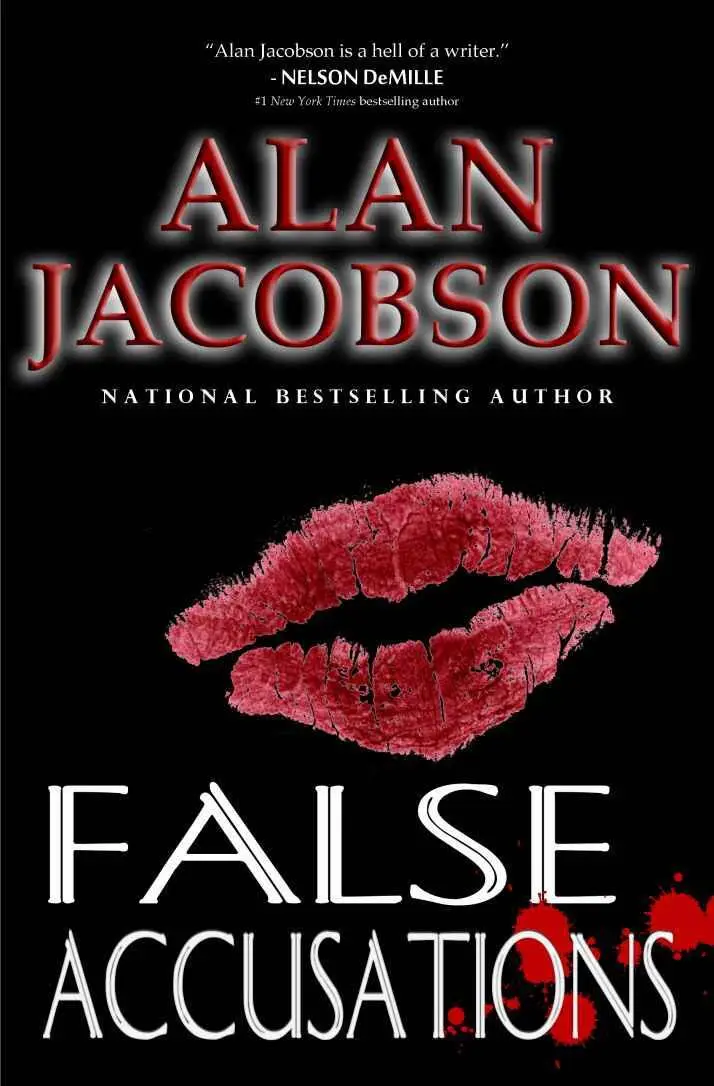
- Название:False accusations
- Автор:
- Жанр:
- Год:неизвестен
- ISBN:нет данных
- Рейтинг книги:4 / 5. Голосов: 1
-
Избранное:Добавить в избранное
- Отзывы:
-
Ваша оценка:
False accusations: краткое содержание, описание и аннотация
Предлагаем к чтению аннотацию, описание, краткое содержание или предисловие (зависит от того, что написал сам автор книги «False accusations»). Если вы не нашли необходимую информацию о книге — напишите в комментариях, мы постараемся отыскать её.
False accusations — читать онлайн бесплатно полную книгу (весь текст) целиком
Ниже представлен текст книги, разбитый по страницам. Система сохранения места последней прочитанной страницы, позволяет с удобством читать онлайн бесплатно книгу «False accusations», без необходимости каждый раз заново искать на чём Вы остановились. Поставьте закладку, и сможете в любой момент перейти на страницу, на которой закончили чтение.
Интервал:
Закладка:
“That’s not what I meant.”
“Again? I do wish you’d say what you mean. But allow me to rephrase. How many tricks were used in your analysis of the physical evidence?”
“You’re twisting my words,” Saperstein said calmly, though his face was shading red. “And if you truly want to-”
“I withdraw the question,” Warwick said. “I’ll ask you this instead: is this ‘trick’ one of your so-called scientific methods that we’re supposed to believe without questioning its validity?”
“You know as well as I do-”
“Just answer the question, please.”
“That’s what I’m trying to do, Mr. Warwick, if you’d let me speak-”
“A simple yes or no is all I want-”
“Objection, Your Honor,” shouted Denton. “He’s badgering the witness, and not permitting him the freedom to answer any of his questions.”
“Mr. Warwick. Make your point and move on. And please permit Mr. Saperstein proper time to answer your questions.”
Warwick nodded at the judge, and then turned back to Saperstein. “Yes or no, sir? Is this trick one of the so-called scientific methods that you and your collective colleagues used in evaluating this physical evidence?”
“I can’t answer your question within those narrow parameters.”
Denton smiled. Saperstein was not going to fall into another trap. He may have made a couple of mistakes, but he was one who learned from his errors and adapted.
“Your Honor,” pleaded Warwick with outstretched hands, “please direct the witness to answer.”
“Mr. Saperstein, please answer the question.”
Saperstein turned to Calvino. “I would like to comply, Your Honor, but I can’t answer it in the manner in which Mr. Warwick has phrased it. He’s twisting what I’m saying and attempting to force me into saying something that wouldn’t be accurate. Does the court wish me to answer incorrectly, or can I be given the proper opportunity to provide truthful information?”
“Answer the question to the best of your ability, sir,” Calvino said.
Denton fought back a smile. Saperstein had squelched a favorite tactic of adversarial attorneys who attempted to elicit certain testimony that appeared to be favorable to their case using the narrow parameters inherent in “yes” or “no” answers.
“There are no tricks or sleight of hand here,” Saperstein said. “Everything I do in the lab is based on scientific procedure. The tests I perform are widely accepted in the field of forensics, to the best of my knowledge. The-”
“Your Honor,” Warwick said, “would you please instruct the witness not to narrate but to merely answer the question?”
“I am answering the question,” Saperstein said. “Your Honor, counsel asked me if this was a trick or a scientific method, and I’m explaining what was done.”
“You opened the door, Mr. Warwick. Let’s hear his answer. Continue, Mr. Saperstein.”
“The method of lip print detection is called queiloscopy. It was mentioned in the literature as far back as 1902, and discussed in more detail in 1950 by a medicolegal consultant working on a case here in the Sacramento area. It wasn’t used as a means of personal identification until I believe 1960, when Dr. Santos of Brazil devised a system for classifying the differences in individuals’ lip prints. Around the same time, Japanese Professors Suzuki and Tsuchiahashi developed their own method of identification-”
“I have that paper right here,” Warwick said, tossing a few stapled pages onto the banister of the witness stand. “Is this what you’re basing your analysis on?”
“That is part of what’s accepted as baseline research in the field-”
“Read the highlighted portion, Mr. Saperstein,” Warwick said, pointing at the article.
Saperstein picked up the pages and read the portion Warwick requested. “Lip prints were collected from two hundred eight individuals, consisting of one hundred fifty males and one hundred thirty females, aged six to fifty-seven years.”
“So, Mr. Saperstein, this ‘scientific method’ you are so intent on using against my client is based on a research study of only two hundred eighty people? I would think that would be more scientific — and therefore more reliable-if the study involved thousands of test subjects. Wouldn’t it, sir?”
Saperstein took a breath and let it out slowly. “Is that a question you would like me to respond to, or do you want to answer that one yourself as well?”
Calvino scowled. “Mr. Saperstein, lose the attitude.”
Saperstein nodded apologetically at Calvino and turned back to Warwick, who was enjoying the moment of admonition. “Yes, Mr. Warwick, that study is what I’m basing my opinions on. That study as well as the follow-up study performed by the same researchers eight years later, in which one thousand four hundred people were evaluated. And the research involving one thousand five hundred people in the 1980s, conducted at the Department of Criminalistics of Civic Militia Headquarters in Poland.
“In that study, the patterns of the lines in the red part of lips were categorized, utilizing a ten-millimeter portion of the middle part of the lower lip-a section that’s almost always visible in a print. Several linear characteristics were identified: bifurcation, reticular, linear, and indeterminate. After the patterns were analyzed, nearly half a million individual properties were counted amongst the four hundred prints. This gave an average of over one thousand individual characteristics per lip print. By comparison, we get only one hundred individual characteristics per fingerprint.”
As Saperstein continued, it became evident that Warwick had not performed a complete international journal search for lip print studies; most of the information and research on lip print analysis had come from abroad and had been published in lesser-known journals.
“In our lab,” Saperstein continued, “Miss Harding’s sample lip print pattern was enlarged in a five-to-one ratio, traced, and then reduced back to its original size and scanned into the computer. The same process was completed for the evidentiary lip print found on the beer cans at the crime scene. Then, points of identification were marked for each of the samples and compared visually by both the analyst and the computer. In general, if we don’t get an exact computer match, we look for at least seven different points that visually match. So in summary, Mr. Warwick, this was pure scientific method. No tricks or mirrors were involved.” Saperstein looked into Warwick’s eyes, which were narrow with anger.
“Nothing further for this witness,” Warwick said.
“Redirect,” Denton said.
Calvino nodded.
“Why didn’t you personally perform the testing on the physical evidence relative to the Mercedes?”
“I was in the hospital. I was suffering from what was diagnosed as ulcerative colitis.”
“Who did the testing of the physical evidence in your absence?”
“Kurt Gray.”
“And who is Kurt Gray?”
“He’s a criminalist.”
“With the same training that you possess in forensic science?”
“Yes, sir.”
“So he’s qualified to run the tests which he conducted.”
“Objection. Mr. Saperstein cannot qualify another witness.”
“Sustained.”
Denton scratched his forehead. “In your opinion, then, Mr. Saperstein, would you trust Mr. Gray to run tests on a case that involved you or your family?”
“Yes.”
“And did you personally perform the DNA testing and analysis?”
“Yes.”
“One last question, Mr. Saperstein.” Denton approached him and placed both hands on the railing of the witness box. “Whose side are you on?”
Saperstein looked perturbed, as if this question had caught him off guard. “I’m on no one’s side. My function is merely to conduct tests in a scientific manner and provide results that are accurate and reproducible.”
Читать дальшеИнтервал:
Закладка:
Похожие книги на «False accusations»
Представляем Вашему вниманию похожие книги на «False accusations» списком для выбора. Мы отобрали схожую по названию и смыслу литературу в надежде предоставить читателям больше вариантов отыскать новые, интересные, ещё непрочитанные произведения.








Обсуждение, отзывы о книге «False accusations» и просто собственные мнения читателей. Оставьте ваши комментарии, напишите, что Вы думаете о произведении, его смысле или главных героях. Укажите что конкретно понравилось, а что нет, и почему Вы так считаете.