Alan Jacobson - False accusations
Здесь есть возможность читать онлайн «Alan Jacobson - False accusations» весь текст электронной книги совершенно бесплатно (целиком полную версию без сокращений). В некоторых случаях можно слушать аудио, скачать через торрент в формате fb2 и присутствует краткое содержание. Жанр: Триллер, на английском языке. Описание произведения, (предисловие) а так же отзывы посетителей доступны на портале библиотеки ЛибКат.
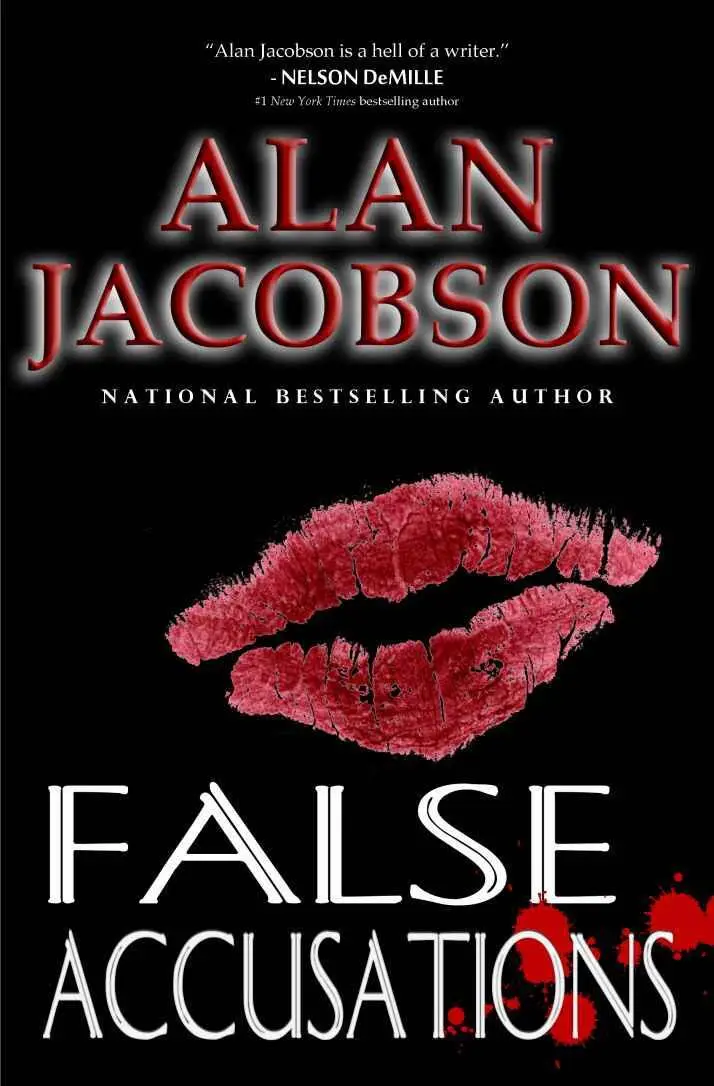
- Название:False accusations
- Автор:
- Жанр:
- Год:неизвестен
- ISBN:нет данных
- Рейтинг книги:4 / 5. Голосов: 1
-
Избранное:Добавить в избранное
- Отзывы:
-
Ваша оценка:
False accusations: краткое содержание, описание и аннотация
Предлагаем к чтению аннотацию, описание, краткое содержание или предисловие (зависит от того, что написал сам автор книги «False accusations»). Если вы не нашли необходимую информацию о книге — напишите в комментариях, мы постараемся отыскать её.
False accusations — читать онлайн бесплатно полную книгу (весь текст) целиком
Ниже представлен текст книги, разбитый по страницам. Система сохранения места последней прочитанной страницы, позволяет с удобством читать онлайн бесплатно книгу «False accusations», без необходимости каждый раз заново искать на чём Вы остановились. Поставьте закладку, и сможете в любой момент перейти на страницу, на которой закончили чтение.
Интервал:
Закладка:
“Were there any other tests that were performed on the saliva that was on the beer cans?”
“Yes.”
“What kind of tests were those?”
“We performed a blood group study and a DNA analysis.”
“Relative to the blood group, what blood type was found in the saliva?”
“AB,” Saperstein said.
“Did you test Dr. Madison’s blood type?”
“We did. It was type O.”
“And Brittany Harding’s?”
“AB.”
Denton raised his eyebrows in mock surprise. “The defendant was AB, and the type found on the beer cans was AB?” he asked, reinforcing the fact, rubbing hand lotion into the jury’s collective skin and watching it soak in.
Saperstein said, “Yes.”
“What percent of the world population is type AB?”
“AB is the rarest blood group that exists. Less than four percent of the population has it.”
“What about type O? Just to give us a basis of comparison.”
“Approximately forty-five percent of the population is type O.”
“So AB is quite rare.”
“Yes.”
“You also said that you performed DNA testing on this saliva,” Denton reminded him, receiving an affirmative nod from Saperstein. “I’m not going to go into the specifics of the testing procedure with you, because we have a witness who’ll be testifying in that regard. But can you please tell the court whose DNA was found in the saliva?”
“That of Brittany Harding.”
Another mumble from the courtroom.
“Quiet, please,” Calvino ordered.
“So let me get this straight, Mr. Saperstein,” Denton said, placing a hand on his chin. “You testified earlier that the vehicle used to cause the deaths of the two decedents was the Mercedes owned by Dr. Phillip Madison. And now you’re saying that the beer cans which were found in the rear of that car did not in fact bear any identification relative to Dr. Madison, but in fact contained lip prints and saliva that were consistent with Brittany Harding’s-”
“Objection,” Warwick said, standing. “Is there a question here? Or is counsel merely summarizing the witness’s testimony, putting words into-”
“I’m not putting words-”
Calvino banged his gavel. “Let’s keep this civil, please. Unless you have something constructive to offer, allow me to make my ruling on the objection, Mr. Denton.”
“Sorry, Your Honor.”
“Objection sustained. Mr. Denton, ask a question or dismiss your witness.”
Denton faced his witness. “Mr. Saperstein, what certainty would you give the fact that the lip prints belong to Brittany Harding?”
“Ninety-five percent.”
“And what’s the chance that the DNA profile you obtained could come from someone else other than the defendant?”
“I would say that there is an extremely low probability.”
“Can you put that into numbers, Mr. Saperstein?”
Saperstein pursed his lips. “Based upon the testing method used, there is only a one-in-fifty-thousand chance that it is not Brittany Harding’s.”
“Objection. This gentleman is not listed as an expert on DNA by the prosecution.”
“He has a point there, Mr. Denton,” Calvino said.
“Your Honor, this gentleman is a senior criminalist who is trained in DNA analysis. I chose to designate a different witness as our DNA expert in order to corroborate the findings of Mr. Saperstein.”
“I didn’t hear you qualify Mr. Saperstein as an expert on DNA analysis,” Calvino said.
“Very well, Your Honor, I shall do so.”
“Mr. Warwick?” Calvino asked.
“I withdraw my objection pending Mr. Denton’s qualification.”
Denton stepped forward. “Mr. Saperstein, what is your training on DNA analysis?”
“I attended several course offerings at University of California at Berkeley and received certification in DNA handling and analysis nearly ten years ago.”
“And in how many cases have you performed DNA analysis? Approximately.”
“Between three and four hundred, I would estimate.”
“Your Honor, I submit Mt. Saperstein to the court as an expert in DNA analysis.”
“Mr. Warwick, do you have any objections?”
Warwick frowned. “No, Your Honor.”
“Very well, then,” Denton said. “Mr. Saperstein, you were quoting us the probability that another person could have the same DNA as that of Brittany Harding.”
“Yes. There is a one-in-fifty-thousand chance that another person’s DNA would match Miss Harding’s DNA, according to the method of analysis we used.”
“One in fifty thousand. And we already know that the only other suspect who ever existed in this case-Phillip Madison-his DNA does not match that found on the cans. Is that correct?”
“Yes. We tested Dr. Madison’s DNA, and the pattern’s not even close.”
“Thank you, Mr. Saperstein,” Denton said as he walked back toward the prosecutor’s table; he nodded to Warwick. “Your witness.”
“Mr. Saperstein,” Warwick said as buttoned his sport coat, “did you perform all of the tests on the evidence gathered at the crime scene?”
“No, I did not. I was ill with ulcerative colitis and-”
“Yes, sir, a simple yes or no would be sufficient. Did you perform the testing that was carried out on the lip print analysis?”
“No.”
“I thought you said you did.” He looked down at the legal pad he was holding. “I believe when Mr. Denton asked, ‘What did you find around the opening on the cans,’ you answered, ‘We found lip prints.’ We, as in yourself and others.” He removed his reading glasses and looked at Saperstein.
“That’s not what I meant.”
“But it is what you said.”
“I meant it as the collective ‘we,’ like those of us in the lab. People, in general.”
“In general? Did you, in fact, have anything to do with the lip print comparisons? I’m speaking about you, personally. Not the collective you, he said with a smile.
“No, I did not.”
Warwick strolled away from Saperstein, and then stopped. “So this was just a generalization.”
“Yes.”
“But generalizations are often wrong, Mr. Saperstein. What else did you tell the jury that was inaccurate?”
“Objection.”
“Sustained,” Calvino said. “Move on, Mr. Warwick.”
The public defender nodded, then paused for a moment. “Is it standard procedure for one criminalist to collect the data and evidence and another to conduct the testing?”
“I guess it depends on the lab. But not at ours, not usually.”
“I’m curious, Mr. Saperstein, why haven’t I heard of lip print analysis before?”
“It’s not widely used.”
“And why is that?”
“We used to think that there aren’t as many occasions where lip prints are left at crime scenes, as opposed to fingerprints, which are quite common due to the handling of material objects. It’s kind of like the pinky finger. Prints of the pinky are not recorded in the national databases because they’re so seldom left behind by a perpetrator. But we’re finding that that’s simply not the case with lip prints-there are many instances where they’re left at crime scenes. A window, or door, for instance, where the criminal looks inside and holds his face right up to the glass. Not to mention cases where the suspect has left prints on a glass he drank from, on photographs, letters, envelopes-”
“Is it widely known, this lip print analysis?”
“It’s still not commonly practiced, but most criminalists I come into contact with know about it.”
“Sort of a trick of the trade?”
Saperstein grinned: “Yes, you might say that.”
Denton winced. He knew what was coming.
“So how many other tricks do you have in your bag, sir?”
Читать дальшеИнтервал:
Закладка:
Похожие книги на «False accusations»
Представляем Вашему вниманию похожие книги на «False accusations» списком для выбора. Мы отобрали схожую по названию и смыслу литературу в надежде предоставить читателям больше вариантов отыскать новые, интересные, ещё непрочитанные произведения.





Обсуждение, отзывы о книге «False accusations» и просто собственные мнения читателей. Оставьте ваши комментарии, напишите, что Вы думаете о произведении, его смысле или главных героях. Укажите что конкретно понравилось, а что нет, и почему Вы так считаете.