Elizabeth Hand - Generation Loss
Здесь есть возможность читать онлайн «Elizabeth Hand - Generation Loss» весь текст электронной книги совершенно бесплатно (целиком полную версию без сокращений). В некоторых случаях можно слушать аудио, скачать через торрент в формате fb2 и присутствует краткое содержание. Город: Northampton, MA, Год выпуска: 2007, ISBN: 2007, Издательство: Small Beer Press, Жанр: Триллер, Ужасы и Мистика, на английском языке. Описание произведения, (предисловие) а так же отзывы посетителей доступны на портале библиотеки ЛибКат.
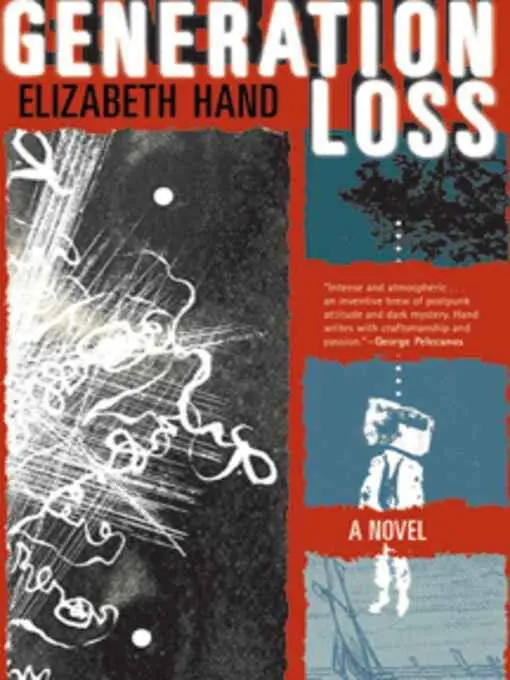
- Название:Generation Loss
- Автор:
- Издательство:Small Beer Press
- Жанр:
- Год:2007
- Город:Northampton, MA
- ISBN:978-1-931520-21-8
- Рейтинг книги:3 / 5. Голосов: 1
-
Избранное:Добавить в избранное
- Отзывы:
-
Ваша оценка:
Generation Loss: краткое содержание, описание и аннотация
Предлагаем к чтению аннотацию, описание, краткое содержание или предисловие (зависит от того, что написал сам автор книги «Generation Loss»). Если вы не нашли необходимую информацию о книге — напишите в комментариях, мы постараемся отыскать её.
Thirty years later she is adrift, on her way down, and almost out when an old acquaintance sends her on a mercy gig to interview a famously reclusive photographer who lives on an island in Maine. When she arrives Down East, Cass stumbles across a decades-old mystery that is still claiming victims, and she finds one final shot at redemption.
Patricia Highsmith meets Patti Smith in this mesmerizing literary thriller.
Praise for Elizabeth Hand’s previous novels: Amazon.com Review
“Inhabits a world between reason and insanity—it’s a delightful waking dream.”
—
“One of the most sheerly impressive, not to mention overwhelmingly beautiful books I have read in a long time.”
—Peter Straub
Generation Loss — читать онлайн бесплатно полную книгу (весь текст) целиком
Ниже представлен текст книги, разбитый по страницам. Система сохранения места последней прочитанной страницы, позволяет с удобством читать онлайн бесплатно книгу «Generation Loss», без необходимости каждый раз заново искать на чём Вы остановились. Поставьте закладку, и сможете в любой момент перейти на страницу, на которой закончили чтение.
Интервал:
Закладка:
As I neared the top, the hill’s crown emerged, a granite dome surrounded by oaks with a few dead leaves still clinging to them. A weathered sign dangled from a lopped-off bough.
oakwind est. 1973
Boards and buckled plywood poked up between rocks and burdock stalks, all that remained of the commune. I picked my way between scrap metal, broken bottles, old tires, a firepit. A man-sized standing stone reared from the wreckage of weeds and winter-killed saplings, flecks of white paint on its granite surface. I crouched in front of it and pushed away dead ferns to get a better look.
Someone had painted three concentric circles on the stone, like a target. The central circle—the bullseye—had been filled in with white paint. There was a smudge of metallic green pigment in the middle circle.
I touched it. The stone was rough and cold. When I withdrew my hand, specks of pigment and lichen stuck to it.
I felt a sudden wave of dizziness, stumbled to my feet and backed away.
From the far side of the hill a raven clacked. A late cricket clung to the standing rock, rubbed its legs then crawled toward the earth.
I kicked at the ground, then, for good measure, bent and dug at it with my fingernails. A scant half-inch of turf came up. I rubbed it between my fingers and stood again, relieved.
There was nothing buried under the stone, not unless the hippies had jackhammered their way into the hill’s granite dome. It was just a rock with a bullseye painted on it. The commune had probably used it for target practice. I started back down the hillside, but only got a few steps before I stopped again.
Tucked among the oaks was the mottled bulk of a large vehicle. An old International school bus, painted in a camo pattern with candy colors—pink, lime green, orange—that time had turned splotched and sickly. Branches burst through the broken windows. What looked like lime green paint was splattered against the glass, but as I got closer I saw this was some kind of mold, its edges curled and black.
I pushed through the underbrush until I reached the cab. Above a wooden platform that served as a step, the door hung in two pieces. I pushed it open.
It was like being in a fish tank where everything has died. Light streaked through windows hung with blackened plastic curtains that had once been green. All the seats had been removed, and wadded rugs had been chewed to fuzz by rodents. There were beer cans and condoms, signs of more recent occupation; splintered chairs, a plastic bucket crusted with brown. An exploded futon. A jagged face hung from the ceiling, lantern-jawed and with huge hollow eyes.
It was another mask, like the frog I’d seen on Toby’s boat. Green, with a beaked mouth and a stiff ridged collar like some kind of horned dinosaur, only this thing had no horns. The glossy paint had peeled, revealing swatches of newsprint. I touched it. It felt pulpy and soft, like an enormous mushroom.
I walked to the rear of the bus. Here a few windows were intact. A raised plywood platform held a foam mattress covered with the remains of an india-print spread, chewed to a paisley filigree. Above the bed, moisture-swollen paperbacks lined a small bookshelf.
What the Trees Said. The Forgotten Art of Building a Stone Wall. Walden Two.
The only hardcover was an old edition of Mircea Eliade’s The Sacred and the Profane. Its frontispiece was stamped Harvard Divinity School Library above a name written in faded blue.
D. Ahearn .
I opened it. The spine was broken, its pages heavily annotated in the same blue ink.
Excitable boy , I thought.
There was also a New Directions paperback of Stephen Haselton’s poetry, with a picture of him on the back. A thin guy, fair haired, clean shaven, blandly handsome. Photo credit: Aphrodite Kamestos.
I flipped through this book but found nothing. No name on the frontispiece. No marginalia. I tossed it onto the shelf and wandered back to the front of the bus. The place looked and felt as though it had been stripped of everything that might have been of interest or value. Not even a torn Grateful Dead poster remained.
So much for the counterculture.
I went outside. Dun-colored clouds crowded the sky. The wind rattled stalks of burdock and dead goldenrod as I headed toward the path. As I entered the stand of trees, I hesitated, feeling that someone was watching me. I turned and looked back at the clearing.
A gray stone loomed among rubble and dead ferns. That was all.
14
No one was in the house when I got back. I paced between the kitchen and the living room, anxious for Gryffin to return and tell me I had a ride to the mainland. I killed time by cracking the second bottle of Jack Daniel’s. I considered calling Phil to ream him out but decided I’d rather do it in person.
Finally I decided to take another look at Aphrodite’s island photos. I’d spent my life dreaming of them. Maybe for just a little longer, I could pretend I was in my own private museum, with the pictures all to myself.
The upstairs hall was cold and smelled of ash. I retrieved my camera and went into the room, leaned against the wall and stared at the photos.
After a few minutes I shot a few frames. It felt good to handle my camera again without someone yelling at me to put it down. I knew I’d never get anything worthwhile—I was fighting nightfall, exhaustion, Jack Daniel’s on a nearly empty stomach. I stumbled around anyway, struggling to get enough distance, enough light, a focus.
The sound of the shutter release was like a moth beating against glass. I took a dozen pictures then slid down to the floor. I began to cry.
Those photos … They were so fucking amazing. It was like she’d thrown open a window and let you look into a perfect world, the most beautiful place you could ever imagine, but you could never get inside it. No matter what I did, I would never be able to produce something that good. I would never make something great . Even at my best, for fifteen seconds thirty years ago, I wasn’t capable of it. Aphrodite had been right.
Bile and the afterburn of bourbon rose in my throat. I lurched into the hall and ran right into Gryffin.
“Jesus!” He caught me and shook his head. “Can’t you walk out a door without knocking me over?”
“No.” I pushed past him.
“Hey, wait up—”
He followed me to my room. I shoved my camera into my bag, avoiding his eyes.
“What happened?” he said. “Did Aphrodite get back?”
“No.” I fought to keep my voice even. “Did you find Toby? I really need to get out of here.”
“He wasn’t around. Suze said he had a job in Collinstown and he stayed over there.”
“I have to go! Isn’t there someone else? The harbormaster, the fucking Coast Guard—I don’t care who it is. Just get me back to my car!”
“Hey, I wish I could, okay? But no one’s around. Merrill Libby’s daughter never came home last night. Everett’s helping organize a search party.”
“Then why aren’t you there?”
“I’m city folk now. They don’t want me.”
He leaned against the door. “I came to see if you felt like celebrating.” He grinned and suddenly looked remarkably like the guy in the snapshot. “I just made fifteen grand.”
I snorted. “Stock market?”
Читать дальшеИнтервал:
Закладка:
Похожие книги на «Generation Loss»
Представляем Вашему вниманию похожие книги на «Generation Loss» списком для выбора. Мы отобрали схожую по названию и смыслу литературу в надежде предоставить читателям больше вариантов отыскать новые, интересные, ещё непрочитанные произведения.








Обсуждение, отзывы о книге «Generation Loss» и просто собственные мнения читателей. Оставьте ваши комментарии, напишите, что Вы думаете о произведении, его смысле или главных героях. Укажите что конкретно понравилось, а что нет, и почему Вы так считаете.