Elizabeth Hand - Generation Loss
Здесь есть возможность читать онлайн «Elizabeth Hand - Generation Loss» весь текст электронной книги совершенно бесплатно (целиком полную версию без сокращений). В некоторых случаях можно слушать аудио, скачать через торрент в формате fb2 и присутствует краткое содержание. Город: Northampton, MA, Год выпуска: 2007, ISBN: 2007, Издательство: Small Beer Press, Жанр: Триллер, Ужасы и Мистика, на английском языке. Описание произведения, (предисловие) а так же отзывы посетителей доступны на портале библиотеки ЛибКат.
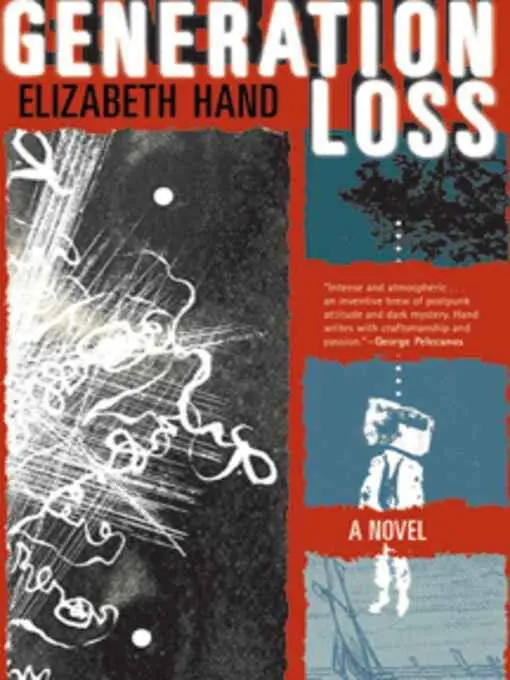
- Название:Generation Loss
- Автор:
- Издательство:Small Beer Press
- Жанр:
- Год:2007
- Город:Northampton, MA
- ISBN:978-1-931520-21-8
- Рейтинг книги:3 / 5. Голосов: 1
-
Избранное:Добавить в избранное
- Отзывы:
-
Ваша оценка:
Generation Loss: краткое содержание, описание и аннотация
Предлагаем к чтению аннотацию, описание, краткое содержание или предисловие (зависит от того, что написал сам автор книги «Generation Loss»). Если вы не нашли необходимую информацию о книге — напишите в комментариях, мы постараемся отыскать её.
Thirty years later she is adrift, on her way down, and almost out when an old acquaintance sends her on a mercy gig to interview a famously reclusive photographer who lives on an island in Maine. When she arrives Down East, Cass stumbles across a decades-old mystery that is still claiming victims, and she finds one final shot at redemption.
Patricia Highsmith meets Patti Smith in this mesmerizing literary thriller.
Praise for Elizabeth Hand’s previous novels: Amazon.com Review
“Inhabits a world between reason and insanity—it’s a delightful waking dream.”
—
“One of the most sheerly impressive, not to mention overwhelmingly beautiful books I have read in a long time.”
—Peter Straub
Generation Loss — читать онлайн бесплатно полную книгу (весь текст) целиком
Ниже представлен текст книги, разбитый по страницам. Система сохранения места последней прочитанной страницы, позволяет с удобством читать онлайн бесплатно книгу «Generation Loss», без необходимости каждый раз заново искать на чём Вы остановились. Поставьте закладку, и сможете в любой момент перейти на страницу, на которой закончили чтение.
Интервал:
Закладка:
Inside was a roll of processed film. God knows how many years ago it had been cooked—decades, maybe. I assumed the photographer was Aphrodite, though there was no way to be sure. Whoever it was, he or she hadn’t given much thought to conservation.
Film is alive. Too much heat, too much humidity, too much sunlight—these things kill it. Fortunately, the chilly conditions in Aphrodite’s mudroom had functioned as a makeshift fridge and protected this roll, at least, over the years. I turned from the woodstove, so the sudden exposure to warmth wouldn’t cause condensation. I unspooled the film carefully between my fingers and held it to the light.
It was black and white, Tri-X. I caught its familiar sweetish odor, somewhere between latex and lactose. The negs were overexposed, maybe deliberately. They showed a naked man lying on his back, the image cropped so the head was out of frame, his torso a surreal contortion of erect cock and hands. All the highlights and shadows were reversed, of course, so that his cock became a luminous wand surrounded by radiant fingers. There were dark shapes in the background that might have been faces, or masks.
Or they might have just been shadows. I continued to thread the negs through my fingers, frowning as I examined each one.
“…great. See you then.”
In the next room, Gryffin’s voice abruptly fell silent. I curled the film back into a tight spool, replaced it in the container, and shoved it into my pocket just as Gryffin entered the kitchen.
“I’m heading out.” He crossed to the sink to dump his coffee mug. “I’ll be back in a couple of hours.”
He started to go, then leaned against the sink and stared at me. I could see the little wheels turning behind those wire-rimmed glasses. Was I a safe bet to leave alone for the evening? Or would I rob his mother blind?
I stared back at him, thinking And where the fuck would I go then?
He must have gotten the message. “Anything edible you can find, help yourself. Or Suze down at the Island Store stays open till six or seven.”
“I’ll manage,” I said.
He studied me again, then beckoned me to the woodstove. “Here. Watch.”
He loaded the firebox with wood, adjusted the damper, pointed to more wood in a box by the door. “If I’m not back in a couple of hours, throw some of that on, okay?”
He left. When he was out of sight, I scanned the living room for any sign of Aphrodite then headed into the basement.
The steps were half rotted, and a naked hundred-watt bulb made ominous spitting sounds when I switched it on. Plaster flaked from the walls, exposing wooden lathes and clumps of horsehair. I heard scrabbling in the shadows as I walked around. Dirt floor, stone foundation; exposed beams curlicued with wormholes. Cobwebs covered shelves of old bottles and rusted tools. An oil drum served as a trash bin.
But nothing that resembled a darkroom setup. I was starting to wonder if Gryffin had lied to me when I spotted a door in the far corner. It was set into a floor-to-ceiling cubicle not much bigger than a closet, made of drywall and two-by-fours. I hurried over and tried the knob.
Gryffin was right. The door was locked.
I tried to jimmie it open. No luck.
I retraced my steps and returned to my bedroom. For a few minutes I sat and watched the sky fade from lavender-gray to indigo to dead black. I didn’t put the light on. Instead I drank Jack Daniel’s until the darkness no longer seemed ominous but soft, diffuse, as though a heavy black curtain had been replaced with gray gauze. A few stars showed through the trees then disappeared. The fog was coming in.
Finally I got up. I found my wallet and retrieved my credit card and started back downstairs.
The hallway was dark. But at the far end, light spilled from an open door. I walked quietly as I could, until I was close enough to see that the light came from a bedroom. Inside was a TV with the sound turned off. I cleared my throat and took another step, waiting for someone to call out.
No one did. I stuck my head inside.
The place was a mess. Heaps of clothes on the floor, books and papers piled on top of a woodstove that obviously hadn’t been used in a while. A space heater hummed noisily. Black-and-white prints hung everywhere, and a double bed was pushed against the far wall. It seemed to be covered with big fur throws—the three deerhounds. I could just make out a small black figure in the middle of the bed, Aphrodite. She lay on her stomach, silver hair tied back with a black ribbon. Several opened photo books were strewn around her. Her skinny legs in their black tights stuck out from beneath one of the dogs, as though the geisha doll had been tossed in with a bunch of stuffed animals.
I couldn’t believe I’d left my camera behind.
I knew better than to go back for it . The Decisive Moment —that was the English title for Cartier-Bresson’s most famous book. And I’d missed my chance—already one of the dogs was stirring. I went back down to the basement.
In a few seconds I’d sprung the lock with my credit card. I entered and instinctively reached for the safelight switch.
Red light surrounded me, along with the dank smell of mildew and the sour-wine stink of acetic acid. As my eyes adjusted to the faint crimson glow, I felt my neck prickle.
It had been twenty years since I’d been inside a darkroom. I steadied myself against a counter and took stock of what surrounded me.
A plywood table with plastic trays for developer and stop bath, fixer and holding bath; shelves made of cinder blocks; a stainless steel sink. Boxes of photographic paper bleached with mold. Jars of developer. A metal cabinet scattered with curled, moisture-damaged prints so blackened with mildew they resembled fungi. Plastic sleeves for holding negatives, all empty. An enlarger. Above the table, a sagging clothesline for drying prints. A pair of heavy rubber gloves hung from the clothesline. I put them on, grateful to have something between me and the foul air. When I picked up a jar of developer, a bloom of spores rose from it like smoke.
Even thirty years ago, this darkroom hadn’t been state-of-the-art. But I didn’t need high-tech equipment to do what I’d come down here for. I flipped on the overhead light. The bulb had blown. I’d have to do my prep work under the safelight. It was dim, 15 watts, but I’d manage.
I opened the tap, hoping the pipes hadn’t frozen. The faucet gurgled and coughed and finally spat a thin stream of brownish water. I waited till it ran clear, rinsed out the plastic processing trays, then set about mixing the developer, the stop bath, the print fixer. I had no idea if the chemicals would still be lively, but it was worth a shot. I mixed each batch directly in its tray and lined them up on the plywood table. Then I looked for tongs.
No tongs. I’d have to agitate the paper by hand, shaking each tray. Messy but feasible. I did find scissors, and the heavy piece of glass I’d need to flatten the negs. I cleaned and dried it on my T-shirt then dug out the roll of film. I uncoiled the long spool and gingerly cut it into four pieces, careful not to damage any individual frame. The plastic envelopes for holding negs were too filthy to use. Again, I’d make do. I turned to examine the enlarger.
It was a Blumfield, circa 1974 by my guess, British made. An expensive piece of equipment, with a flat easel surface and an upright pillar holding the enlarger itself. It seemed dusty but otherwise in working order. I cleaned off the surface where the negs would go, blew dust from the enlarger lens, then switched on the tungsten diffuser bulb, praying it hadn’t blown too.
It hadn’t. I switched off the diffuser and searched until I found a sealed box of Kodak paper. The cardboard was buckled and smeared with mold, but inside its foil wrapper the paper was undamaged. I grabbed a sheet and went to work.
Читать дальшеИнтервал:
Закладка:
Похожие книги на «Generation Loss»
Представляем Вашему вниманию похожие книги на «Generation Loss» списком для выбора. Мы отобрали схожую по названию и смыслу литературу в надежде предоставить читателям больше вариантов отыскать новые, интересные, ещё непрочитанные произведения.









Обсуждение, отзывы о книге «Generation Loss» и просто собственные мнения читателей. Оставьте ваши комментарии, напишите, что Вы думаете о произведении, его смысле или главных героях. Укажите что конкретно понравилось, а что нет, и почему Вы так считаете.