James Barrington - Foxbat
Здесь есть возможность читать онлайн «James Barrington - Foxbat» весь текст электронной книги совершенно бесплатно (целиком полную версию без сокращений). В некоторых случаях можно слушать аудио, скачать через торрент в формате fb2 и присутствует краткое содержание. Город: London, Год выпуска: 2007, ISBN: 2007, Издательство: Macmillan, Жанр: Триллер, на английском языке. Описание произведения, (предисловие) а так же отзывы посетителей доступны на портале библиотеки ЛибКат.
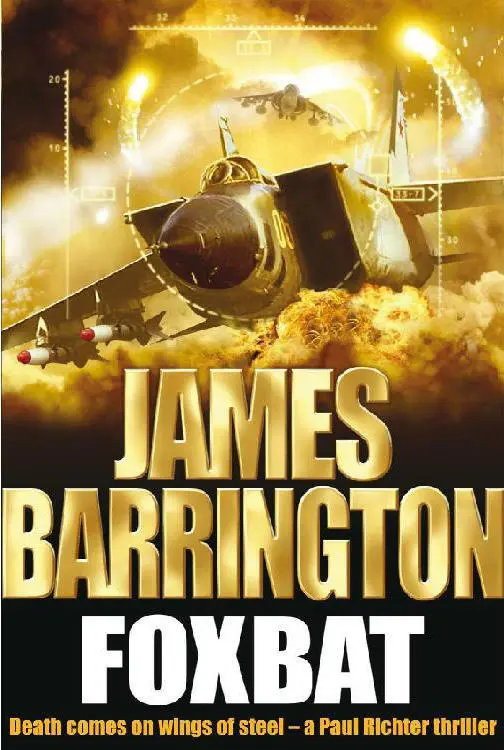
- Название:Foxbat
- Автор:
- Издательство:Macmillan
- Жанр:
- Год:2007
- Город:London
- ISBN:978-0-230-01475-6
- Рейтинг книги:3 / 5. Голосов: 1
-
Избранное:Добавить в избранное
- Отзывы:
-
Ваша оценка:
Foxbat: краткое содержание, описание и аннотация
Предлагаем к чтению аннотацию, описание, краткое содержание или предисловие (зависит от того, что написал сам автор книги «Foxbat»). Если вы не нашли необходимую информацию о книге — напишите в комментариях, мы постараемся отыскать её.
Moving to the present, American satellites have detected unusual activity at several Algerian air bases, and at Aïn Oussera one large hangar has been cordoned off and armed guards posted outside. Western intelligence agencies suspect that Algeria might be working-up its forces prior to launching an attack on Libya or Morocco, with potentially destabilising effects in the region. They’re also concerned that they might have obtained new aircraft or weapon systems, perhaps secreted in the guarded hangar at Aïn Oussera. The only way to find out is to get someone to look inside the building, and it will have to be a covert insertion.
This is where Paul Richter is called in, as ‘a deniable asset’, in an exciting non-stop thriller that moves rapidly through Bulgaria, Russia, and ultimately North Korea.
Foxbat — читать онлайн бесплатно полную книгу (весь текст) целиком
Ниже представлен текст книги, разбитый по страницам. Система сохранения места последней прочитанной страницы, позволяет с удобством читать онлайн бесплатно книгу «Foxbat», без необходимости каждый раз заново искать на чём Вы остановились. Поставьте закладку, и сможете в любой момент перейти на страницу, на которой закончили чтение.
Интервал:
Закладка:
‘Any questions?’ Winchester asked, but nobody spoke. ‘OK, command briefing complete. Let’s get to it.’
NIS Headquarters, Naegok-dong, Seoul, South Korea
Richter was escorted to a conference room located on the top floor of the National Intelligence Service headquarters in southern Seoul. The white five-storey structure had a square central entrance hall, topped with a dome, but the bulk of the building consisted of two curving arms of offices that embraced the approach road. As ‘spook central’ buildings go, it was more attractive than most.
‘Mr Richter.’ A short, stocky man stood up from his seat at the end of the long table and walked towards him, extending his hand. ‘My name is Kang Jang-Ho, and I’m the deputy director of this facility. Bae Chang-Su, the director, will be here shortly. You’ve had a long flight, I understand. Can I offer you some refreshment?’
Richter shook Kang’s hand. ‘Yes,’ he then replied, realizing that he felt pretty hungry: even business-class meals on Aeroflot were not too appealing. ‘That would be very welcome.’
‘Coffee and sandwiches – something like that?’ Kang suggested, picked up a telephone and held a brief conversation.
As he put the instrument down, another man entered the room, taller and slimmer and with a thin moustache. From the way Kang straightened up, Richter guessed this must be the ‘autocratic’ Bae Chang-Su, as proved the case when the newcomer introduced himself.
They sat down at one end of the long table, equipped with chairs for over a dozen people, Bae taking his seat at the end.
‘You have some information for us, I understand,’ he began.
Richter nodded and explained what he and Bykov had found out in Russia, and the assumed destination of the missing MiG-25s. The South Koreans had already known some of it, but the probability that Foxbats had also been stolen from Algeria was news to them.
‘According to General Bykov, at least sixteen have gone missing from Russian air bases, and we think maybe two from Aïn Oussera in Algeria, totalling a minimum of eighteen. Because of the fragmented state of the military in Russia, and the possibility that somebody high up in the Defence Ministry is facilitating these thefts, there could be a lot more aircraft unaccounted for. My own guess is that there must now be at least twenty MiG-25s north of the DMZ.’
Bae didn’t appear surprised by this. ‘What I can’t understand is why the North Koreans would want these aircraft. All their combat planes are old and no match for ours, so I would expect them to go after more modern fighters.’
At that moment there was a knock on the door, and a young man entered carrying a tray of refreshments. Richter waited until he’d left the room before responding.
‘According to my source in Moscow, the North Koreans may have picked on the MiG-25 because it was specifically designed to intercept ICBMs in the terminal stage of their flight. More importantly, the Foxbat is about the only aircraft likely to be left flying after the first nuclear explosion, because the EMP – the electromagnetic pulse – will fry the electronics of pretty much everything else, either in the air or on the ground.’
‘You’re suggesting the North Koreans intend to launch a nuclear attack?’ Bae asked tightly.
‘I honestly don’t know,’ Richter replied, ‘but what concerns London is exactly the point you’ve already made. Why would they choose the MiG-25 unless they had a very good reason? And its survivability after a nuclear exchange is about the only explanation we’ve come up with. Our main concern is that, even if the West doesn’t resort to nuclear weapons, the North Koreans would, just to eliminate the opposition and give them immediate control of the skies. They could keep their fighters and bombers secure in hardened shelters, detonate a nuke over the joint South Korean and American forces, then fly these Foxbats to intercept any missiles the Americans launched. That would soon eliminate most of the opposition on land, and could give them air superiority because the only aircraft left flying would be North Korean, allowing them to consolidate an advance towards Seoul.’
For a few moments neither Bae nor Kang responded, just stared across the table at each other as Richter began another sandwich.
‘You don’t paint an attractive picture,’ Bae Chang-Su said eventually, ‘but it may interest you to know that, in our last discussion, Washington outlined a remarkably similar scenario.’
‘So what’s your government doing about it?’
‘I can’t be specific about our military response, because I don’t know precisely what orders have been given, but you can assume our armed forces have escalated the alert state. The government has already made representations to Pyongyang, and we’ve sought assistance from the Americans under the terms of Operation Plan 5027. Meanwhile, until our neighbours in the north make some kind of move, that’s about all we can do.’
The sound of an approaching helicopter became audible, and Bae glanced out of the window. ‘Excellent,’ he murmured. ‘Your taxi’s arrived on time, Mr Richter. London asked us to provide you with transportation as far as Kunsan, and I understand your Royal Navy will be sending an aircraft to meet you there.’
Six minutes later Richter was gazing out through the side window of the Bell helicopter. Kunsan Air Base lay about a hundred and twenty miles almost due south, and his flight would take a little over an hour.
Only forty-eight hours earlier he’d been climbing into the rear of the Antonov An-72 transport aircraft at Slavgorod North for the flight back to Moscow, and since then he seemed to have spent most of his time either busy on the phone or in the air. As the helicopter lifted off, he stared at the white shape of the NIS headquarters receding below him, and wondered what the next forty-eight hours might bring.
Chapter Fourteen
Saturday
Kunsan Air Base, South Korea
Seventy-five minutes after lifting off from Naegok-dong, the Bell touched down at Kunsan Air Base. As the rotors slowed to a stop, the crewman slid the side door open but gestured to Richter to remain in his seat. A refuelling bowser was waiting to one side of the landing pad, and beyond it Richter could see the familiar shape of a Royal Navy Merlin ASW helicopter ground-taxying slowly towards the Bell he was waiting in.
The crewman gave a thumbs-up, then gestured towards the open door. Richter picked up his two bags and stepped out onto the discoloured concrete. He moved briskly away from the Bell before stopping beside the marshaller who was waiting for the Merlin, wands crossed below his waist. The Merlin parked some twenty yards away, its nose dipping as the pilot applied the brakes.
The engines and spinning rotors of the Royal Navy helicopter combined to create a noise that was deafening. Richter gestured to the marshaller that he was the passenger for this aircraft. The South Korean lifted one of his wands to attract the Merlin’s pilot’s attention and pointed the other one at Richter, then waved for him to go forward.
Richter ducked involuntarily as he moved under the rotor disk, and headed for the open side door. The aircrewman gave him a grin as he stepped into the rear compartment, and handed him a passenger helmet, based on that worn by British Army tank drivers. He then gestured to the instructor’s seat on the mission console. Directly behind the aircrewman’s seat, it lies on the starboard side of the Merlin and faces aft.
The moment Richter secured his seatbelt, he heard the aircrewman confirming that their passenger was on board. Moments later, the Merlin began moving forwards. This aircraft’s downwash is so powerful that it’s capable of wrecking any smaller helicopter nearby, so it continued ground-taxying until it was well clear of the Bell.
Читать дальшеИнтервал:
Закладка:
Похожие книги на «Foxbat»
Представляем Вашему вниманию похожие книги на «Foxbat» списком для выбора. Мы отобрали схожую по названию и смыслу литературу в надежде предоставить читателям больше вариантов отыскать новые, интересные, ещё непрочитанные произведения.







Обсуждение, отзывы о книге «Foxbat» и просто собственные мнения читателей. Оставьте ваши комментарии, напишите, что Вы думаете о произведении, его смысле или главных героях. Укажите что конкретно понравилось, а что нет, и почему Вы так считаете.