Paul McKellips - Jericho 3
Здесь есть возможность читать онлайн «Paul McKellips - Jericho 3» весь текст электронной книги совершенно бесплатно (целиком полную версию без сокращений). В некоторых случаях можно слушать аудио, скачать через торрент в формате fb2 и присутствует краткое содержание. Город: Washington, DC, Год выпуска: 2012, ISBN: 2012, Издательство: FBR Press, Жанр: Триллер, на английском языке. Описание произведения, (предисловие) а так же отзывы посетителей доступны на портале библиотеки ЛибКат.
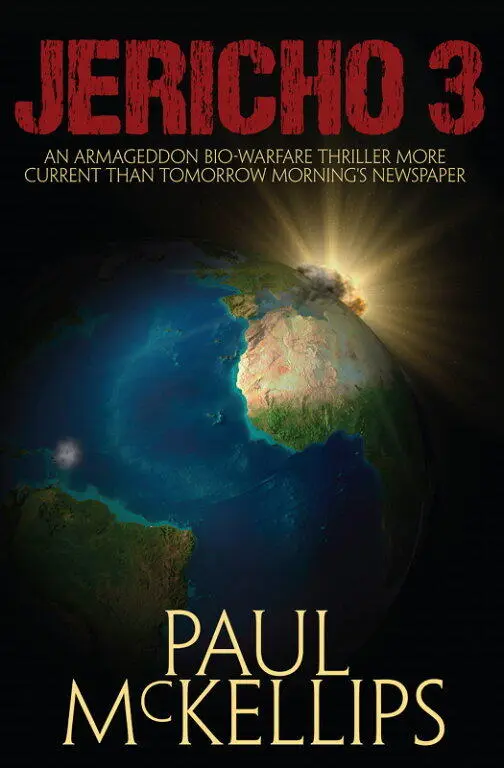
- Название:Jericho 3
- Автор:
- Издательство:FBR Press
- Жанр:
- Год:2012
- Город:Washington, DC
- ISBN:978-0-9853322-0-4
- Рейтинг книги:5 / 5. Голосов: 1
-
Избранное:Добавить в избранное
- Отзывы:
-
Ваша оценка:
Jericho 3: краткое содержание, описание и аннотация
Предлагаем к чтению аннотацию, описание, краткое содержание или предисловие (зависит от того, что написал сам автор книги «Jericho 3»). Если вы не нашли необходимую информацию о книге — напишите в комментариях, мы постараемся отыскать её.
In a remote corner of Afghanistan, three members of the Taliban are diagnosed with a rare, incredibly infectious disease. At a U.S. base just outside Pakistan, an American army doctor is kidnapped by a local tribe to perform an unlikely surgical procedure on the wife of a powerful leader. And back in the U.S., Camp is handed his most challenging assignment ever, which leaves the normally confident hero desperate for answers. All the while, Camp must hold back his secret desire for Leslie Raines, his beautiful cohort, as they are sent off on two sides of the same mission… only to reunite when the stakes get deadly.
With his trademark grit and a globe-racing plot, Paul McKellips takes readers deep into the Middle East conflict, raising timely questions of radicalism, faith, and honor. As the clock ticks down toward Armageddon, Camp and Raines must do everything it takes to stop the total annihilation of two countries.
Timely, gripping, and frighteningly real, JERICHO 3 is a one-of-a-kcenter thriller that will open eyes long after the final page has been turned.
JERICHO 3 Infectious disease. Bio-warfare. Nuclear weapons. WAR JUST GOT PERSONAL.
Ambassador John Bolton writes: “
is a gripping novel… an urgent message… about an Iranian bio threat that should wake us up to the range of horror that could be visited on America and its friends and allies by our sworn enemies.”
Jericho 3 — читать онлайн бесплатно полную книгу (весь текст) целиком
Ниже представлен текст книги, разбитый по страницам. Система сохранения места последней прочитанной страницы, позволяет с удобством читать онлайн бесплатно книгу «Jericho 3», без необходимости каждый раз заново искать на чём Вы остановились. Поставьте закладку, и сможете в любой момент перейти на страницу, на которой закончили чтение.
Интервал:
Закладка:
The cat fight was on as Dr. Groenwald and Special Agent Daniels were reduced to mere spectators.
“Colonel, I understand that you are an expert in the confined safety of a biocontainment laboratory, but I’m talking real world here. In World War II both the Soviet Red Army and the German Wehrmacht forces suffered hundreds of thousands of casualties from infectious diseases.”
“Oh my gosh,” Raines said expressionless.
“A former Soviet scientist and defector — Kanatjan Alibekov — asserted that the Soviets used tularemia as a causative agent during the Battle of Stalingrad in 1942 and 1943.”
“A biological weapon,” Daniels said hoping to add a layer of depth and texture to the history lesson. “But once unleashed, it killed as many Russians as it did Germans.”
“Folks, based on the clinical cases and the nature of the pathogen we all studied from Stalingrad during vet school, I must tell you that I disagree. It was a natural outbreak.”
Raines stood abruptly and reached for her brief case.
“Millions died in the siege of Stalingrad, Colonel Raines,” Fallon Jessup said with a burst of fury. “For some of us in this room, we’d like to prevent a reoccurrence of that disaster.”
“Listen Jessup, I didn’t raise my hand and put this uniform on to see anyone die, so don’t lecture me.”
“Kanatjan Alibekov was the former deputy director of the Soviet Russian Biopreparat. He claims that tularemia was deployed against Nazi troops during the battle of Stalingrad. Hundreds of thousands of tularemia infections quickly arose at the beginning of the siege and there was a high — more than 70 percent — pulmonary involvement among those infected with tularemia from both sides, suggesting man-made air-borne dissemination.”
“That’s the biological weapons part,” Daniels added.
“Geez, you two must be a real hoot on a Friday night glued to the history channel. Listen, I’d really love to stay and listen to more. I’m sure you have some fascinating stories about food and dysentery from Valley Forge as well, but I’ve got to get back to some current work on hemorrhagic fevers.”
“Colonel Raines… please sit down,” Groenwald said softly. Raines was shocked more by the verbal evidence of his spinal column than by the command itself. She sat.
“Listen… I apologize for being abrupt,” Raines said, “but history reveals that the Rostov region already had 14,000 confirmed tularemia cases long before the siege of Stalingrad. With all due respect, mosquitoes carried the pathogens, and what the mosquitoes didn’t cause initially, inhalation of dust from the unharvested straw in the fields completed the delivery of the toxins. I’m sure your Soviet defector has enjoyed his 15 minutes of fame, but it was a natural outbreak of tularemia. Regardless, we already have vaccines and antibiotics.”
“Colonel, we have vaccines for laboratory workers like you. That’s all. Do you really think we have enough vaccine doses or even antibiotics for a city of five million people if there’s an outbreak?” Daniels asked. “The numbers of casualties could easily overwhelm existing capacity to treat both the sick and the worried well. Hell, colonel, in the 1950s we put tularemia in aerosol cans. But nobody messed with this stuff like the Soviets.”
“Your scenario is highly unlikely, Agent Daniels. Sanitation and pest control is far more advanced than in the fields of Stalingrad in 1942.”
“In 1982, the Soviets developed a vaccine-resistant recipe for tularemia,” Daniels countered.
“And in the 1990s the Russians asserted they destroyed their tularemia stockpiles,” Raines added.
“And of course we all believe the Russians.”
The room was silent. Daniels had a valid point.
“Colonel, in the now defunct US bio-weapon program, tularemia was weaponized by freeze drying bacteria-laden slurry and muting it into a flue powder for aerosol delivery,” Jessup said.
“Whoa, another info gem. Who knew!”
“The Soviets had an aggressive BW program during the Cold War. So did the United States. We had massive stockpiles of tularemia. The Soviets had 52 clandestine sites employing 50,000 people. They were producing as much as 100 tons of weaponized smallpox every damn year. Colonel Kanatjan Alibekov ran their program in the Kirov Oblast, a town of 470,000 people west of the Ural Mountains along the Vyatka River. Colonel Raines, Kirov is a 36-hour ride on the Trans-Siberian railway connecting to the Trans-Caspian and on into Ashgabat, Turkmenistan.”
“Oshkosh? Either way I’m sure it’s a lovely trip.”
“Ashgabat is on the Iranian border. Colonel Raines, why would the Russians send boxcars of tularemia to Ashgabat? Why would they send a lethal bacteria, weaponized or not, to the border with Iran? Let’s just blue sky this for a minute, shall we? Let’s say the Russians are looking to make some cash. And let’s say a bad state actor is interested in buying tularemia — rabbit fever — just because they know the world will blame it on a natural outbreak caused by mosquitoes and rodent dust inhaled from dirty grass and straw, just as you assert even now that it was a natural outbreak in Stalingrad way back then. Hell, you may be the first one to stand up and exonerate the Iranians, assuring the world that the outbreak was natural. That, Colonel Raines, is what we’re looking at. If you’d shut up for six seconds you might, in fact, get schooled.”
Agent Fallon Jessup finished with a flurry and added the exclamation point. Raines was silent for a few seconds.
“How do we know it’s tularemia and that it’s headed for Turkmenistan?” Groenwald asked.
“We’re on that train right now,” Daniels said, “and the shipment is verified.”
“The Iranian connection?” Raines asked.
“Pure speculation at this point as we try to connect the dots. But Ashgabat is a relatively large transportation hub; trains and trucks, all just 21 unfettered miles to the northern Iranian border,” Daniels said.
“General Ferguson is in the loop?” Raines asked.
“He’s been briefed and in turn he’s passed the intel on to the Alpha Team heading up Camp’s mission.”
Raines glared at Special Agent Daniels.
“What mission?”
Daniels looked over at Jessup, and they both fell silent.
Raines got up and paced over to Groenwald’s white board. She pulled out a black marker and began to draw.
“Two SkitoMisters are sold by an Illinois company to the City of Hamburg, Germany. The machines go missing and are reported stolen. A port in Jakarta, Indonesia records the serial numbers and a black market importer hocks them to a buyer in Pakistan. Now a Russian train carrying Cold War stockpiles of tularemia along with a CIA informant on-board is heading for the Iranian border. Whether or not the tularemia can be aerosolized is irrelevant because we have no capacity during three to five days of an outbreak to meet the medical demands of people infected with rabbit fever. The world can logically blame nature and poor sanitation for tularemia. One nation collects cash for an old bio-weapon while another state kills, or at least terrorizes, millions.”
The room was silent as Raines continued.
“So let me guess… you want to see if we can create an aerosol version of tularemia? Better than our Rabbit-Fever-In-A-Can from the 1950s. You want something toxic, effective and lethal — not garden variety — but pandemic and widespread.”
“Something like that… we need to know what they might try,” Jessup said.
“You want me to play Terrorist Raines and cook up something they might reasonably cook up. Existing vaccine doses and antibiotic supply? I’m sure you’ve done the numbers… what do we have?”
Читать дальшеИнтервал:
Закладка:
Похожие книги на «Jericho 3»
Представляем Вашему вниманию похожие книги на «Jericho 3» списком для выбора. Мы отобрали схожую по названию и смыслу литературу в надежде предоставить читателям больше вариантов отыскать новые, интересные, ещё непрочитанные произведения.












Обсуждение, отзывы о книге «Jericho 3» и просто собственные мнения читателей. Оставьте ваши комментарии, напишите, что Вы думаете о произведении, его смысле или главных героях. Укажите что конкретно понравилось, а что нет, и почему Вы так считаете.