Paul McKellips - Jericho 3
Здесь есть возможность читать онлайн «Paul McKellips - Jericho 3» весь текст электронной книги совершенно бесплатно (целиком полную версию без сокращений). В некоторых случаях можно слушать аудио, скачать через торрент в формате fb2 и присутствует краткое содержание. Город: Washington, DC, Год выпуска: 2012, ISBN: 2012, Издательство: FBR Press, Жанр: Триллер, на английском языке. Описание произведения, (предисловие) а так же отзывы посетителей доступны на портале библиотеки ЛибКат.
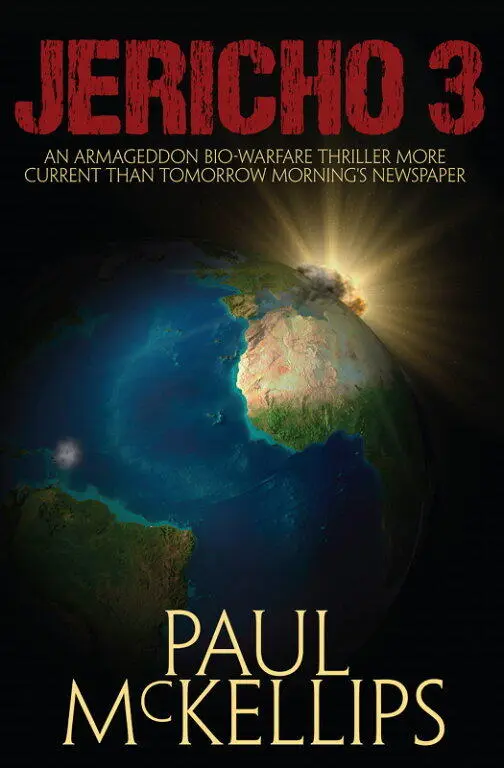
- Название:Jericho 3
- Автор:
- Издательство:FBR Press
- Жанр:
- Год:2012
- Город:Washington, DC
- ISBN:978-0-9853322-0-4
- Рейтинг книги:5 / 5. Голосов: 1
-
Избранное:Добавить в избранное
- Отзывы:
-
Ваша оценка:
Jericho 3: краткое содержание, описание и аннотация
Предлагаем к чтению аннотацию, описание, краткое содержание или предисловие (зависит от того, что написал сам автор книги «Jericho 3»). Если вы не нашли необходимую информацию о книге — напишите в комментариях, мы постараемся отыскать её.
In a remote corner of Afghanistan, three members of the Taliban are diagnosed with a rare, incredibly infectious disease. At a U.S. base just outside Pakistan, an American army doctor is kidnapped by a local tribe to perform an unlikely surgical procedure on the wife of a powerful leader. And back in the U.S., Camp is handed his most challenging assignment ever, which leaves the normally confident hero desperate for answers. All the while, Camp must hold back his secret desire for Leslie Raines, his beautiful cohort, as they are sent off on two sides of the same mission… only to reunite when the stakes get deadly.
With his trademark grit and a globe-racing plot, Paul McKellips takes readers deep into the Middle East conflict, raising timely questions of radicalism, faith, and honor. As the clock ticks down toward Armageddon, Camp and Raines must do everything it takes to stop the total annihilation of two countries.
Timely, gripping, and frighteningly real, JERICHO 3 is a one-of-a-kcenter thriller that will open eyes long after the final page has been turned.
JERICHO 3 Infectious disease. Bio-warfare. Nuclear weapons. WAR JUST GOT PERSONAL.
Ambassador John Bolton writes: “
is a gripping novel… an urgent message… about an Iranian bio threat that should wake us up to the range of horror that could be visited on America and its friends and allies by our sworn enemies.”
Jericho 3 — читать онлайн бесплатно полную книгу (весь текст) целиком
Ниже представлен текст книги, разбитый по страницам. Система сохранения места последней прочитанной страницы, позволяет с удобством читать онлайн бесплатно книгу «Jericho 3», без необходимости каждый раз заново искать на чём Вы остановились. Поставьте закладку, и сможете в любой момент перейти на страницу, на которой закончили чтение.
Интервал:
Закладка:
“You miss the point. You churn out college graduates who can make video games, manage museums and run hamburger stores. Do you study philosophy? Do you study religion? Do you understand history? No, you study for jobs so you can buy big cars, get fat and use credit cards.”
“You’re right, Omid. I’m just a dumb, fat American with a Visa card and a Cadillac. Enlighten me!”
“Of course they are building nuclear weapons… of course they plan to bomb Israel… and if possible, they will bomb you with long-range intercontinental ballistic missiles and with bombs inside cargo containers at your ports. You know all of this, yet still, you know nothing.”
“They? You may be playing double-agent for some quick cash, but ‘they’ is ‘you’, Omid, whether you like it or not.”
“That’s where you are wrong, Camp. That’s where your leaders have made major miscalculations. Iran has two governments, two populations of people. There is no unitary structure or sovereign power that makes our decisions. There are many competing factions within Iran. Yet you continue to say ‘Iran will do this’ and ‘Iran will do that’. The formal government was stolen from the people during the last election and is still run at Ahmadinejad’s pleasure. But the religious and ideological command is the domain of the Supreme Leader, Ayatollah Ali Khamenei.”
“Is this supposed to be new information?”
“Power is decentralized. Everyone is vying for power in Iran, even the Russian mafia, even Muqtada al Sadr in Iraq. You think one voice in Tehran speaks for all Iranians? You think one threat from Tehran is a threat from every farmer, teacher, mother and child? You know nothing.”
“Sorry, Omid, but nut jobs run your country hell-bent on destroying Israel at any cost. Any way you slice it, Islamic extremism runs rampant and unchecked both in Iran and throughout your proxies like Hezbollah. You may have some romantic notion of a Persian Renaissance after a nuclear winter, but as far as I’m concerned, you still view us as the Great Satan, and you still want death for the infidels. It’s in the Holy Koran, Omid; it’s in your book. Look it up and read it.”
Omid grew silent and shrugged his shoulders. He closed his eyes as though he was praying.
“Yes, Camp, it’s in there. I can’t deny that. Some fanatics and terrorists believe they must help Allah, that it is their duty to purge the world of infidels. But the vast majority of Muslims are content to let Allah solve all of that in the next life. Are you a good Christian?”
Camp reflected on his answer for several seconds. “I believe in God. I used to go to church; at least I did when I was a boy. I try to do the right things, but — I don’t know — I’m not sure I’m a very good Christian.”
“Some might read your Holy Bible or listen to a preacher and conclude that you help Jesus by killing your sinners in prison with the death penalty. Some might read your Holy Bible and decide that they can help Jesus by killing doctors who perform abortions. You can argue that those words are in your Holy text, too. But do all Christians believe that? Do they all act on that? Your Holy Bible says that it is easier for a rich man to pass through the eye of a needle than it is for him to get into heaven. But you still have nice cars, nice homes, and what you call 401Ks? By any standard, American Christians are rich. Do you read that Holy text and decide to remain poor? Of course not. But it’s in your book, Camp. You can’t deny it. Perhaps most Christians are willing to let Jesus solve everything in the afterlife. Most Muslims feel the same way.”
“Omid, there’s a difference between moderate Muslims who are willing to live in peace and radical Islamic fundamentalism through state-sponsored terror.”
“You see satellite images and think you understand everything. You do not. If you did, you would act differently… if you did, you would have come to our aid during the people’s protest and the democratic uprising… if you did, then you would understand why I betray the regime so I can embrace the people. How can you be so smart, so educated, yet still know nothing?”
Omid walked away from the fire, unrolled his bed and curled up against the wall near Billy Finn.
13
National Interagency Biodefense Center
BSL-4 Facility
Fort Detrick, Maryland
Lieutenant Colonel Raines got her coffee from the atrium’s barista, scanned her security card and processed her biometric as she rode the elevator without floor buttons to her cleared location.
Groenwald’s door was open, and he was talking with a man and a woman she didn’t at first recognize, but she offered a smile and a wave as she passed by nonetheless.
“Colonel Raines? Can you join us?” Groenwald called as she did a one-eighty. The two guests stood as Raines entered.
“Special Agent Daniels,” Raines said with a bit of surprise in her voice as Daniels turned to greet her. “Nice to see you again.”
“Colonel, looks like you’ve made a full recovery,” Daniels said. “This is Agent Fallon Jessup with the bioterror directorate.”
“Pleasure to meet you, ma’am.” Raines looked over at Dr. Groenwald and explained. “Special Agent Daniels was key to the mission last year that took us through Algiers, Morocco and Yemen. He was there the night I was wounded.”
“Well, I’d like to hear the whole story some day. Colonel, can you take a seat and join us?” Groenwald asked as he pointed to the last remaining straight back desk chair in the room.
“How is Captain Campbell doing?” Daniels asked.
“The last I heard he was working on a special project in Afghanistan.”
“Well, please tell him Daniels says hello next time you speak with him.”
“Colonel Raines, Daniels and Jessup have come to us for some help,” Groenwald said.
“Colonel, we have reason to believe that scientists in Pakistan have made some major strides in weaponizing tularemia. We’ve already been in touch with General Ferguson, and he suggested we visit both you and Dr. Groenwald,” Daniels said.
“The attending physician at FOB Lightning concluded that their tularemia cases were garden variety… uncooked meat, contaminated water… the usual,” Raines said somewhat defensively.
“You’re referring to Major Banks, the physician who was abducted shortly after his conclusions.”
“Yes.”
“Agent Jessup is a Naval Academy graduate and now handles our bio desk in the region. If you don’t mind, we’d like to brief you.”
Fallon Jessup was a tall and slender blonde, a head-spinner who wore a cute figure and carried a “back off” gaze that turned meat market heroes into playground boys. Raines had no reason to be threatened by her beauty, but she wasn’t inclined to take an intellectual backseat either. But Raines was a career officer. She didn’t like Academy “brats” that served one tour and then switched jobs for more money. Raines didn’t have much interest in former military officers who took the “one and done” career path.
“Please Agent Jessup… school me.”
Groenwald’s eyes flared ever so slightly. He had taken Raines to be a recovering pacifist. Nothing in her file suggested she could morph into a street-fight brawler that quickly.
“Well, we first recognized tularemia in the early 1900s. It was a plague-like disease in rodents and a severe, sometimes fatal, illness for humans. But it’s potential for epidemic emerged in the 1930s and 1940s in Europe and the Soviet Union. Water systems were contaminated, and tularemia was characterized by waterborne outbreaks.”
Raines cleared her throat.
“Agent Daniels, I’ve been studying the ecology, microbiology, pathogenicity and prevention of tularemia — and others — for my entire career. Did you happen to bring any useful or current information with you today?”
Читать дальшеИнтервал:
Закладка:
Похожие книги на «Jericho 3»
Представляем Вашему вниманию похожие книги на «Jericho 3» списком для выбора. Мы отобрали схожую по названию и смыслу литературу в надежде предоставить читателям больше вариантов отыскать новые, интересные, ещё непрочитанные произведения.











Обсуждение, отзывы о книге «Jericho 3» и просто собственные мнения читателей. Оставьте ваши комментарии, напишите, что Вы думаете о произведении, его смысле или главных героях. Укажите что конкретно понравилось, а что нет, и почему Вы так считаете.