Paul McKellips - Jericho 3
Здесь есть возможность читать онлайн «Paul McKellips - Jericho 3» весь текст электронной книги совершенно бесплатно (целиком полную версию без сокращений). В некоторых случаях можно слушать аудио, скачать через торрент в формате fb2 и присутствует краткое содержание. Город: Washington, DC, Год выпуска: 2012, ISBN: 2012, Издательство: FBR Press, Жанр: Триллер, на английском языке. Описание произведения, (предисловие) а так же отзывы посетителей доступны на портале библиотеки ЛибКат.
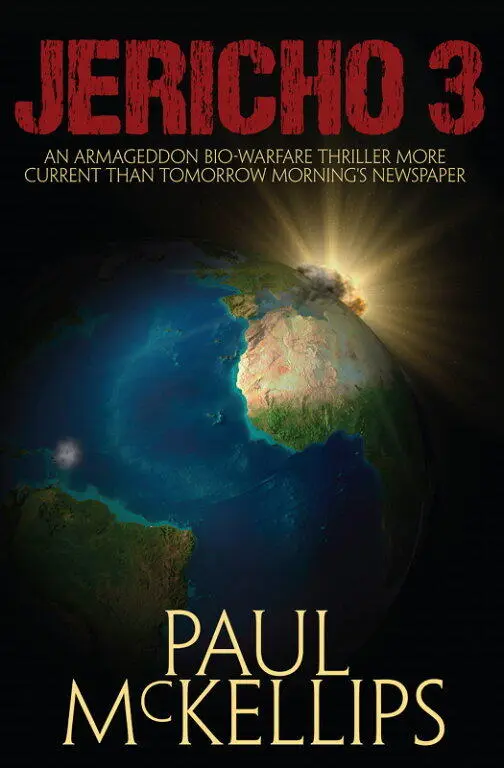
- Название:Jericho 3
- Автор:
- Издательство:FBR Press
- Жанр:
- Год:2012
- Город:Washington, DC
- ISBN:978-0-9853322-0-4
- Рейтинг книги:5 / 5. Голосов: 1
-
Избранное:Добавить в избранное
- Отзывы:
-
Ваша оценка:
Jericho 3: краткое содержание, описание и аннотация
Предлагаем к чтению аннотацию, описание, краткое содержание или предисловие (зависит от того, что написал сам автор книги «Jericho 3»). Если вы не нашли необходимую информацию о книге — напишите в комментариях, мы постараемся отыскать её.
In a remote corner of Afghanistan, three members of the Taliban are diagnosed with a rare, incredibly infectious disease. At a U.S. base just outside Pakistan, an American army doctor is kidnapped by a local tribe to perform an unlikely surgical procedure on the wife of a powerful leader. And back in the U.S., Camp is handed his most challenging assignment ever, which leaves the normally confident hero desperate for answers. All the while, Camp must hold back his secret desire for Leslie Raines, his beautiful cohort, as they are sent off on two sides of the same mission… only to reunite when the stakes get deadly.
With his trademark grit and a globe-racing plot, Paul McKellips takes readers deep into the Middle East conflict, raising timely questions of radicalism, faith, and honor. As the clock ticks down toward Armageddon, Camp and Raines must do everything it takes to stop the total annihilation of two countries.
Timely, gripping, and frighteningly real, JERICHO 3 is a one-of-a-kcenter thriller that will open eyes long after the final page has been turned.
JERICHO 3 Infectious disease. Bio-warfare. Nuclear weapons. WAR JUST GOT PERSONAL.
Ambassador John Bolton writes: “
is a gripping novel… an urgent message… about an Iranian bio threat that should wake us up to the range of horror that could be visited on America and its friends and allies by our sworn enemies.”
Jericho 3 — читать онлайн бесплатно полную книгу (весь текст) целиком
Ниже представлен текст книги, разбитый по страницам. Система сохранения места последней прочитанной страницы, позволяет с удобством читать онлайн бесплатно книгу «Jericho 3», без необходимости каждый раз заново искать на чём Вы остановились. Поставьте закладку, и сможете в любой момент перейти на страницу, на которой закончили чтение.
Интервал:
Закладка:
The sign on the door read: Pieter J. Blauw, MD, PhD Lab.
Blauw was holding court with three of his post-doctoral research staffers and the veterinary technician who cared for his research animals.
Raines walked in and stood to the side as Blauw finished up.
“Colonel Raines, I trust you found the lab without great difficulty.”
“Yes, sir, exactly as your map and instructions indicated. Looks like you have quite the operation going on in here.”
“We do. I’ll give you the 50-cent tour as we walk over to my office.”
“Is this all Alzheimer’s research?”
“We have an Alzheimer’s focus but neurodegenerative diseases in general. I have three post-docs, a microbiologist and a few vet techs on my team. Nothing like I had back in the days at Brezden but really quite ample.”
Raines explored the stacks and stacks of Allentown XJ cage and rack systems.
“Transgenic mice?”
“Well, genetically modified at least. They have additional, artificially-introduced genetic material in every cell. We call that foreign DNA. It gives us a gain of function, for example the mouse may produce a new protein. But we’re also looking for a loss of function if that foreign DNA interrupts another gene.”
“Are you buying transgenics with Alzheimer’s knocked-in from the breeders, or do you create your own?”
“Actually both, Colonel Raines. In our research, we’re using genetically modified mice with inbred strains so that we have a stable genetic background, and then we add novel strains carrying alleles of genes that have been identified as potential targets for Alzheimer’s therapies. At the risk of being too technical, in our mice the transgene contains a tetracycline operator that drives four repeats of the protein ‘tau’ gene.”
“Yep, you just lost me.”
“Well, the microtubule-associated protein ‘tau’ is the most commonly misfolded protein in human neurodegenerative diseases like Alzheimer’s, Parkinson’s, dementia, Pict’s and palsy. Our focus is on the mechanisms behind the pathogenesis, or neurodegenerative diseases similar to, when prions spread through the nervous system.”
“Okay, sorry I asked,” Raines said as she laughed and took a seat in Blauw’s research office at the far end of his lab.
“I understand. Try this on for size… almost 80,000 Americans die from Alzheimer’s each year, the fourth leading cause of death in the US after heart disease, cancer and stroke. That’s why I do this. Just like Mr. Campbell, four million are diagnosed each year at a cost to the nation of $100 billion. One of my heroes from Germany, Alois Alzheimer, was the neurologist who first described the pathology of the disease nearly 100 years ago, and we’re still working on it.”
“Are we any closer to solving this disease now, than we were back then?”
“Each day we add a new piece to the puzzle. We just don’t know how many puzzle pieces are in the full disease picture. The brain is one of the last frontiers in medicine. But thanks to these mice, we have increased the speed of discovery. In a six-month old mouse we can see AD disorders in the hippocampus and spatial learning deficit. In a 13-month old mouse we can see memory deficits. Breakthroughs are a function of time, money, good people and a lot of luck. Every day we hope we’re going to find something that makes it to a clinical trial.”
“And that’s why I’m here. Mrs. Campbell wanted me to help them select a human clinical trial for Mr. Campbell. What do you recommend?” Raines asked.
“I prepared a file for you,” Blauw said as he handed Raines a manila folder. “Three studies are currently recruiting patients. Given the fact that Mr. Campbell is 77 years old, he might be suitable for a trial out in Baltimore. Essentially, they are looking at the influence of age on amyloidal load in Alzheimer’s and in atypical focal cortical AD.”
“Are they using experimental meds?”
“No, not with this one, they’re injecting a radio-tracer to measure age-specific deterioration factors for both early-onset and late-onset as well as atypical cortical AD. They look for brain lesions through PET scans and try to measure cortical brain atrophy and the glucose metabolism that correlates to neuronal activity.”
“Doesn’t sound like this will help him get better.”
“Colonel Raines… he may see some marginal improvements with the medicines, diet and exercise… but he’s not going to get better. He’s an old-school fighter. So if he wants to contribute to the body of information on Alzheimer’s, this is a great start. This is a two month study. I’ll keep looking for others if he’s interested. You can also check out clincialtrials.gov and see if others come up.”
“I assume he would be qualified for this trial in Baltimore?”
“Yes, his clinical dementia rating is 1.5, his cued Grober and Buschke recall test was 10 of 48 and his total recall was 30 out of 48.”
“I take it that means yes.” Blauw smiled and checked his watch. “I know you’re a busy man. Thanks for taking so much time with me.”
Raines stood and shook Dr. Blauw’s hand and started to leave.
“Colonel Raines… he’s 77 years old… there’s not much time.”
Raines walked out through the aisle in the long lab, over the jet-walkway, down the elevator and out to the parking lot where she sat in her Wrangler wondering what she should tell Camp, or even if she should tell him anything at all.
12
Combat Outpost Chergotah
Khost Province, Afghanistan
Afghanistan’s border with Pakistan careens 450 miles down the eastern portion of Regional Command-East. It was inundated with extreme mountainous terrain and perilous conditions along the Hindu Kush mountain range which topped 16,000 feet in some places.
More than 2,000 footpaths ran across the border in RC-East and another 200 paths could handle a mule depending on weather conditions. The people of the area weren’t as much Afghans or Pakistanis as they were tribal members with interconnected family ties sitting on both sides of an invisible border.
Combat Outpost Chergotah sat at 8,000 feet where oxygen was hard to come by and western comforts were non-existent.
Chergotah was just two miles from the border with Pakistan.
Less than 100 war-weary soldiers from the 4th Brigade Combat Team, 25th Infantry Division out of Fort Richardson, Alaska worked, mentored and trained a rag-tag group of Afghan Border Policemen to sustain border security and maintain peace among the local tribes and villagers.
MRAPs with Common Remotely Operated Weapons Stations secured the area with .50-caliber machine guns and Mark 19 grenade launchers that used precision computer video targeting systems controlled with a 10-inch TV screen by each gunner sitting in a warm cabin cockpit below.
Special Forces Operation Detachment Alpha had taken over a vacant Afghan house on the outpost. An open wood fire warmed the air to a balmy 45 degrees. Classified maps hung impaled into walls of mud, wood and straw with oversized nails.
An old wooden table sat in the center of the room as ODA Troopers staged for the rehearsal. Manson and Colt laid out the M4A1s for Camp and Finn. Master Sergeant “Manson” sported a wandering and half-crazed eye that never seemed to align with the other, and his laugh was as demonic as his namesake’s which seemed to fit as he mounted the M203 grenade launcher to his 9-inch barrel M4. The only thing fancy for Camp and Finn’s weapons were aftermarket buttstocks and vertical forward grips. If everything went according to plan, neither would need to fire so much as a round.
Geek, Chip, Ham and Dex worked on the intel and communications components for high elevation technical mountain movements, while Dino and Jazz prepped C4 explosive bricks and an assortment of small-charge door busters. Country and Bulldog had enough rappelling equipment and mountaineering gear to run a 6-month survival course for Outward Bound. Lynch and Veggie packed up their medical supplies including a MEDEVAC 4 combat tactical stretcher, just in case Major Banks was found wounded or unable to walk. They packed an entire extra set of outdoor gear for Banks. What the Taliban didn’t finish, the extreme weather would if they didn’t pack accordingly.
Читать дальшеИнтервал:
Закладка:
Похожие книги на «Jericho 3»
Представляем Вашему вниманию похожие книги на «Jericho 3» списком для выбора. Мы отобрали схожую по названию и смыслу литературу в надежде предоставить читателям больше вариантов отыскать новые, интересные, ещё непрочитанные произведения.








Обсуждение, отзывы о книге «Jericho 3» и просто собственные мнения читателей. Оставьте ваши комментарии, напишите, что Вы думаете о произведении, его смысле или главных героях. Укажите что конкретно понравилось, а что нет, и почему Вы так считаете.