Raymond Chandler - The Long Goodbye
Здесь есть возможность читать онлайн «Raymond Chandler - The Long Goodbye» весь текст электронной книги совершенно бесплатно (целиком полную версию без сокращений). В некоторых случаях можно слушать аудио, скачать через торрент в формате fb2 и присутствует краткое содержание. Жанр: Классический детектив, на английском языке. Описание произведения, (предисловие) а так же отзывы посетителей доступны на портале библиотеки ЛибКат.
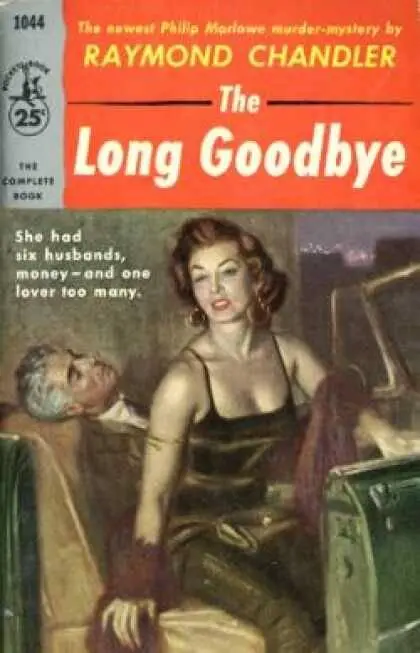
- Название:The Long Goodbye
- Автор:
- Жанр:
- Год:неизвестен
- ISBN:нет данных
- Рейтинг книги:4 / 5. Голосов: 1
-
Избранное:Добавить в избранное
- Отзывы:
-
Ваша оценка:
The Long Goodbye: краткое содержание, описание и аннотация
Предлагаем к чтению аннотацию, описание, краткое содержание или предисловие (зависит от того, что написал сам автор книги «The Long Goodbye»). Если вы не нашли необходимую информацию о книге — напишите в комментариях, мы постараемся отыскать её.
Marlowe meets and befriends English expatriate Terry Lennox, a drunk who has been abandoned by his ex-wife Sylvia, at The Dancers Club. Months later he spots Lennox drunk again, runs him home, and sobers him up, giving him traveling money to Las Vegas. Lennox sends repayment and re-marries Sylvia, after which Marlowe shares an occasional drink with him: during one, Lennox accuses Sylvia of infidelity. He next appears at Marlowe's door in flight to Tijuana, apparently because he has killed her. Marlowe drives him there and stonewalls policemen Green and Dayton when he returns, spending time in jail. He refuses to cooperate with a lawyer sent by Sylvia's millionaire father, local magnate Harlan Potter.
Marlowe won't talk even after the D.A. says that Lennox wrote a full confession before shooting himself in Mexico. A reporter suggests to him that there is a cover-up, which is confirmed by calls from the lawyer and warnings from gangster Mendy Menendez, an old friend of Lennox, who explains that Lennox was captured by the Nazis during World War II. Marlowe gets a letter from Lennox, which waffles on his role in the murder and contains a $5,000 bill.
A second apparent plot begins when Howard Spencer, a publisher's representative, hires Marlowe to baby-sit hack novelist Roger Wade (Chandler's self-portrait). The alcoholic writer can't finish his novel and is missing, but his stunning blonde wife Eileen provides a note about "Dr. V" and details of Wade's stays at drunk farms. Marlowe gets information on these places from an old friend in a big agency and narrows his list to three suspects. None pan out except Dr. Verringer, who is about to sell out so that he can support a manic-depressive named Earl. Spying Wade through a window, Marlowe saves him from crazy Earl. For this he collects a kiss from Eileen, and he learns that she knew Sylvia Lennox, which links the two plots.
A lull follows, during which Marlowe meets Sylvia's sister Linda Loring and her insufferable doctor husband. They argue about Sylvia's murder and whether Harlan Potter wants the case closed, but a respectful friendship ensues. Marlowe sees the Lorings again at Roger Wade's cocktail party, where the doctor accuses the novelist of sleeping with his wife. A scene follows, but Wade handles the blow-up well. Marlowe, however, won't accept $1,000 to nanny the author through his novel. He doesn't like the writer's ego or his wife, who tells him her own story of true love lost.
A week later Wade calls for help, and Marlowe arrives to find him collapsed in front of his house, with Eileen sitting nearby smoking. He and the house-boy put Wade to bed, and Marlowe walks away from an opportunity with Eileen. Instead he collects Wade's drunken notes to gain insight into his problems. Then there's a shot. Marlowe finds husband and wife struggling over a gun, the novelist claiming he attempted suicide. Dosed with drugs, he finally sleeps. Eileen invites Marlowe into her bed, but he declines.
Linda Loring introduces Marlowe to Harlan Potter, who wants the Lennox murder closed. Marlowe demurs. Now information develops that Lennox used to call himself Paul Marston, and that Roger Wade had an affair with Sylvia. Marlowe, at the Wades with Eileen, finds the writer dead. His old friend Lt. Ohls treats the case as a suicide, but Eileen accuses Marlowe. More comes out about Lennox's former life: he was married to Eileen and presumed dead in World War I, so she married Wade. But then he reappeared and she panicked.
In the revealed plot, she killed both Sylvia and Roger. Lennox' name is cleared. Linda Loring divorces her obnoxious husband and asks Marlowe to marry her; he refuses to be a kept man, but does spend a night with her, the only woman Marlowe ever beds (aside from Helen Vermilyea in Chandler's better-off-forgotten swan song, Playback. There's a final detail to check and it's supplied by Senor Maioranos ("Mr. Better-years"), who is Terry Lennox in disguise. He and Marlowe talk, but the old affection is gone. As Marlowe said of Linda Loring's departure, "to say goodbye is to die a little."
As he had in the preceding The Little Sister (1949), Chandler engaged in pointed social criticism in The Long Goodbye, stretching the genre. The brunt of his attack is born by the rich: Marlowe sees their enterprises – business, the press, gambling interests, lawyers, and the courts – forming a monolith that disenfranchises the average citizen. "Money tends to have a life of its own, even a conscience of its own," says villain Harlan Potter, who is the ironic spokesman for many of Chandler's views (190-91). The roots of crime lie not with nymphomaniacs (as in The Big Sleep) or in economic climbing (Farewell's Velma Valento), but in big money's exploitation of the lowest-common-denominator effect of mass institutions and democracy. This, Chandler finally decided, rather than some inherently debilitating effect of the setting, robs immigrants to L.A. of the admirable independence that drew them there.
More interesting still is the way Chandler used the novel, which he wrote as his wife lay dying, to analyze and comment on his own life. Like Terry Lennox, Chandler was a soldier scarred by World War I, whose young days at Dabney Oil were full of big cars and illicit affairs. Like Roger Wade, he had become a middle-aged, childless, self-hating, alcoholic, celebrity writer. Like Philip Marlowe, Chandler clung in conscience to early ideals, belief in character, fidelity, and respect for creation. The novel detests the very self-pity that propels it. Can Chandler integrate the parts of his life? Marlowe's last words to Lennox are "So long, Senor Maioranos. Nice to have known you – however briefly" (311). The final answer is no. It is no accident that Terry Lennox and Roger Wade never appear together, but rather a psychological impossibility. That a woman undoes both is Chandler's old saw, but secondary here. "Your husband is a guy who can take a long hard look at himself and see what is there," says Marlowe to Eileen. "Most people go through life using up half their energy trying to protect a dignity they never had" (153). Not until Ross Macdonald would the hard-boiled novel again be exploited for autobiographical insight so sharply.
The Long Goodbye — читать онлайн бесплатно полную книгу (весь текст) целиком
Ниже представлен текст книги, разбитый по страницам. Система сохранения места последней прочитанной страницы, позволяет с удобством читать онлайн бесплатно книгу «The Long Goodbye», без необходимости каждый раз заново искать на чём Вы остановились. Поставьте закладку, и сможете в любой момент перейти на страницу, на которой закончили чтение.
Интервал:
Закладка:
From here on it didn't quite add up. You'd expect her to look for him and find him and make sure he wasn't hurt. It wouldn't hurt him to lie out on the ground on a warm summer night for a while. She couldn't move him. It had taken all I had to do that. But you wouldn't quite expect to find her standing in the open doorway smoking a cigarette, not knowing except very vaguely where he was. Or would you? I didn't know what she had been through with him, how dangerous he was in that condition, how much afraid she might be to go near him. "I've had all of it I can take," she had said to me when I arrived. "You find him." Then she had gone inside and pulled a faint.
It still bothered me, but I had to leave it at that. I had to assume that when she had been up against the situation often enough to know there was nothing she could do about it except to let it ride, then that would be what she would do. Just that. Let it ride. Let him lie out there on the ground until somebody came around with the physical equipment to handle him.
It still bothered me. It bothered me also that she had checked out and gone into her own room while Candy and I got him upstairs to bed. She said she loved the guy. He was her husband, they had been married for five years, he was a very nice guy indeed when sober-those were her own words. Drunk, he was something else, something to stay away from because he was dangerous. All right, forget it. But somehow it still bothered me. If she was really scared, she wouldn't have been standing there in the open door smoking a cigarette. If she was just bitter and withdrawn and disgusted, she wouldn't have fainted.
There was something else. Another woman, perhaps. Then she had only just found out. Linda Loring? Maybe. Dr. Loring thought so and said so in a very public manner.
I stopped thinking about it and took the cover off the typewriter. The stuff was there, several loose sheets of typed yellow paper that I was supposed to destroy so Eileen wouldn't see them. I took them over to the couch and decided I deserved a drink to go with the reading matter. There was a half bath off the study. I rinsed the tall glass out and poured a libation and sat down with it to read. And what I read was really wild. Like this:
28
The moon's four days off the full and there's a square patch of moonlight on the wall and it's looking at me like a big blind milky eye, a wall eye. Joke. Goddam silly simile. Writers. Everything has to be like something else. My head is as fluffy as whipped cream but not as sweet. More similes. I could vomit just thinking about the lousy racket. I could vomit anyway. I probably will. Don't push me. Give me time. The wbrms in my solar plexus crawl and crawl and crawl. I would be better off in bed but there would be a dark animal underneath the bed and- the dark animal would crawl around rustling and hump himself and bump the underside of the bed, then I would let out a yell that wouldn't make any sound except to me. A dream yell, a yell in a nightmare. There is nothing to be afraid of and I am not afraid because there is nothing to be afraid of, but just the same I was lying like that once in bed and the dark animal was doing it to me, bumping himself against the underside of the bed, and I had an orgasm. That disgusted me more than any other of the nasty things I have done.
I'm dirty. I need a shave. My hands are shaking. I'm sweating. I smell foul to myself. The shirt under my arms is wet and on the chest and back. The sleeves are wet in the folds of the elbows. The glass on the table is empty. It would take both hands to pour the stuff n9w. I could get one out of the bottle maybe to brace me. The taste of the stuff is sickening. And it wouldn't get me anywhere. In the end I won't be able to sleep even and the whole world will moan in the horror of tortured nerves. Good stuff,- huh, Wade? More.
It's all right for the first two or three days and then it is negative. You suffer and you take a drink and for a little while it is better, but the price keeps getting higher and higher and what you get for it is less and less and then there is always the point where you get nothing but nausea. Then you call Veriinger. All right, Verringer, here L come. There isn't any Verringer any more. He's gone to Cuba or he is dead. The queen has killed him. Poor old Verringer, what a fate, to die in bed with a queen-that kind of queen. Come on, Wade, let's get up and go places. Places where we haven't ever been and aren't ever going back to when we have been. Does this sentence make sense? No. Okay, I'm not asking any money for it. A short pause here for a long commercial.
Well, I did it. I got up. What a man. I went over to the couch and here I am kneeling beside the couch with my hands down on it and my face in my hands, crying. Then I prayed and despised myself for praying. Grade Three drunk despising himself. What the hell are you praying to, you fool? If a well man prays, that's faith. A sick man prays and he is just scared. Nuts to prayer. This is the world you made and you make it all by yourself and what little outside help you got-well you made that too. Stop praying, you jerk. Get up on your feet and take that drink. It's too late for anything else now.
Well, I took it. Both hands. Poured it in the glass too. Hardly spilled a drop. Now if I can hold it without vomiting. Better add some water. Now lift it slow. Easy, not too much at a time. It gets warm. It gets hot. If I could stop sweating. The glass is empty. It's down on the table again.
There's a haze over the moonlight but I set that glass down in spite of it, carefully, carefully, like a spray of roses in a tall vase. The roses nod their heads with dew. Maybe I'm a rose. Brother, have I got dew. Now to get upstairs. Maybe a short one straight for the journey. No? Okay, whatever you say. Take it upstairs when I get there. If I get there, something to look forward to. If I make it upstairs I am entitled to compensation. A token of regard from me to me. I have- such a beautiful love for myself-and the sweet part of it-no rivals.
Double space. Been up and came down. Didn't like it upstairs. The altitude makes my heart flutter. But I keep hitting these typewriter keys. What a magician is the subconscious. If only 'it would work regular hours. There was moonlight upstairs too. Probably the same moon. No variety about the moon. It comes and goes like the milkman and the moon's milk is always the same. The milk's moon is always-hold it, chum. You've got your feet crossed. This is no time to get involved in the case history of the moon. You got enough case history to take care of the whole damn valley.
She was sleeping on her side without sound. Her knees drawn up. Too still I thought. You always make some sound when you sleep. Maybe not asleep, maybe just trying to sleep. If I went closer I would know. Might fall down too. One of her eyes opened-or did it? She looked at me or did she? No. Would have sat up and said, Are you sick, darling? Yes, I am sick, darling. But don't give it a thought, darling, because this sick is my sick and not your sick, and let you sleep still and lovely and never remember and no slime from me to you and nothing come near you that is grim and gray and ugly.
You're a louse, Wade. Three adjectives, you -lousy writer. Can't you even stream-of-consciousness you louse without getting it in three adjectives for Chris-sake? I came downstairs again holding on to the raiL My guts lurched with the steps and I held them together with a promise. I made the main floor and I made the study and I made the couch and I waited for my heart to slow down. The bottle is handy. One thing you can say about Wade's arrangements the bottle is always handy. Nobody hides it, nobody locks it up. Nobody says, Don't you think you've had enough, darling? You'll make yourself sick, darling. Nobody says that. Just sleep on side softly like roses.
Читать дальшеИнтервал:
Закладка:
Похожие книги на «The Long Goodbye»
Представляем Вашему вниманию похожие книги на «The Long Goodbye» списком для выбора. Мы отобрали схожую по названию и смыслу литературу в надежде предоставить читателям больше вариантов отыскать новые, интересные, ещё непрочитанные произведения.









Обсуждение, отзывы о книге «The Long Goodbye» и просто собственные мнения читателей. Оставьте ваши комментарии, напишите, что Вы думаете о произведении, его смысле или главных героях. Укажите что конкретно понравилось, а что нет, и почему Вы так считаете.