Matthew Pearl - The Poe Shadow
Здесь есть возможность читать онлайн «Matthew Pearl - The Poe Shadow» весь текст электронной книги совершенно бесплатно (целиком полную версию без сокращений). В некоторых случаях можно слушать аудио, скачать через торрент в формате fb2 и присутствует краткое содержание. Жанр: Исторический детектив, на английском языке. Описание произведения, (предисловие) а так же отзывы посетителей доступны на портале библиотеки ЛибКат.
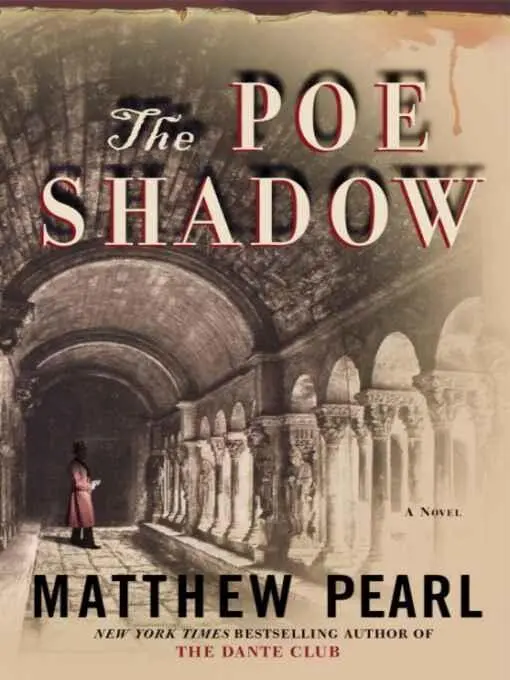
- Название:The Poe Shadow
- Автор:
- Жанр:
- Год:неизвестен
- ISBN:нет данных
- Рейтинг книги:5 / 5. Голосов: 1
-
Избранное:Добавить в избранное
- Отзывы:
-
Ваша оценка:
The Poe Shadow: краткое содержание, описание и аннотация
Предлагаем к чтению аннотацию, описание, краткое содержание или предисловие (зависит от того, что написал сам автор книги «The Poe Shadow»). Если вы не нашли необходимую информацию о книге — напишите в комментариях, мы постараемся отыскать её.
Poe was supposed to be almost anywhere other than Baltimore: he was traveling from Richmond to New York with a planned stop in Philadelphia, not Baltimore. No one knows how he came to be in the city – or, for that matter, how he ended up at the tavern. For some of us, this pretty much describes a really great Saturday night, but when it happens to the master of darkness, just days before his untimely death, it has the makings of a mystery.
Pearl takes us back to those few lost days through the inquiries of Quentin Clark, a Poe-mad young Baltimorean who is dismayed not just by the writer's death but by the press's apathetic reponse to the news. Clark takes it upon himself to look into matters and rectify this slight to his hero. The trouble is, Clark is a stock character from the world of commercial thrillers: a man with a lot to lose, imperiled by his own obsession. Engaged to a beautiful young woman, the son of wealthy and very proper parents and pursuing a career as a lawyer, he may sacrifice them all to his devotion to Poe.
Clark haunts the writer's grave, visits the hospital where he lay dying and tracks down the Poe cousins. But wherever he turns, he's met with indifference or outright obstruction. Finally, in desperation, he turns to another source of information: the pages of a book. Clark has always admired Poe's "Murders in the Rue Morgue" and the other mysteries featuring C. Auguste Dupin, the brilliant Frenchman who solves crimes too baffling for the Paris police. "Dupin's reasoning followed a method Poe called ratiocination," Clark reminds himself, "employing one's imagination to achieve analysis, and one's analysis to climb the heights of imagination."
When Clark stumbles on a newspaper item suggesting that Dupin was based on a real Frenchman, he promptly takes off for the Continent. Of course, there turns out to be more than one candidate for this honor, and soon a couple of testy Frenchmen are racing back to America, eager to snatch whatever glory they might from Poe's death.
Baroquely orchestrated complications ensue, up to and including a threat to the future of the French republic. As he demonstrated in his serial-killers-and-philosophers best seller, "The Dante Club," Pearl is a fine scene-setter and a resolute, if not always inspired, plotter. "The Poe Shadow" is thick with intrigue and thicker still with carefully researched (and ostentatiously displayed) details.
Pearl, who taught literature at Harvard before embarking on his literary career, sometimes displays a wonderfully knowing tone, and enjoys playing with 19th-century lingo. When a Baltimore police officer asks Clark if he has a wife and is told that he has a fiancée, the officer warns: "You should have much to occupy yourself without needing to think of this unhappy affair, then. Or your sweetheart might give you the mitten." Sadly, Pearl's plot is not all sweethearts and mittens.
With its bewildered narrator and its attempt to marry the rational and the spooky, "The Poe Shadow" seems to be modeled on Poe's own writing, but it's missing a crucial element: brevity. Although Pearl has a real affinity for 19th-century America, he overwhelms the strengths of his book with a hurricane of ersatz Victorian prose. He doesn't just disinter Poe's story; he disinters the language of Poe's time. After a while, you feel like you're trapped in a sepia-toned faux-daguerrotype. Pearl has created a museum rather than a world. And no one lives in a museum.
The Poe Shadow — читать онлайн бесплатно полную книгу (весь текст) целиком
Ниже представлен текст книги, разбитый по страницам. Система сохранения места последней прочитанной страницы, позволяет с удобством читать онлайн бесплатно книгу «The Poe Shadow», без необходимости каждый раз заново искать на чём Вы остановились. Поставьте закладку, и сможете в любой момент перейти на страницу, на которой закончили чтение.
Интервал:
Закладка:
One morning, I took a seat on the stone steps of the athenaeum before it opened and waited for the doors to be unlatched. Once inside, I chose a chair across from the place where I knew the gentleman preferred, so I could watch him more closely. When he arrived, though, he, seemingly oblivious to my motives, found a different table. I did not want it to seem like I was following him, so I kept a distance. The next day, I loitered near the clerk's desk, to see where the other gentleman would situate himself. I claimed a nearby place. I could now observe his every movement.
He was most galling in the joyfulness he exhibited at reading about the circumstances of Poe's death.
"Ah, did you see this one now?" He turned to a woman at the neighboring table, holding up a newspaper. "They're wondering what happened to all the money he scraped together from lecturing in Richmond. If it had been on Poe's person, where is it now? That's a question. The editors of the press are shrewd." There he laughed as if at an infinitely witty jest.
Shrewd, he says! "Sir, how is it you laugh in such a manner?" I asked, knowing I should instead keep to myself. "Do you not think this a subject of the most serious gravity, deserving higher decorum?"
"It is most serious," he said, his unruly eyebrows straightening on command. "Serious as a judge. Yet most critical, too, that we shall be told in full what happened to him."
"And do you not take these reports with a considerable modicum of salt? Do you think every item you read proclaims the truth, as some prophet of a Gospel?"
He gave the idea of his credulity strenuous thought. "Why else would they waste fine ink on it, dear man, if it weren't true? I should not think like the Hebrews, and not believe that newer testaments are also smarter, instead chasing all false Messiahs with ‘lo here, lo there!'"
In my agitation, I left the athenaeum for the remainder of the day. I suspected that the pest's desire to gawk would expire quickly, and was relieved when there came days he failed to appear; but then he would be resurrected the following day. Sometimes, given some reminder to a certain poem by Poe, he would rise and spontaneously recite verses to the room. For instance, one afternoon a church bell tolled outside for a funeral. He jumped up with Poe's words on his lips:
Oh, the bells, bells, bells!
What a tale their terror tells
Of Despair!
He would usually sit among the papers, interrupting himself only to blow his nose ferociously into his handkerchief, or one he borrowed from an unlucky patron. I became excessively friendly with strangers I happened to meet at the reading room, based only on their virtue of not being that sneezing, supercilious man.
I complained to the clerk, pacing in front of his table. "Why should he be so concerned with articles about Poe?" I asked.
"Who, Mr. Clark?"
I blinked at the kind old clerk. "Who? Why that man who comes in nearly every day-"
"Ah, I thought you were speaking of the man who had given me those articles about Edgar Poe some time ago," he replied, "which I ordered delivered to you."
I brought my pacing to a stop as I thought of the package of cuttings the clerk had sent me before I left for Paris-a selection that included the first mention I had seen of a real Dupin. "I had naturally assumed you had collected those yourself."
"No, Mr. Clark."
"But who was it that gave them to you?"
"It must have been some two years ago now," he meditated. "Which pigeon-hole of my brain did that go into?" he laughed.
"Please try to recall. I should be most interested." The clerk agreed that he would tell me if he was able to remember. Someone, I presumed, who cared about Poe before the morbid sensation and vulgar curiosity that had been caused by the Baron's manipulation. Before men like this enthusiast who was now forever stationed across the room from me.
Duponte advised me to ignore the man. Now that I had met Bonjour at the bookseller's, he said, the Baron Dupin would have many eyes looking for me-just as he had in Paris-to determine the nature of our activity. I must pretend he was not even there, as though he did not exist.
"Oh, look here. We shall hear more soon." That was the shaggy-haired man's commentary one morning at the athenaeum.
I tried exceedingly hard to keep away before finding myself replying from the next table over. "Sir? How do you mean we shall hear soon?"
He squinted as though never having seen me before. "Ah, right here, dear man," he said, finding his spot on the page. "There. They say there are whispers in the very first circles of society that the ‘real Dupin' has come to Baltimore and will sort out what it was happened to Poe. Do you see?"
I looked over the paper and found the notice.
"The editor heard of it first-hand. C. Auguste Dupin was…" the man went on, then paused to blow his nose. "C. A. Dupin was a most winning genius in some of Poe's tales, don't you know? He solves some rather knotty puzzles. He's the real china, and no mistake."
I wanted to report all this to Duponte, primarily to give voice to my vexation, but did not find him in his accustomed place in my library that evening. The newspapers were scattered over the desk and table as usual, indicating that he had been at his labors earlier.
"Monsieur Duponte?" My voice traveled upon Glen Eliza's long halls and up the stairwells in an aimless echo. I questioned my domestics, but none had seen him since earlier that day. An ominous fear seized me. I shouted loudly enough to be heard by neighboring houses. Duponte probably had come to feel confined by his reading for so long. He might still be near my house.
But I found no traces of the analyst on the property or in the valley below the house. Soon I walked to the street and hired a carriage.
"I am looking for a friend, driver-let us ride around, with all steam on." Given that Duponte had not left the grounds of Glen Eliza since our arrival, I'd begun to suspect he'd happened on something exciting to investigate.
We passed by the avenues around the Washington Monument, through the Lexington Market, through the crowded wharf-side streets watched over by the clipper ships. The affable coachman tried several times to start a conversation, once along the stretch of road as we drove past the Washington College Hospital.
"Do y'know, your honor," he shouted back to me, "that is where Edgar Poe died?"
"Stop the carriage!" I cried.
He did, happy to win my attention. I stepped up to the driver's box.
"What is it you said before about that place, driver?"
"I was just pointing out the sights to you. Ain't you a stranger here? Can whip you up to a nice culinary establishment in no time, if you wish, rather than riding in circles, your honor."
"Who told you about Poe? You read it in the newspapers?"
"It was a fellow who rode in my coach who was telling me about it."
"What did he say?"
"That Poe was the greatest damned poet in America. Yet he heard tell Poe been left to die on the dirty floor of a rum-hole by some rough circumstance. He said he read of it all in the newspapers. A sociable man, he was-I mean he who rode in my carriage."
The driver could not call to mind what this man looked like, although he was clearly nostalgic for what an easy conversationalist he had been, compared to his present passenger.
"Not three days ago I had him in my coach. Do y'know, he did sneeze something awful."
"Sneeze?" I asked.
"Yes, borrowed my handkerchief and used it up something awful. "
I watched the afternoon sink into twilight, knowing that with sunset I would lose any hope of spotting Duponte. Baltimore's street lighting was among the poorest of any city, and sometimes walking home after dark was difficult even for the native citizen. I had concluded that the wisest course would be to return and wait for him at Glen Eliza.
Читать дальшеИнтервал:
Закладка:
Похожие книги на «The Poe Shadow»
Представляем Вашему вниманию похожие книги на «The Poe Shadow» списком для выбора. Мы отобрали схожую по названию и смыслу литературу в надежде предоставить читателям больше вариантов отыскать новые, интересные, ещё непрочитанные произведения.









Обсуждение, отзывы о книге «The Poe Shadow» и просто собственные мнения читателей. Оставьте ваши комментарии, напишите, что Вы думаете о произведении, его смысле или главных героях. Укажите что конкретно понравилось, а что нет, и почему Вы так считаете.