Michael Kurland - Professor Moriarty Omnibus
Здесь есть возможность читать онлайн «Michael Kurland - Professor Moriarty Omnibus» весь текст электронной книги совершенно бесплатно (целиком полную версию без сокращений). В некоторых случаях можно слушать аудио, скачать через торрент в формате fb2 и присутствует краткое содержание. Жанр: Исторический детектив, на английском языке. Описание произведения, (предисловие) а так же отзывы посетителей доступны на портале библиотеки ЛибКат.
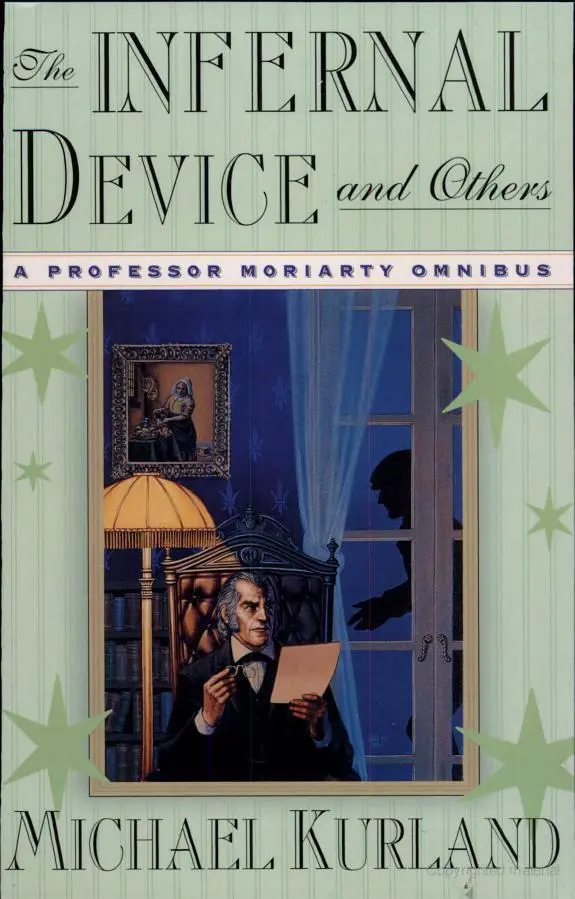
- Название:Professor Moriarty Omnibus
- Автор:
- Жанр:
- Год:неизвестен
- ISBN:нет данных
- Рейтинг книги:3 / 5. Голосов: 3
-
Избранное:Добавить в избранное
- Отзывы:
-
Ваша оценка:
Professor Moriarty Omnibus: краткое содержание, описание и аннотация
Предлагаем к чтению аннотацию, описание, краткое содержание или предисловие (зависит от того, что написал сам автор книги «Professor Moriarty Omnibus»). Если вы не нашли необходимую информацию о книге — напишите в комментариях, мы постараемся отыскать её.
-A dangerous adversary seeking to topple the British monarchy places Moriarty in mortal jeopardy, forcing him to collaborate with his nemesis Sherlock Holmes.
-A serial killer is stalking the cream of England's aristocracy, baffling both the police and Sherlock Holmes and leaving the powers in charge to play one last desperate card: Professor Moriarty.
-The first new Moriarty story in almost twenty years, it has never before appeared in print.
Professor Moriarty Omnibus — читать онлайн бесплатно полную книгу (весь текст) целиком
Ниже представлен текст книги, разбитый по страницам. Система сохранения места последней прочитанной страницы, позволяет с удобством читать онлайн бесплатно книгу «Professor Moriarty Omnibus», без необходимости каждый раз заново искать на чём Вы остановились. Поставьте закладку, и сможете в любой момент перейти на страницу, на которой закончили чтение.
Интервал:
Закладка:
Professor Moriarty, Barnett thought, was certainly the most complex and contradictory man he had ever known. On the surface, the tall, thin, stoop-shouldered, introspective professor appeared no more interesting and no more sophisticated than any provincial schoolteacher who might combine a proficiency in mathematics with a better than average understanding of people. Yet Moriarty combined a true brilliance in mathematics, and indeed in all the physical sciences, with an unsurpassed intuitive insight into people. From a superficial examination of the man who sat opposite him in a railroad carriage, Moriarty could state the man's profession, marital status, interests, and possibly even add a few intimate details of his private life. When pressed to explain his methods, Moriarty drew an inductive path leading from his observations to his conclusions that made you feel foolish for not having seen it yourself. And he was usually, if not invariably, correct.
And yet this understanding of the actions and motives of other people did not seem to extend to any sort of empathy with or sympathy for his fellow human beings. Moriarty respected facts and admired the analytical and deductive facilities of the human animal. He had small use for any human emotion and no use at all for those people who, in his view, refused to use their brains.
He considered himself bound by no laws, yet would never break his oath or go back on his word. And for all that he professed a distaste for his fellow human beings, nothing could bring him more quickly to anger or provoke more of his biting scorn than an account of one person callously mistreating another.
Moriarty affixed his pince-nez to the bridge of his nose and turned his gaze to Barnett. "You have been staring at me for the past ten minutes," he said. "Have I suddenly developed a keratosis?"
"No," Barnett said. "No, sir. I apologize. But, to tell you the truth, I was thinking about you. About your attitudes."
"My attitudes?"
"Yes. Toward people."
"You refer, I assume," Moriarty said calmly, "to my characteristic revulsion toward my fellow man."
"I wouldn't have put it that strongly," Barnett said.
Moriarty snorted. "My fellow man is a fool," he said, "incapable of acting twice consecutively in his own interest, for the very good reason that he has only the sketchiest idea of what his interest is, or where it lies. He allows his emotions to override his puny intellect and blindly follows whichever of his fellows brays the loudest in his direction. He firmly believes in the existence of an almighty God, whom he pictures, somehow, as looking a lot like himself, and further believes that it matters to this Creator of the Universe whether He is prayed to in a kneeling or sitting position. He rejects Isaac Newton and Charles Darwin in favor of Bishop Ussher and the Davenport Brothers. He supposes that a planet a hundred times as massive as the earth, and a thousand million miles distant, was placed there solely to predict the outcome of his business affairs or his romantic dalliances. He believes in ghosts, poltergeists, mesmerism, spiritualism, clairvoyance, astrology, numerology, and a hundred other foolishnesses, but isn't sure about evolution or the germ theory of disease."
"Come, Professor," Barnett said, "is not that a bit broad? Surely there are exceptions."
"Indeed," Professor Moriarty said, nodding. "And it is the exceptions who make life interesting." He took a large handkerchief from his jacket pocket and, removing the pince-nez from his nose, polished the glasses carefully. "I am not a complete misanthrope, Mr. Barnett," he said, "and you must not imagine that I am. Indeed, it must be that on some unconscious level of my brain I am quite concerned about this hypothetical fellow man, or I wouldn't get so angry over his foibles."
"I thought, perhaps, it was just annoyance at recalling that you, yourself, are one of the creatures," Barnett said.
Moriarty considered this for a minute. "So I am," he said finally. "I had quite forgotten."
-
The four-wheeler turned left off Holland Park Avenue, and Moriarty pulled out his pocket-watch. "We're almost there," he said. "Strike a match, will you?"
Barnett obliged from the small packet of waterproofs he carried to light his occasional cigars.
"Ah!" Moriarty said. "It is still a quarter till the hour of ten. A bit late for calling, but I have no doubt that His Grace will see us."
A few minutes later they had turned past the ancient gateposts and were heading up the drive toward Baddeley Hall. As recently as fifty years before, this great three-story Tudor mansion had been the main house to the great estate of Baddeley, surrounded by hundreds of acres of well-managed land. But now Greater London had grown past Baddeley, and most of the managing was done by estate agents who collected the quarterly rents on street after street of semidetached cottages. It had ruined the duke's shooting — but had enormously increased his income.
Moriarty looked out of the carriage window and chuckled with satisfaction as they pulled around to the great oak doors that were Baddeley Hall's main entrance. "I was right," he said. "The trip was not in vain."
"What do you mean?" Barnett asked.
"See for yourself," Moriarty said. "Every lamp in the house must be lighted."
"A party?" Barnett suggested, feeling contrary.
"Nonsense!" Moriarty replied. "Where are the rows of waiting carriages? No, there are but two vehicles waiting in the drive: a closed landau bearing a crest I cannot make out from here and a hansom. Family friends and advisors, no doubt, come to aid the duke in his time of travail. Their drivers, I see, are warming themselves within the mansion while waiting for their passengers. However, I'm afraid that poor Clarence will have to wait out in the cold."
Clarence pulled up to the front steps and they dismounted. "I don't know how long we'll be," Moriarty told Clarence. "I think it wiser if you stay with your vehicle. I don't expect any trouble here now, but there's no point in taking unnecessary risks."
"That's quite all right, Professor," Clarence replied cheerily, taking off his bowler and scratching his bald head. "It ain't all that cold and it ain't raining. I have a flask of tea here, and there's enough light from these here gas fixtures to read the 'Pink 'un' by, so I'm content." He waved his hat at the horse. "Maud here gets nervous when I leave her alone at night, anyway."
"Very good, then," Moriarty said. He and Barnett mounted the steps together, and Barnett pulled the lion's-head bellpull by the door. Moriarty took out one of his calling cards and wrote "Ivan Zorta" in ink on the back.
The door opened, and a tall man in the Ipswich livery stared out impassively at them. "Yes?"
"I must see your master on a matter of the utmost importance." Moriarty said. "Show him this card."
The man placed the card on a tray. "Come in," he said, taking their hats and Moriarty's stick. "You may wait in there."
They crossed the entrance hall under the footman's watchful eye and entered a small reception room. Within a very few minutes a second, shorter but more regal-looking man — Barnett correctly surmised that this was the butler — came to fetch them. "His Grace will see you now," he said. "Please follow me."
Barnett followed Moriarty down the hall, staring with frank curiosity at his surroundings. This was the first time he had ever been in a duke's residence, and might well be the last, so he wanted to take it all in. The walls were rich, dark oak and hung with ancient family portraits interspersed with occasional pastoral scenes. There was a great, wide staircase that a troop of men could have marched down eight abreast. At its foot, by the intricately carved oak baluster, was a full suit of armor that looked, at least to Barnett's uneducated eye, as though it had once been worn in battle.
Читать дальшеИнтервал:
Закладка:
Похожие книги на «Professor Moriarty Omnibus»
Представляем Вашему вниманию похожие книги на «Professor Moriarty Omnibus» списком для выбора. Мы отобрали схожую по названию и смыслу литературу в надежде предоставить читателям больше вариантов отыскать новые, интересные, ещё непрочитанные произведения.



Обсуждение, отзывы о книге «Professor Moriarty Omnibus» и просто собственные мнения читателей. Оставьте ваши комментарии, напишите, что Вы думаете о произведении, его смысле или главных героях. Укажите что конкретно понравилось, а что нет, и почему Вы так считаете.