Michael Kurland - Professor Moriarty Omnibus
Здесь есть возможность читать онлайн «Michael Kurland - Professor Moriarty Omnibus» весь текст электронной книги совершенно бесплатно (целиком полную версию без сокращений). В некоторых случаях можно слушать аудио, скачать через торрент в формате fb2 и присутствует краткое содержание. Жанр: Исторический детектив, на английском языке. Описание произведения, (предисловие) а так же отзывы посетителей доступны на портале библиотеки ЛибКат.
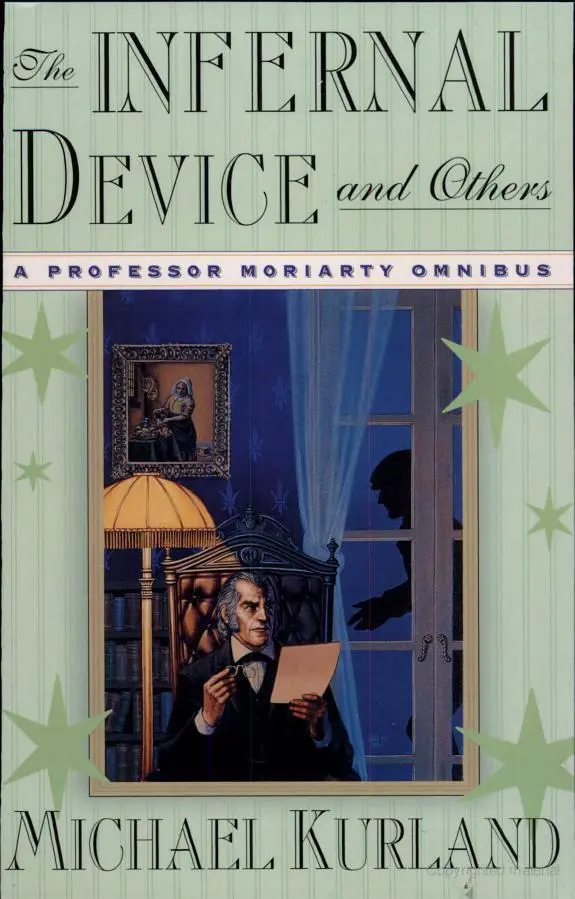
- Название:Professor Moriarty Omnibus
- Автор:
- Жанр:
- Год:неизвестен
- ISBN:нет данных
- Рейтинг книги:3 / 5. Голосов: 3
-
Избранное:Добавить в избранное
- Отзывы:
-
Ваша оценка:
Professor Moriarty Omnibus: краткое содержание, описание и аннотация
Предлагаем к чтению аннотацию, описание, краткое содержание или предисловие (зависит от того, что написал сам автор книги «Professor Moriarty Omnibus»). Если вы не нашли необходимую информацию о книге — напишите в комментариях, мы постараемся отыскать её.
-A dangerous adversary seeking to topple the British monarchy places Moriarty in mortal jeopardy, forcing him to collaborate with his nemesis Sherlock Holmes.
-A serial killer is stalking the cream of England's aristocracy, baffling both the police and Sherlock Holmes and leaving the powers in charge to play one last desperate card: Professor Moriarty.
-The first new Moriarty story in almost twenty years, it has never before appeared in print.
Professor Moriarty Omnibus — читать онлайн бесплатно полную книгу (весь текст) целиком
Ниже представлен текст книги, разбитый по страницам. Система сохранения места последней прочитанной страницы, позволяет с удобством читать онлайн бесплатно книгу «Professor Moriarty Omnibus», без необходимости каждый раз заново искать на чём Вы остановились. Поставьте закладку, и сможете в любой момент перейти на страницу, на которой закончили чтение.
Интервал:
Закладка:
Miss Perrine looked disapprovingly at his machine. "The Grandall is a good typewriter," she said, "but I prefer the Remington."
"As I shall need my own machine at any rate, I was planning to get a second. It shall be a Remington, as you say."
"Thank you, Mr. Barnett."
"As for starting, right now would seem a suitable time."
"Very good. What would you have me do?"
Barnett indicated the pile of letters on his desk. "Answer these," he said.
FOURTEEN — PASSING STRANGE
The City is
of
Night, perchance
of
Death But Certainly
of
Night.
— James Thomson
Cecily Perrine proved to be more than Barnett could have hoped for. He had advertised for a secretary and he had found a wonder. She handled the business side of American News Service so well that it almost immediately ceased being merely a front for Barnett's other activity and became a profitable enterprise in its own right. Very quickly she became adept at providing what American newspapers would pay for, from crime news to war news, feature articles to in-depth studies of European affairs. Barnett suppressed his infatuation with her as best he could, and replaced it with admiration for her ability.
In the meantime, he was busy with his own task: searching through the crime news, the society pages, the letters to the editors (published and un-), and even the agony columns for that hint of the bizarre which might indicate the presence of Trepoff or the Belye Krystall.
The bizarre was not hard to find in London, but identifying the elusive hand of Trepoff was another matter. The head of a small child was found in a hatbox in the parcel room of Kensington station. Was Trepoff involved? A man in Walling left his house in the morning, was seen going back for his umbrella, and then disappeared from the face of the Earth. A strange explosion destroyed the house of a Paddington chalk-merchant, who was then found in the cellar, dead of the bite of a giant tropical spider. Was Trepoff the agent, and if so, to what end?
The great safe deposit vaults of the London & Midlands Bank were opened one Monday morning and discovered to be completely empty, with no discernible trace of how the event had happened. The police professed themselves to be baffled in one sentence, and in the next promised an "early arrest."
"It really is quite puzzling," Barnett told Moriarty that evening, "although I see no sign that our mysterious Trepoff is involved in it. The only set of keys, without which I am assured no man could have opened the vault doors unless he employed sufficient explosive to bring the building down around him, was in the hands of the branch manager continuously from the time he left the bank on Friday until he returned on Monday morning. The time clock on the vault was set by the assistant manager, in the manager's presence, as is their custom, and, indeed, did not release the mechanism until eight o'clock Monday morning. The electric alarm system, which connects with the local police station, was not set off. And the guard, who is locked in for the weekend, saw nothing unusual. Nevertheless, two large vaults have been completely emptied of their contents."
"It does not concern us," Moriarty told Barnett. "Trepoff was not involved."
"How can you be sure?"
Moriarty was bent over the small worktable in his study, titrating a clear reagent into a test tube half-full of brown liquid. For a time he did not answer, but continued to critically observe the liquid. All at once the brown color faded and the test tube was clear. Moriarty made a note in his notebook and kept watching as the reagent mixed with the now-clear liquid drop by drop. Within a minute there was another change, this one more gradual, until the liquid had turned a deep blue. Moriarty put the test tube aside and wrote a couple of quick lines in the notebook. Then he turned to Barnett.
"The bank manager keeps the keys to his branch — the entire set, mind you — on his dresser while he sleeps. Does this strike you as being a safe procedure?"
"I, ah, don't know," Barnett said. "I suppose not."
"Further, he does not share a bedroom with his wife, but sleeps alone. And he is a heavy sleeper. It would be no trick for a clever man to obtain impressions of the keys."
"I see," Barnett said, and by now he thought he was beginning to.
"The Briggs-Murcheson time clock is a fascinating device," Moriarty said, going over to his desk and sitting down. "Mr. Murcheson — Mr. Briggs is deceased — Mr. Murcheson would no doubt be quite surprised to discover that if a powerful electromagnet is placed in the proximity of the escapement mechanism and the current applied to it is reversed fifty times a second, the clock is speeded up to approximately twice its normal speed. Which means that if the clock were set for, let us say, the sixty-one hours between Friday at seven P.M. and Monday at eight A.M., and someone were to apply such an electromagnet in the appropriate place shortly after midnight Friday, he might expect the timing mechanism to be released at about four-thirty Sunday morning. It could, of course, be reset after someone had gained access to the interior of the vault."
"This is all just a theory, of course," Barnett said. "What of the guard?"
"Theoretically," Moriarty said, smiling, "we may assume that the gentleman, as is common with many of his sort, is fond of the bottle. A little laudanum mixed into the flask that he takes to work would effectively render him non compos mentis for the required period. And he could hardly be expected to mention it afterward, as it would cost him his job."
"And the electrical alarm?"
"Ah, yes," Moriarty said. "Which goes under the streets to the police station. A workman at the appropriate manhole, several blocks away from the bank, could easily render it inoperative for the required time."
"I see," Barnett repeated. And he was now sure he did.
"An aggregate of defenses, when taken together, may sound formidable," Moriarty said, "although when individually examined, they may be nothing of the sort." He laced his fingers together on the desk. "But let us leave off this theoretical discussion, however fascinating, and get on to more urgent matters. I have some word of Trepoff."
"You do?" Barnett said. "What have you found out? And how did you go about it?"
"I have spent every evening for the last few weeks playing chess at the Bohemian Club and at the Balalaika. The Russians have a passion for chess equaled only by their passion for intrigue. If I may say so, they are on the average better at chess."
"Weren't you afraid of being recognized? This Trepoff is trying to kill you, after all."
"He seems to have given up that notion — at least for the time being," Moriarty said. "And I took precautions against being recognized. Indeed, I passed you once as you rounded the corner of Montague Place, and you failed to recognize me. I added thirty years to my age and took six inches off my height. You have no idea how tiring it is to appear six inches shorter for hours at a time."
"Have you made any contacts among the anarchists?" Barnett asked.
Moriarty nodded. "They trust me. I am an old gentleman who beats them at chess and refuses to allow them to discuss their politics around him because it's all a stupid game and will accomplish nothing. I rant at them about how stupid they are, so they trust me."
"You speak Russian?" Barnett asked.
"Well enough," Moriarty said. "I mostly listen."
"What sort of people are they?"
Moriarty shook his head. "They are as ineffectual as children. They talk and they talk, they plan, and they argue. Hour after hour they argue. They may kill a few people — it is easy to kill — but they cannot form a successful committee. So how can they ever hope to form a government?"
Читать дальшеИнтервал:
Закладка:
Похожие книги на «Professor Moriarty Omnibus»
Представляем Вашему вниманию похожие книги на «Professor Moriarty Omnibus» списком для выбора. Мы отобрали схожую по названию и смыслу литературу в надежде предоставить читателям больше вариантов отыскать новые, интересные, ещё непрочитанные произведения.








Обсуждение, отзывы о книге «Professor Moriarty Omnibus» и просто собственные мнения читателей. Оставьте ваши комментарии, напишите, что Вы думаете о произведении, его смысле или главных героях. Укажите что конкретно понравилось, а что нет, и почему Вы так считаете.