Brian Freeman - Marathon
Здесь есть возможность читать онлайн «Brian Freeman - Marathon» весь текст электронной книги совершенно бесплатно (целиком полную версию без сокращений). В некоторых случаях можно слушать аудио, скачать через торрент в формате fb2 и присутствует краткое содержание. Город: New York, Год выпуска: 2017, ISBN: 2017, Издательство: Quercus, Жанр: Детектив, на английском языке. Описание произведения, (предисловие) а так же отзывы посетителей доступны на портале библиотеки ЛибКат.
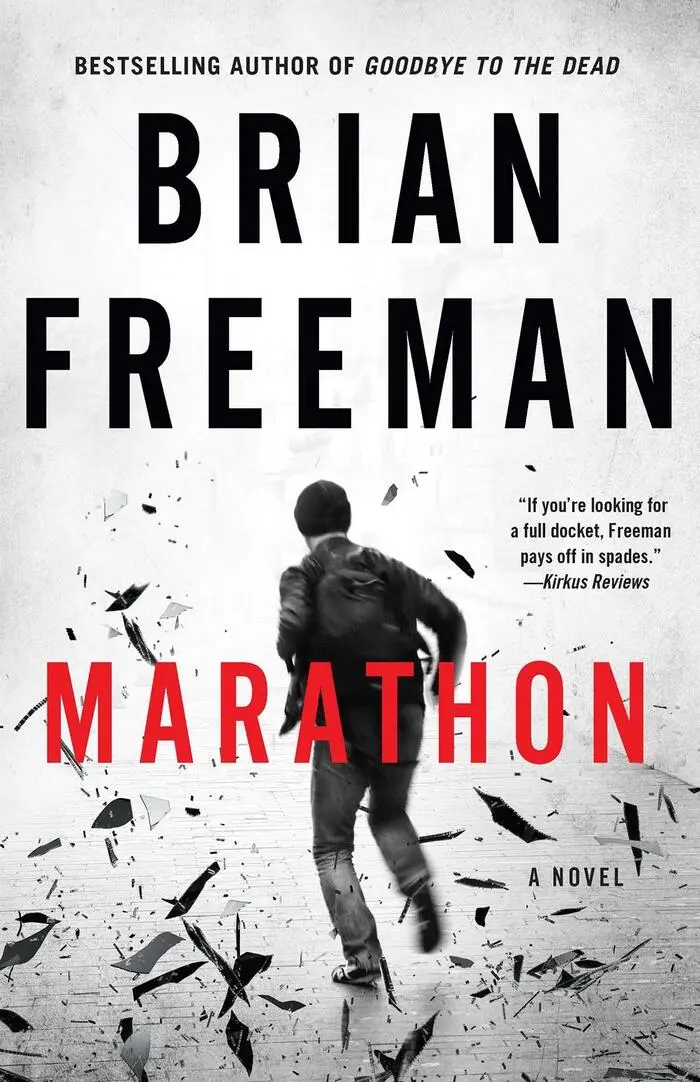
- Название:Marathon
- Автор:
- Издательство:Quercus
- Жанр:
- Год:2017
- Город:New York
- ISBN:978-1-68144-241-9
- Рейтинг книги:4 / 5. Голосов: 1
-
Избранное:Добавить в избранное
- Отзывы:
-
Ваша оценка:
Marathon: краткое содержание, описание и аннотация
Предлагаем к чтению аннотацию, описание, краткое содержание или предисловие (зависит от того, что написал сам автор книги «Marathon»). Если вы не нашли необходимую информацию о книге — напишите в комментариях, мы постараемся отыскать её.
Within minutes, Jonathan Stride, Serena Dial, and Maggie Bei are at work with the FBI to find the terrorists behind the tragedy. As social media feeds a flood of rumors and misinformation, one spectator remembers being jostled by a young man with a backpack not far from the bomb site. He spots a Muslim man in a tourist’s photo of the event and is convinced that this was the man who bumped into him in the crowd — but now the man’s backpack is missing.
When he tweets the photo to the public, the young man, Khan Rashid, becomes the most wanted man in the city. And the manhunt is on.
But are the answers behind the Duluth bombing more complex than anyone realizes? And can Stride, Serena, and Maggie find the truth before more innocent people are killed?
Marathon — читать онлайн бесплатно полную книгу (весь текст) целиком
Ниже представлен текст книги, разбитый по страницам. Система сохранения места последней прочитанной страницы, позволяет с удобством читать онлайн бесплатно книгу «Marathon», без необходимости каждый раз заново искать на чём Вы остановились. Поставьте закладку, и сможете в любой момент перейти на страницу, на которой закончили чтение.
Интервал:
Закладка:
Moments later, they reached the end of the golf course and crossed a gurgling creek onto the wooded land of the Hartley Nature Center. The forest was dense. A soggy trail barely a foot wide wound into the trees. With a flashlight Malik illuminated the standing water of a swamp.
Khan was lost, but Malik walked with confidence. Mosquitoes feasted on their skin, and gnats flew up into the moist part of Khan’s nose. The swampland got deeper, and a floating boardwalk carried them to the next trail, making their boots sound like the clip-clop of horses on the planks. Where two trails intersected, Malik stopped to get his bearings, but then he led them onto a new trail with his light. The park felt claustrophobic at night, with the trees crowding around them and grabbing at their arms like the street urchins in Lahore. Khan couldn’t see anything except the flashlight beam on the ground.
Malik stopped again, but this time, there was no cross-trail. He swung his flashlight as if looking for something, and finally, his light stopped on a white handkerchief tied to a tree branch that dangled over the path. His friend looked back with a dark smile.
“The going gets tough from here.”
“It wasn’t tough before?” Khan asked.
Malik pushed directly into the thick trees. Their boots splashed into several inches of water. Sharp branches clawed their faces. The bugs were even more voracious here. The two of them fought their way forward through a cage made of tree branches, and what was probably no more than a tenth of a mile felt longer and harder than everything they’d hiked before. They made noise. Too much noise. But it couldn’t be helped.
Finally, with a jolt, they burst out of the woods onto a paved residential street. It was the intersection of Harvard Avenue and Oxford Street. Malik gave him a thumbs-up and pointed down Oxford, which was lined with trees and telephone wires.
“We’re only three blocks from Woodland Avenue. The gallery’s there.”
Khan found it almost impossible not to run, knowing that Ahdia and Pak were so close. Even so, they went more slowly, because the risk was greatest here. Houses and driveways appeared among the trees. Some had lights on inside. After one more block, the trees gave way to an open neighborhood where houses were packed closely together. He saw a school building on a slope to their right. Streetlights lit them up. He was conscious that they were two Muslim men, wanted by the police.
“It’s not far now,” Malik said.
Khan felt his adrenaline surge. He was so close. Where he was now, the world was chaos and violence and confusion, but two blocks away, in the loft of a tiny gallery, was happiness. He could feel the pieces of his life come together again. He walked faster and faster, because he needed to escape the guns and the bugs and the wolves.
And yet he felt something else, too.
A dark cloud. A sense of unimaginable dread.
Something was wrong. He had no idea how he knew, but something was very wrong. He felt it. The closer he got to Woodland Avenue, the more he could hardly contain himself from sprinting. It was as if angels were falling from the sky and beating their wings in despair. As if disaster were on the wind. They passed house after house and finally crested the shallow hill, and when he saw the stop sign below him, he said, “Malik, run.”
“What? Why?”
“Don’t you smell it?”
Malik lifted his nose to the air, and his face fell, and without a word, they both ran. Khan had never run faster. No sprinter would have passed him. But none of it mattered; none of it chased away Iblis. Shaitaan. Satan. The explosion rocked the ground. It lifted him off his feet; it threw him down. He was dazed and terrified. He got up and ran again, and already he could feel the heat. When he turned into the cracked asphalt drive that led to the rear of the gallery, he had to dive away to avoid a van that nearly ran him over. He didn’t see what it looked like. He didn’t see who drove it. It was there and gone, and all that was left was the hell in front of him.
Fire roared like a beast from every window. Smoke clouded the air, poisonous and black. Glass covered the ground like diamonds.
Khan screamed from the bottom of his soul.
“ Ahdia! Pak! ”
He ran for the gallery. Malik tried to grab him and hold him, but he shook himself free and ran. Nothing would stop him. He would walk through fire. He would breathe smoke. He would suffer any pain to reach them and free them and save them. His family.
His wife. His child.
But the fire was stronger. Satan was stronger. He charged in, and the flames drove him back. Again and again. The ground was on fire. The trees were on fire. The conflagration sucked away his breath. He fought to the front of the building, hoping to see an open window, hoping to find his wife and son safely on the street, hoping to see them ready to jump into his arms.
No.
Every window was smoke.
Every window was fire.
“Khan!” Malik shouted.
Tears poured down Khan’s face. Tears filled his soul. He wailed like a baby.
“Khan!” Malik called again, trying to shout down the roar of the fire.
Sirens screamed, drawing close, but not soon enough, not fast enough. They were too late.
“Khan, we have to go, there’s nothing you can do.”
Khan tried to call their names again, but his mouth and tongue were black and dry and unable to form a word. The tears dried on his face, like burns. He felt Malik pulling him, yanking him back toward the park. He squeezed both hands against his skull, as if he could crush the bone and pull out his brain and destroy life and memory and breath and consciousness. He wanted to curl up and die. He wanted to run into the fire and let it consume him. If he could, he would have become nothing but black ash floating in the air.
“Khan,” Malik said again.
He could barely walk, so Malik dragged him like a child. Even when they were blocks away, he could still hear the guttural throb of the fire. The boastful, evil, murderous fire. It followed him back into the woods, and he knew it would never be gone from his memory.
32
The fire was out, but the smell of smoke clung to Stride, a stench that couldn’t be washed off. Black soot streaked his skin. He leaned against the door of his Expedition and felt every one of his fifty years. Around him, Woodland Avenue was closed and taped off in both directions. Media crowded the perimeter, looking for answers. Special Agent Maloney had already spoken to them; so had the mayor and the police chief. They’d said what they had to say — words of outrage and comfort, appeals for calm, promises of justice. Stride knew that words didn’t change a thing.
Haq Al-Masri stood next to him. His body had the tight coil of a rattlesnake. His gaze never left the scorched remains of the gallery.
“This is what happens,” Haq said, hissing out the words. “Politicians prattle about free speech, and in the real world, people die. Every one of us in our community knew this was coming. Every one of us knew something like this would happen sooner or later. You can’t have this kind of vicious hatred spread around without someone paying the price.”
Stride had nothing to say.
“I want that woman arrested for murder!” Haq went on. “She killed them. If she put a gun to their heads, she couldn’t have been more responsible. You know that’s true.”
Stride put a hand on the man’s shoulder. He didn’t want an argument about justice, especially when he knew there was no likelihood of Dawn Basch ever being prosecuted for murder. “Haq, I feel the pain of this every bit as much as you do. I’m devastated.”
Haq was in no mood to listen. “Basch already spoke to the press. Did you hear her? Expressing sadness at the loss of life? That lying hypocrite. She got exactly what she wanted. And her followers! Have you seen the things they’ve been posting? Calling Ahdia a terrorist. Saying she got what she deserved. Saying the death of a child takes a future terrorist from the world. It is unbelievable. You wonder where violence comes from? You wonder where radicals come from?”
Читать дальшеИнтервал:
Закладка:
Похожие книги на «Marathon»
Представляем Вашему вниманию похожие книги на «Marathon» списком для выбора. Мы отобрали схожую по названию и смыслу литературу в надежде предоставить читателям больше вариантов отыскать новые, интересные, ещё непрочитанные произведения.
Обсуждение, отзывы о книге «Marathon» и просто собственные мнения читателей. Оставьте ваши комментарии, напишите, что Вы думаете о произведении, его смысле или главных героях. Укажите что конкретно понравилось, а что нет, и почему Вы так считаете.