Brian Freeman - Marathon
Здесь есть возможность читать онлайн «Brian Freeman - Marathon» весь текст электронной книги совершенно бесплатно (целиком полную версию без сокращений). В некоторых случаях можно слушать аудио, скачать через торрент в формате fb2 и присутствует краткое содержание. Город: New York, Год выпуска: 2017, ISBN: 2017, Издательство: Quercus, Жанр: Детектив, на английском языке. Описание произведения, (предисловие) а так же отзывы посетителей доступны на портале библиотеки ЛибКат.
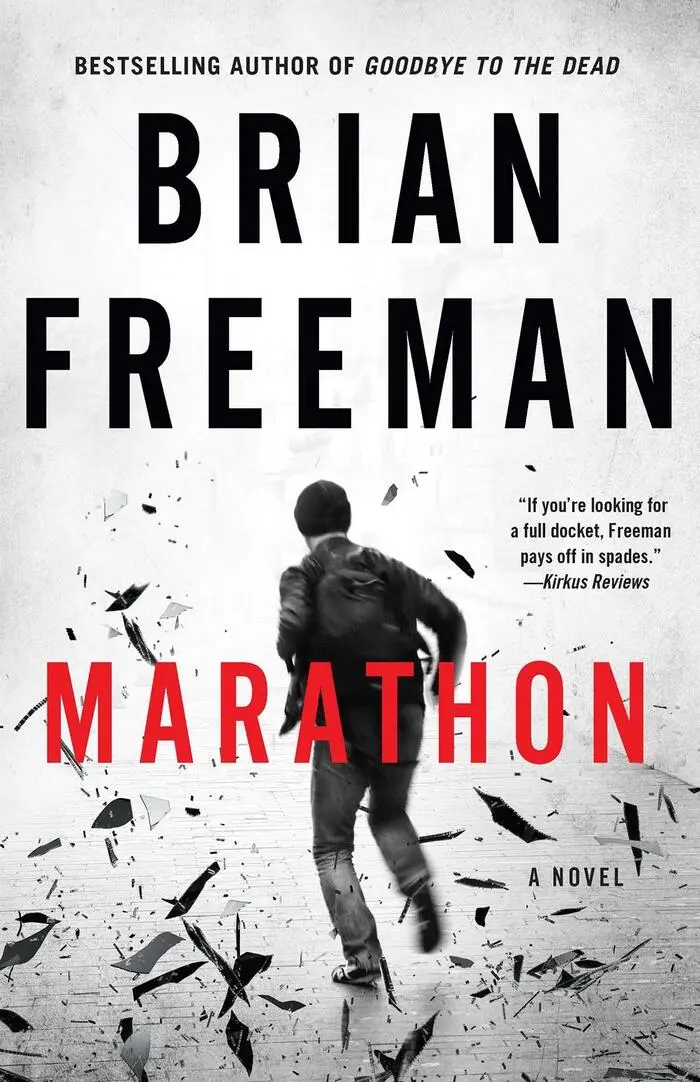
- Название:Marathon
- Автор:
- Издательство:Quercus
- Жанр:
- Год:2017
- Город:New York
- ISBN:978-1-68144-241-9
- Рейтинг книги:4 / 5. Голосов: 1
-
Избранное:Добавить в избранное
- Отзывы:
-
Ваша оценка:
Marathon: краткое содержание, описание и аннотация
Предлагаем к чтению аннотацию, описание, краткое содержание или предисловие (зависит от того, что написал сам автор книги «Marathon»). Если вы не нашли необходимую информацию о книге — напишите в комментариях, мы постараемся отыскать её.
Within minutes, Jonathan Stride, Serena Dial, and Maggie Bei are at work with the FBI to find the terrorists behind the tragedy. As social media feeds a flood of rumors and misinformation, one spectator remembers being jostled by a young man with a backpack not far from the bomb site. He spots a Muslim man in a tourist’s photo of the event and is convinced that this was the man who bumped into him in the crowd — but now the man’s backpack is missing.
When he tweets the photo to the public, the young man, Khan Rashid, becomes the most wanted man in the city. And the manhunt is on.
But are the answers behind the Duluth bombing more complex than anyone realizes? And can Stride, Serena, and Maggie find the truth before more innocent people are killed?
Marathon — читать онлайн бесплатно полную книгу (весь текст) целиком
Ниже представлен текст книги, разбитый по страницам. Система сохранения места последней прочитанной страницы, позволяет с удобством читать онлайн бесплатно книгу «Marathon», без необходимости каждый раз заново искать на чём Вы остановились. Поставьте закладку, и сможете в любой момент перейти на страницу, на которой закончили чтение.
Интервал:
Закладка:
“Get me the list,” Stride said again. “I’ll make sure we do drive-bys at all the locations throughout the night.”
Haq didn’t answer. He stared at the screen on his phone. His face bloomed with fear.
“What is it?” Stride asked him.
“She just posted another photo,” Haq murmured.
“Where?”
“A gallery in Woodland. The owner is a Muslim artist. She’s a friend of mine. Jonathan, we have to get over there right now.”
“Why?” Stride asked.
Then he read Haq’s face, and he knew the answer already. “That’s where you’re hiding Ahdia and her son.”
30
Ahdia huddled with Pak in a corner of the gallery attic, near the two small windows that looked out on Woodland Avenue. Stifling air gathered in the tiny loft, making them both sweat. The artist, Goleen, did much of her work up here, so the room had a faint chemical smell of paint and turpentine. Her huge, twisted bronzes of Arabic letters, mounted on pedestals, were lined up like a parade against one wall. In the gloomy darkness, the sculptures looked like monsters, and Pak was afraid of them.
When cars passed outside, their headlights lit up a spiderweb on the dusty old windows, which were painted shut and divided into chambers like prison bars. Ahdia could see a large black spider gliding along the web’s sticky surface, laying a trap for the moths and gnats that sought out the light. It made her shiver. Pak was afraid of monsters, but Ahdia was afraid of spiders.
“Where is Papa?” Pak asked in a loud voice.
Ahdia’s eyes shot to the staircase that led to the main floor of the gallery, which was housed in a brick building no larger than an old one-room schoolhouse. She was sure they were alone. Goleen had gone home hours ago. Even so, Haq had said to take no chances of being found out.
She put a finger gently on her son’s lips and smiled at him. “Softly now. We must be very quiet.”
“I miss Papa,” Pak whispered.
“I know. So do I. He will be with us very soon.”
“Will you sing me a song?” the boy asked.
“Oh, Pak, I don’t know—”
“Please,” he urged her. “The song about the crow, okay?”
Ahdia could never say no to him. She rustled his hair and put her lips near his ear and breathed the song to him, barely aloud, in Urdu. It was a fable about a clever, thirsty crow who found water in the base of an urn and added stones until the water rose high enough for him to dip in his beak. She could remember her mother singing the same song to her in a warm, noisy bedroom in Karachi; it was one of her earliest memories.
When she was done, Pak made her sing it again. The music relaxed both of them.
Holding her son always made her feel blessed. He was her everything. She knew physical love for Khan, but the love of a husband and wife made her feel selfish, because it was about her own happiness. Her love for Pak was something that tiptoed into the deepest parts of her soul, and it was not about happiness; it was about fierce, selfless devotion.
“Mama, I’m thirsty,” Pak murmured.
“Like the crow?” she replied, smiling.
“Yes.”
“Shall I look for pebbles to make the water rise?”
Pak giggled.
“Okay, stay here, and I’ll see if there is any water downstairs,” she told him quietly.
“What about the monsters?” he asked, pointing at the sculptures.
“Don’t worry about them. The crow will keep you safe.”
Ahdia crossed the attic floor, which was messy with old drop cloths that bore the remnants of Goleen’s work. She found the wooden stairs in the pitch-blackness, and she took them one at a time, blindly, wincing at the loud creak of every loose floorboard. She reached the gallery, where the air was cooler. Tall, rectangular windows broke up the walls on three sides, letting in light from the street. She saw more sculptures, like those in the attic. Wall hangings as intricate as a kaleidoscope. Hand-painted pottery. Jewelry made from colored beach stones. She wished she had a talent like Goleen, to create something beautiful out of nothing, but her own mind worked like a mathematician’s, full of numbers and computer formulas.
At the back of the gallery was a small office, with a desk, a bathroom, and a half-size refrigerator. Goleen had told her she was welcome to anything in it. Ahdia found two small bottles of water. She drank one herself, realizing she was thirsty from the dry, dusty space and the salty sandwiches Haq had smuggled to them earlier in the day. She clutched the other bottle in her hand as she returned to the gallery.
Through the tall windows, Ahdia saw the twin eyes of headlights, and she felt exposed. A large vehicle pulled into the dirt driveway beside the building, and she heard the crunch of its tires on loose rock. She threw herself to the floor and held her breath. The gallery itself was elevated six feet above street level, so she was higher than the truck that had passed below her. Its lights disappeared into a parking lot in back that was sheltered by trees and led to a small side street near the fringe of Hartley Park. She no longer heard its engine.
Maybe it was gone.
Ahdia flew across the gallery. She took quick steps back up to the attic, not caring about the shrieking of the wood under her feet. With almost no light to guide her, she collided with one of Goleen’s heavy sculptures and caught it just as it fell to the floor. She rested it at her feet, and then she made her way to the far corner where Pak was waiting for her. She sat down and gathered him up in her arms.
“Mama, I’m still thirsty,” he said loudly.
“Shhh. Okay.”
She unscrewed the cap on the bottle and handed it to him. As he drank, the plastic crinkled as the air was sucked away. She tensed, wanting him to finish quickly. When he was done and wiped his mouth, he exhaled with a sigh of satisfaction that seemed to shake the building.
Ahdia took the bottle away. “Be very, very quiet now.”
He opened his mouth to speak, but she shook her head, and he could see in her stern eyes that she was serious. Pak buried his face in her chest. They held on to each other, dead still. The only movement in the room was the black spider, scuttling about the strands of its web, its legs flicking like knitting needles. She had a feeling that the spider was a sign of bad things to come.
Below her, muffled, she heard the shattering of glass.
Moments later, the wooden floor of the gallery groaned. Someone was downstairs.
Travis had parked the van where it couldn’t be seen from the street.
He checked the photo on Twitter, because he didn’t want to make a mistake. When he compared the brick building in front of him to the picture that Dawn Basch had posted, he could see that he was in the right place.
His original plan had been to burn Khan Rashid’s house to the ground. He’d filled up half a dozen gasoline tanks from Wade’s garage by stopping at four different gas stations around the city. He’d headed for the dead-end street where Rashid lived, but when he got there, he found the house watched by two police cruisers. Rather than let himself and his truck be seen, he’d backed away into the side street, made a U-turn, and headed to Woodland Avenue.
He needed a different target. A new focus for his rage and revenge, something that would send a message. He’d found it online. Dawn Basch had tweeted a series of photos with the hashtag ‘radicalduluth,’ and one of the photos showed a Muslim-owned gallery barely two miles away.
Good.
He’d start there.
Travis made sure he was alone as he got out of the van. The night air was damp. He heard frogs in the woods like a deafening chorus. The back door of the brick gallery was immediately in front of him. He had to decide. Stay or go. Fight or run. It had sounded so easy when he was standing in Wade’s garage, but now he was actually here.
Читать дальшеИнтервал:
Закладка:
Похожие книги на «Marathon»
Представляем Вашему вниманию похожие книги на «Marathon» списком для выбора. Мы отобрали схожую по названию и смыслу литературу в надежде предоставить читателям больше вариантов отыскать новые, интересные, ещё непрочитанные произведения.

Обсуждение, отзывы о книге «Marathon» и просто собственные мнения читателей. Оставьте ваши комментарии, напишите, что Вы думаете о произведении, его смысле или главных героях. Укажите что конкретно понравилось, а что нет, и почему Вы так считаете.