Brian Freeman - Marathon
Здесь есть возможность читать онлайн «Brian Freeman - Marathon» весь текст электронной книги совершенно бесплатно (целиком полную версию без сокращений). В некоторых случаях можно слушать аудио, скачать через торрент в формате fb2 и присутствует краткое содержание. Город: New York, Год выпуска: 2017, ISBN: 2017, Издательство: Quercus, Жанр: Детектив, на английском языке. Описание произведения, (предисловие) а так же отзывы посетителей доступны на портале библиотеки ЛибКат.
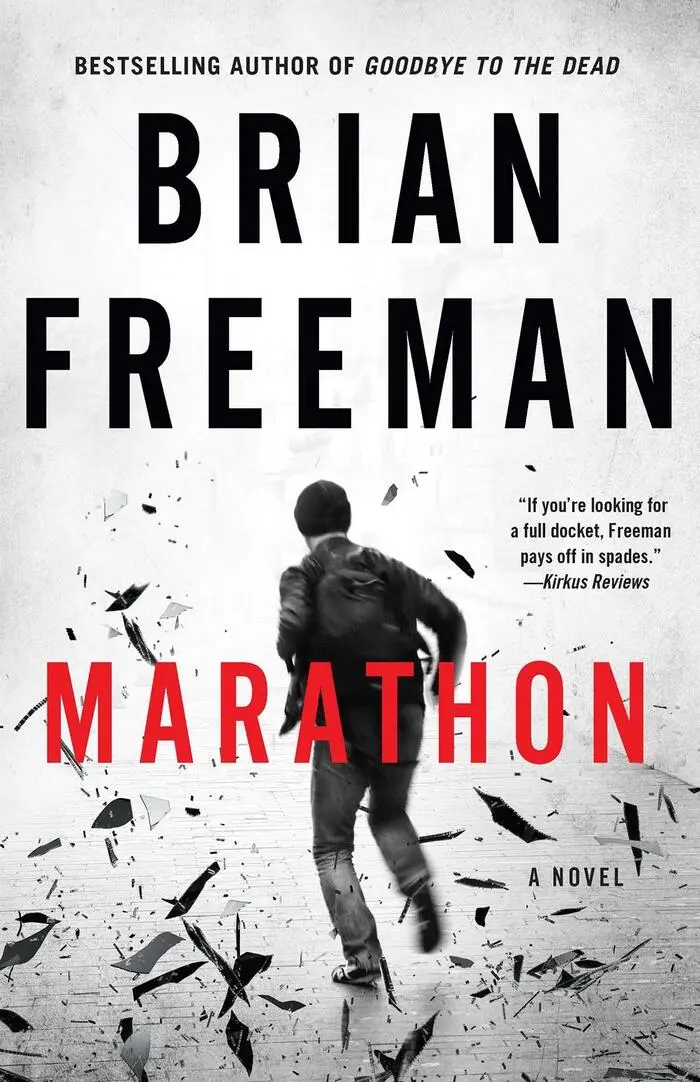
- Название:Marathon
- Автор:
- Издательство:Quercus
- Жанр:
- Год:2017
- Город:New York
- ISBN:978-1-68144-241-9
- Рейтинг книги:4 / 5. Голосов: 1
-
Избранное:Добавить в избранное
- Отзывы:
-
Ваша оценка:
Marathon: краткое содержание, описание и аннотация
Предлагаем к чтению аннотацию, описание, краткое содержание или предисловие (зависит от того, что написал сам автор книги «Marathon»). Если вы не нашли необходимую информацию о книге — напишите в комментариях, мы постараемся отыскать её.
Within minutes, Jonathan Stride, Serena Dial, and Maggie Bei are at work with the FBI to find the terrorists behind the tragedy. As social media feeds a flood of rumors and misinformation, one spectator remembers being jostled by a young man with a backpack not far from the bomb site. He spots a Muslim man in a tourist’s photo of the event and is convinced that this was the man who bumped into him in the crowd — but now the man’s backpack is missing.
When he tweets the photo to the public, the young man, Khan Rashid, becomes the most wanted man in the city. And the manhunt is on.
But are the answers behind the Duluth bombing more complex than anyone realizes? And can Stride, Serena, and Maggie find the truth before more innocent people are killed?
Marathon — читать онлайн бесплатно полную книгу (весь текст) целиком
Ниже представлен текст книги, разбитый по страницам. Система сохранения места последней прочитанной страницы, позволяет с удобством читать онлайн бесплатно книгу «Marathon», без необходимости каждый раз заново искать на чём Вы остановились. Поставьте закладку, и сможете в любой момент перейти на страницу, на которой закончили чтение.
Интервал:
Закладка:
“Yeah, it didn’t take him long,” Maggie agreed.
Ninety seconds sounded right. One and a half minutes. That was how long it had taken to incinerate a mother and son. She understood how Stride felt. There were moments as a cop that made you want to throw it all away.
Maggie thought about the facts they’d already gathered. The fire investigation team had traced the ignition point to the rear of the building. There were ruts in the dirt but not enough to give them tire tracks. The bomber had broken inside, dumped gasoline, set it ablaze, and sped off. If there was forensic evidence in the building, the fire had destroyed most of it.
“What about security cameras up and down Woodland?” she asked.
Guppo shook his head. “Nothing. No help there.”
“Sometimes I think it would be easier to work in a city where Big Brother is always watching.”
“No, thanks,” Guppo said. “I’m staying here.”
Maggie crossed to the gallery, where the smell of smoke remained strong. She’d talked to the owner, a woman named Goleen, who’d been numbed by the death and destruction. Goleen had shown her pictures of her art, none of which had survived the fire. Maggie recognized the woman’s talent, but the geometric designs and Arabic sculptures reminded her that many Muslims lived in a world apart, with a culture she simply didn’t understand. Some walls were hard to climb.
“Mind if I ask you something, Max? Just between you and me?”
“Sure.”
“Do you think Dawn Basch is right? Is there some kind of problem with Islam that causes violence?”
Guppo scratched his comb-over. “Wow. I don’t know. When it happens over and over, you can’t help but think that, right? How could anyone do some of those crazy things without a hole in their heart? The thing is, we live next door to a Somali family who are the sweetest people you’re ever going to meet. There’s nothing wrong with their religion. I think about them whenever I get angry about terrorism.”
“Sometimes I feel like the Muslim world has a few centuries of catching up to do when it comes to civilization,” Maggie said.
“Yeah, well, so does the guy who did this. Look, I blame the leaders, not the followers. You’ve got wannabe Hitlers overseas who spread poison and a cult of deluded young people who swallow it.”
“I suppose you’re right. I know being prejudiced about it just makes it worse. Be honest — do some of the cops around here still have a problem with me being Chinese?”
“If they do, they’re smart enough not to say it to me,” Guppo replied.
Maggie smiled. No matter how much of the dark side Guppo saw of the world, he retained a sunny outlook on life. He had a wife. He had his daughters. He had a house and a pontoon boat. As far as Guppo was concerned, he couldn’t be more blessed. Maggie wished she could segment her life into good and bad the way he did, but, like Stride, she sometimes carried the dark side home with her.
“So we have no witnesses, no cameras, and no evidence,” she said.
“Right.”
“And the suspect pool is everyone on Twitter.”
“Right.”
Maggie clucked her tongue in frustration. There had to be a way to narrow it down. Somewhere, somehow, this guy had left them a clue. Standing on the sidewalk, she caught a whiff of gasoline rising from the ashes, and that gave her an idea. “Hey, how much gas did the fire guys think the perp used?”
“Hard to be exact, but several gallons,” Guppo said. “Maybe ten or more.”
“Most people don’t have that much gas hanging around their garage,” she said.
“Probably not. What are you thinking?”
“I’m thinking the gallery bombing feels spontaneous, right? Nobody decided to do this days or weeks ago. They came up with the plan after the marathon and probably after Khan Rashid hit the news and Basch tweeted her Muslim-owned hit list.”
“Agreed,” Guppo said.
“Okay, so odds are this guy bought a lot of gasoline recently.”
Guppo saw immediately what she had in mind. “If he was at a gas station, he was on camera. I’ll get some uniforms to start gathering up video feeds from every station within five miles of here. We can start working our way backward in the hours before the fire.”
“Exactly,” Maggie said. “If we’re lucky, we’ll spot somebody filling up a bunch of gas cans.”
Cat stared through the woods at the ruined Nopeming Sanatorium. The day was quiet around her except for a chorus of birdsong. Rain spat in her face from gray clouds.
She’d been here many times. Never legally. One of Curt’s crazy parties had been held here in the dead of a winter night, until the police broke it up. Street people and urban explorers found abandoned buildings irresistible, and Nopeming was notorious. A reality television show about ghost investigators had featured the site on one of their episodes, and ever since, the owners had struggled to keep out trespassers who wanted to sneak inside to prove their courage.
A homeless Ojibwe man had told Cat that Nopeming meant “out in the woods.” The facility dated back to the early part of the last century, when it had served as a place for tuberculosis patients to live and die. Years later, it became a nursing home, and then it fell into disrepair, too expensive to tear down, too expensive to rebuild. The owners had dreams of turning it into a charter school, but for now, it was the haunted house of the Northland, hidden behind a fenced road and locked gate.
Cat didn’t want to get caught. She’d parked on the frontage road and hiked up the long driveway and then ducked into the woods when the building came into view. She saw no sign of the caretaker today. If a truck was parked outside, you knew to stay away. From the outside, the four-story yellow brick building looked like a sprawling old hotel, and it was only when you looked closely that you could see the broken windows and torn curtains flapping in the breeze.
Cat ran across the wet lawn. She knew how to get in. Several of the upper-floor windows were open to equalize the indoor and outdoor temperatures and prevent mold. She found a birch tree leaning toward the building and scrambled up the trunk into the thick of the branches. One branch, just sturdy enough to support her weight, faced an open window, and she scooted along it until the branch bent down and ushered her onto the sill. She slipped nimbly inside one of the old sanatorium bedrooms.
Plaster dust littered the floor, and electrical wires hung from missing ceiling tiles. Remnants of a tattered sheer, flimsy curtain danced in the wind, sagging on a broken rod. Rainwater puddled under her feet. It was a small, warm room, and it creeped her out to think of the many people who had occupied the beds here, dying slowly and horribly.
She made her way to a corridor that stretched the length of the building. Up and down the walls, paint peeled, looking like the white wings of hundreds of gulls. The hallway was a mix of sun and shadow, filled with a minefield of debris. The wooden banisters were covered in dust. It felt humid.
Cat listened but heard no signs of life.
She peered into each empty room as she walked, passing through open fire doors from one end of the building to the other. No one was inside. When she found a stairwell, she climbed to the next floor, crunching dried paint shards with each step.
Upstairs, she called softly, “Eagle?”
And then again: “Eagle? It’s Cat.”
No one answered, but she squelched a scream as something moved in the ceiling immediately above her. She looked up into a hole where several ceiling tiles were missing, and the bandit face of a raccoon stared back at her. It was huge, hunched up on its back legs, and not scared of her at all. Cat backed away from the animal, turned, and ran. The floor was wet, and she slipped and fell, and a cloud of dust blew into her eyes. Her jeans tore, and something sharp scraped her knee. Getting up, limping, she blinked and wiped her face with one arm. When she could see again, she found herself staring into one of the bedrooms.
Читать дальшеИнтервал:
Закладка:
Похожие книги на «Marathon»
Представляем Вашему вниманию похожие книги на «Marathon» списком для выбора. Мы отобрали схожую по названию и смыслу литературу в надежде предоставить читателям больше вариантов отыскать новые, интересные, ещё непрочитанные произведения.





Обсуждение, отзывы о книге «Marathon» и просто собственные мнения читателей. Оставьте ваши комментарии, напишите, что Вы думаете о произведении, его смысле или главных героях. Укажите что конкретно понравилось, а что нет, и почему Вы так считаете.