Махи Бинбин - Marrakech Noir
Здесь есть возможность читать онлайн «Махи Бинбин - Marrakech Noir» весь текст электронной книги совершенно бесплатно (целиком полную версию без сокращений). В некоторых случаях можно слушать аудио, скачать через торрент в формате fb2 и присутствует краткое содержание. Город: New York, Год выпуска: 2018, ISBN: 2018, Издательство: Akashic Books, Жанр: Детектив, на английском языке. Описание произведения, (предисловие) а так же отзывы посетителей доступны на портале библиотеки ЛибКат.
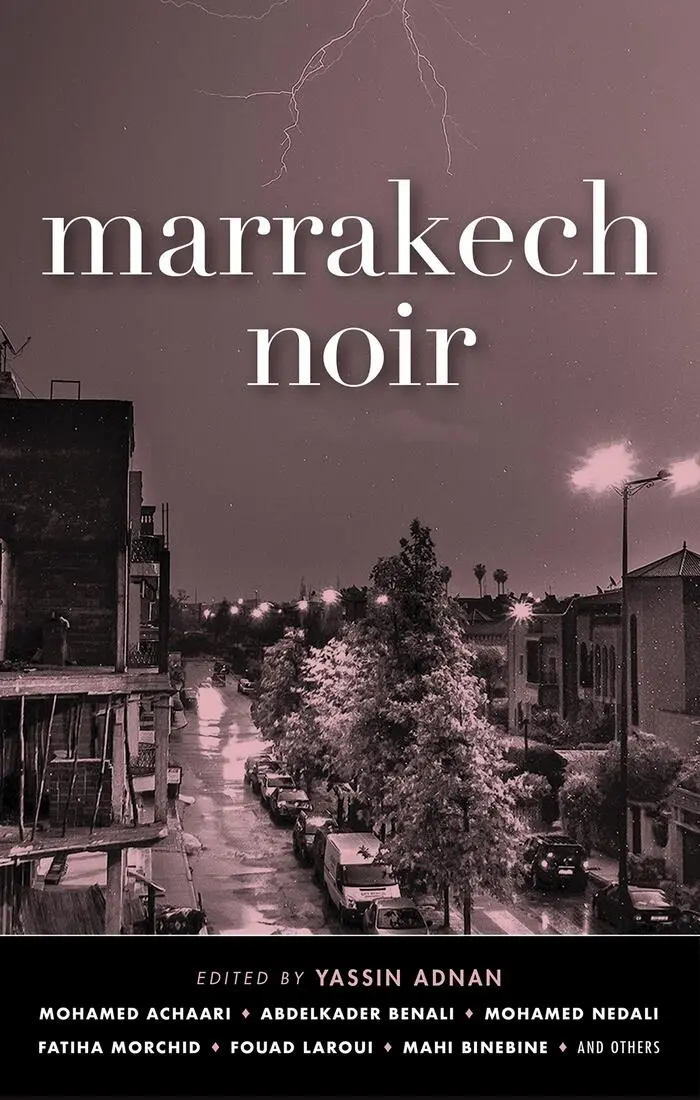
- Название:Marrakech Noir
- Автор:
- Издательство:Akashic Books
- Жанр:
- Год:2018
- Город:New York
- ISBN:978-1-61775-473-9
- Рейтинг книги:5 / 5. Голосов: 1
-
Избранное:Добавить в избранное
- Отзывы:
-
Ваша оценка:
Marrakech Noir: краткое содержание, описание и аннотация
Предлагаем к чтению аннотацию, описание, краткое содержание или предисловие (зависит от того, что написал сам автор книги «Marrakech Noir»). Если вы не нашли необходимую информацию о книге — напишите в комментариях, мы постараемся отыскать её.
Marrakech Noir — читать онлайн бесплатно полную книгу (весь текст) целиком
Ниже представлен текст книги, разбитый по страницам. Система сохранения места последней прочитанной страницы, позволяет с удобством читать онлайн бесплатно книгу «Marrakech Noir», без необходимости каждый раз заново искать на чём Вы остановились. Поставьте закладку, и сможете в любой момент перейти на страницу, на которой закончили чтение.
Интервал:
Закладка:
When viewed through the prism of the new museum permitting the pasha to return gracefully to the city, in the form of a new artistic foundation that would once again place him on the throne in Marrakech, then the entire project became an aggressive attack on the country’s symbolic security.
When Patti heard these astute observations from the engineer, she had a sudden panic attack. She envisioned the very thing that had happened to Anais happening to her as well. But al-Sharqawi soon arrived to calm her with his daily stock of stories about the city, about the film stars staying at the Mamounia, about the pasha’s restaurant and dance hall, an international chain which obviously had no connection with their particular pasha, and about riads in the Old Medina.
“Do you love the pasha?” Patti asked al-Sharqawi as he was about to leave.
“It’s you that I love,” he replied sincerely, with a sparkle in his eye.
She guffawed loudly, and that encouraged him to go on: “You’re more remarkable than all the pashas in the world!”
Patti said she knew nothing about the pasha. She had received a number of books about him from the engineer, but had not opened even one of them. Ever since the very first time she had glimpsed him in the newspaper, she had always regarded him as a dream beyond reach.
Al-Sharqawi liked toying with this idea in particular, claiming that the pasha would emerge and visit people in their dreams. Getting out of bed, people would wander around the city’s alleyways until they passed by his silent palace. They would come to realize that he was no longer to be found, since he had died in the midfifties; all that remained was the terror that could bend people’s backs, and laughter that could make people cry.
“The pasha used to live for the love of women,” al-Sharqawi remarked. “Everything else was a swamp of illusions. He had two wives from Turkey: one was from the Atlas Mountains in Morocco, and the other was the daughter of al-Maqqari, the Ottoman grand vizier. When his brother died, he already had ninety-six women in his harem, and he simply added another twenty-four that he expropriated from his brother’s harem.
“He had his own hunters in Paris, Tangier, and Marrakech,” al-Sharqawi continued, “who would supply his bed with beautiful female tourists and other companions. He used to give them valuable jewels and rolls of silk. In addition to all this, he had European lovers, among them the wives of prominent diplomats who would spend days and nights in his palace. The diplomats all knew, but they received the most incredible gifts in recompense. There were so many births, both known and unknown, that hardly a day went by without a baby being seen who looked just like him. Both the elite and general populace thought the pasha was a father to enough children to fill an entire city. In every case, people looked at the child’s features and saw the pasha’s likeness. So, my dear lady, this is the man you dreamed of marrying. Had you done so, today you would be the most miserable woman in the entire world.”
“But I still have the dream, even though I didn’t win the pasha’s heart!” Patti said with a laugh.
Not even a week went by after the discovery of the remains before amazing things started to happen across town. They all emerged from stories told by al-Sharqawi. He insisted that they were fresh and came from sources whose veracity could not be doubted.
The story of the savage beating with no known assailant had now extended, and had claimed some new victims among the archaeologists and local authorities. Then the mummy escaped, and people started to see the dead corpse roaming the pasha’s palace, still wrapped in its shroud, by Bab Doukkala. The mummy vanished for a while then reappeared by the Telouet Kasbah. One of the restoration workers saw it playing golf without a club or ball at the course where dirt and dead trees were piled up. Patti and al-Sharqawi saw it in the Jacuzzi, warming its decrepit bones. Each time the rumors initially amazed people, but before long, popular enthusiasm elevated them to a level of unadulterated truth.
As part of this general fever, al-Sharqawi grew moody and unpredictable, slamming doors at the Mamounia Hotel right in the face of visiting tourists, especially after people demanded to hear some of his amazing stories. These feelings grew more pronounced when Marrakech started preparing for the crowning of Jemaa el-Fnaa as a World Heritage Site. For many years, that square had been his square. As night fell, he would establish his circle of listeners, and they would grow and grow till they became a swarm of bees buzzing around his tales. At night’s end, he would send them all away. But what happened had happened, and he was no longer who he had been, and neither was the square itself.
He used to recite from The Thousand and One Nights , from the sagas of Abu Zayd al-Hilali, Antarah Ibn Shaddad, and Sayf Ibn Dhi-Yazan; about the tales of the jinn, sorcerers, and also pious men of God. Then, a nasty worm made its way into his little mind and urged him to start including contemporary tales into his evening sessions. He discovered that the pasha was a very dynamic subject, one that the people of Marrakech listened to carefully. They were secret stories that had never seen the light of day:
The pasha, alone at night in his palace, walking around his bed, using sweeping arm gestures to dispel the sounds of legions of people fleeing his fighters as they advanced in the High Atlas, while being fired at by a 77mm Krupp gun, the only one of its kind in the entire kingdom — the one that Hasan the First had given to al-Madani al-Klawi, so that he could exert complete control over the south, as far as the edges of the Sahara.
Then there’s the pasha, left on his own and scared out of his wits in his dark room, as he goes through his daily ritual of experiencing visions of precisely the same kind of terror that people felt when thinking about his own tyrannical behavior. There would be a grisly hour of panic, weeping, and groveling as he imagined his brother al-Madani coming through a crack in the door, even though he was dead, and yelling at him: “You’re no use to anyone! France is stronger than you are and so is the tribe! The only thing bigger than you is what’s between your legs!”
The pasha would listen, as his brother spoke to the French general: “It’s just a dagger. I’ll stab him and then put it back in its scabbard.”
The pasha would prostrate himself at al-Madani’s feet and beg him to let him have just a little bit of his cunning, so he could feel something other than raw fear.
The pasha used to dress the Syrian lute player in ten jewels, one for each toe. He would ask her to dance on his chest like Samia Gamal, as though she were dancing in a demon’s palm.
The pasha frothed at the mouth in rage because the caid, Hmmu, would put on a big show of opposing the French while he was actually biding his time, never missing an opportunity to show his contempt for the pasha as an agent of colonialism.
The pasha had dreams of liberating the Telouet Kasbah from the clutches of his brother and nasty brother-in-law who stuck in his craw.
The pasha’s enormous harem consisted of Egyptian and Syrian dancers, Turkish lute players, and Chinese masseuses.
Then the pasha was involved in a parade that he’d organized to welcome Theodore Staigh, Lyautey’s deputy, with the aim of providing proof that the deputy’s predecessors had been right about the pasha, and also to convince the people that the presence of France in this difficult country was something to which he was personally committed, no matter the cost. Up to that point, it had already cost France fifteen thousand deaths, while the number of Moroccan souls lost was 400,000.
Читать дальшеИнтервал:
Закладка:
Похожие книги на «Marrakech Noir»
Представляем Вашему вниманию похожие книги на «Marrakech Noir» списком для выбора. Мы отобрали схожую по названию и смыслу литературу в надежде предоставить читателям больше вариантов отыскать новые, интересные, ещё непрочитанные произведения.





Обсуждение, отзывы о книге «Marrakech Noir» и просто собственные мнения читателей. Оставьте ваши комментарии, напишите, что Вы думаете о произведении, его смысле или главных героях. Укажите что конкретно понравилось, а что нет, и почему Вы так считаете.