Elizabeth George - Just One Evil Act
Здесь есть возможность читать онлайн «Elizabeth George - Just One Evil Act» весь текст электронной книги совершенно бесплатно (целиком полную версию без сокращений). В некоторых случаях можно слушать аудио, скачать через торрент в формате fb2 и присутствует краткое содержание. Год выпуска: 2013, ISBN: 2013, Издательство: Dutton, Жанр: Детектив, на английском языке. Описание произведения, (предисловие) а так же отзывы посетителей доступны на портале библиотеки ЛибКат.
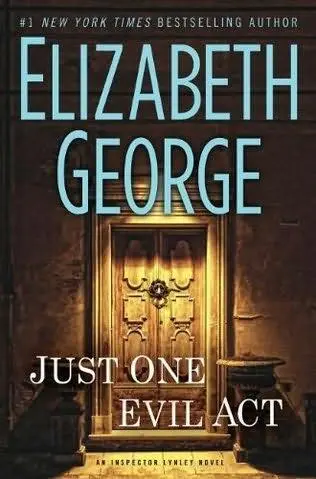
- Название:Just One Evil Act
- Автор:
- Издательство:Dutton
- Жанр:
- Год:2013
- ISBN:978-0-698-13828-5
- Рейтинг книги:5 / 5. Голосов: 1
-
Избранное:Добавить в избранное
- Отзывы:
-
Ваша оценка:
Just One Evil Act: краткое содержание, описание и аннотация
Предлагаем к чтению аннотацию, описание, краткое содержание или предисловие (зависит от того, что написал сам автор книги «Just One Evil Act»). Если вы не нашли необходимую информацию о книге — напишите в комментариях, мы постараемся отыскать её.
bestselling author Elizabeth George offers the latest in her Inspector Lynley series: a gripping child-in-danger story featuring fan favorite Barbara Havers. Detective Sergeant Barbara Havers is at a loss: The daughter of her friend Taymullah Azhar has been taken by her mother, and Barbara can't really help—Azhar had never married Angelina, and his name isn't on Hadiyyah's, their daughter's, birth certificate. He has no legal claim. Azhar and Barbara hire a private detective, but the trail goes cold.
Azhar is just beginning to accept his soul-crushing loss when Angelina reappears with shocking news: Hadiyyah is missing, kidnapped from an Italian marketplace. The Italian police are investigating, and the Yard won't get involved, until Barbara takes matters into her own hands. As she attempts to navigate the complicated waters of doing anything for the case against her superior's orders, her partner, Inspector Thomas Lynley, is dispatched to Italy as the liaison between the Italian police and Hadiyyah's distraught parents.
In time, both Barbara and Lynley discover that the case is far more complex than just a kidnapping, revealing secrets about Angelina; her new lover, Lorenzo; and even Azhar—secrets Barbara may not be willing to accept. With both her job and the life of a little girl on the line, Barbara must decide what matters most and how far she's willing to go to protect it.
Just One Evil Act — читать онлайн бесплатно полную книгу (весь текст) целиком
Ниже представлен текст книги, разбитый по страницам. Система сохранения места последней прочитанной страницы, позволяет с удобством читать онлайн бесплатно книгу «Just One Evil Act», без необходимости каждый раз заново искать на чём Вы остановились. Поставьте закладку, и сможете в любой момент перейти на страницу, на которой закончили чтение.
Интервал:
Закладка:
“ Sì? ” Salvatore sipped the coffee. He leaned against the counter and waited for more. It was soon in coming, and it made the coffee turn to bile in his mouth.
A man was leading a child away from the car and into the woods, the officer said. Signor Germano saw them and assumed that it was a father leading his child to relieve herself out of sight of the road.
“Why did he assume it was a father and child? Is he sure the child was female?” Salvatore asked.
Truth be told, Signor Germano wasn’t completely sure about the sex of the child, but he thinks it was a little girl. And he assumed it was a father and child because . . . well, what else would it have been? Why would anyone assume anything else but an innocent drive in the hills on a sunny afternoon, interrupted momentarily by a child’s need to squat in the bushes out of sight?
“This Signor Germano,” Salvatore asked, “is he certain about the sighting?”
He was indeed because he visited his mamma on a regular schedule.
“And he takes the same route every time?”
Sì, sì, sì. The route is in the Apuan Alps, and it’s the only road to get to his mamma’s village.
It was too much to hope for that Signor Germano would remember in which lay-by the red car had been parked, and he did not remember. But since he’d been on his way to his mamma’s village, the lay-by was, naturally, somewhere along the mountain road in advance of that place.
Salvatore nodded. This was progress indeed. It could be nothing at all, but he had a feeling this was not so. He dispatched two officers to fetch Signor Germano and to drive him into the Apuan Alps on the route to his mamma’s village. If his memory was jogged as to the correct lay-by, excellent. If his memory failed him, then every lay-by would have to be checked. For the point was not the lay-by itself but the shrubbery beyond it, as well as the woods and any trail leading into the woods. Salvatore didn’t want to think that the child might have been disposed of in the Alps, but every day that passed without word about a ransom and without finding her alive made that possibility ever more likely.
His order to the officers was to hold close this information about the red car in the Alps. The only people to be told would be the parents, he said. And they would be told only that a possible sighting was being looked into as there was no need to cause them further distress about a man leading a child into the woods until the police knew if this was, indeed, a relevant piece to the puzzle. Meantime, he said, he wanted an officer looking into all the car hire agencies from Pisa to Lucca. If a red convertible had been hired by someone, he wanted to know who, he wanted to know when, and he wanted to know for how long. And not a word about any of this, chiaro ? he said. The last thing he wanted was Fanucci getting hold of the information and leaking it to the press.
PISA
TUSCANY
Salvatore decided that it was time to have a word with Michelangelo Di Massimo. He also decided that the presence of New Scotland Yard, in addition to his own presence, might go some distance towards rattling the man. Since he’d been in Lucca looking for Angelina Upman and her daughter, he was the best lead they had. While it was true that he rode a motorcycle—a powerful Ducati, according to the records that Salvatore had dipped into—there was nothing to stop him from borrowing a vehicle from another, nor was there anything to stop him from hiring one for a single day to take him first into Lucca and then into the Apuan Alps.
He rang DI Lynley and then fetched him at Porta di Borgo, one of the surviving gates of the internal, older walls that had once encircled the town. The London man had walked the short distance from the anfiteatro . He was waiting just outside the arch, flipping through the pages of Prima Voce. He slid into the passenger’s seat and said in his careful Italian, “The tabloids are choosing your drug addict, it seems.”
Salvatore chuckled. “They must choose someone. It is their way.”
“Or, if they don’t have a suspect, they go after the police, yes?” Lynley said.
Salvatore glanced in his direction and smiled. “They will do what they will do,” he said.
“May I ask: Is someone leaking to the papers?”
“ Come un rubinetto che perde acqua ,” Salvatore told him. “But this faucet’s dripping has them well occupied. Their concentration on Carlo keeps them away from what we’re doing and what we know.”
“What’s made you decide to talk to him now?” Lynley asked, in reference to Michelangelo Di Massimo.
Salvatore made the turn that would take them to Piazza Santa Maria del Borgo. It was crowded here, as usual, a combination of parcheggio for tour buses and milling tourist groups trying to orient themselves in the town as the bright sunlight fell upon their shoulders. At the piazza’s north side, Porta Santa Maria gave Salvatore access to the viale that encircled the town. They would take this roadway to navigate quickly round the wall and glide over to the autostrada .
He told Lynley about the reported sighting in the Apuan Alps: a red convertible, a child, a man, their heading into the woods together. Lynley said astutely, “And this man . . . was he blond?”
Salvatore said, “This we do not know from the sighting.”
“But it would seem . . .” Lynley looked doubtful. “With someone looking as Di Massimo looks, that would have been noticed certainly?”
“Who knows what will be remembered from one moment to the next, eh, Ispettore ?” Salvatore said. “You may be right and our journey to Pisa may be for nothing, but the facts remain: He was looking for them in Lucca and he plays football for Pisa, so we have a possible connection between him and Mura. If that means something, it is time we learned what. I have a feeling about this Di Massimo.”
He didn’t tell the London man the rest of what he knew about Di Massimo just then. But there were reasons beyond the man’s ridiculous blond hair that Salvatore knew who the Pisan was.
Michelangelo Di Massimo had an office along the river in Pisa, walking distance from Campo dei Miracoli as well as from the university. There were people who found this section of the city reminiscent of Venice, but Salvatore had never been able to see it. The only things Venice and this part of Pisa had in common were water and ancient palazzi . In Pisa, the first was sluggish and unclean, and the second were uninspiring. No one, he thought, would be writing poetry about Pisa’s riverside anytime soon.
When they reached the building that held Di Massimo’s home and office—which were one and the same—there was no answer when Salvatore rang the bell. But at the tobacconist two doors away, they discovered that the Pisan was having his regular hair appointment. They would find him, they were told, in an establishment called Desiderio Dorato, not far from the university. It was a name that Di Massimo had obviously taken straight into his heart.
The man himself was enthroned within the place, enshrouded in a black plastic cape from shoulders to feet. His head was covered with whatever substance turned his hair from capelli castagni to the promised dorati . When they came upon him, he was deeply involved in reading a novel, a book whose traditional yellow cover announced it as a crime story.
Salvatore took it out of his hands as preamble to their discussion. “Michelangelo,” he said pleasantly, “are you getting some pointers, my friend?” He felt, rather than saw, Thomas Lynley glance curiously in his direction. It was time, he decided, to tell the London man exactly who Di Massimo was.
He did it by way of introduction, emphasising Lynley’s position at New Scotland Yard and revealing in a friendly fashion the London detective’s purpose in coming to Italy. No doubt, he said, Michelangelo had heard of the missing child from Lucca, non è vero ? He couldn’t imagine a private investigator of Di Massimo’s stature to be uninterested in a case such as this one since, above everything else that made it intriguing, the man who stood in place of the missing child’s father was, like Di Massimo, a player of football.
Читать дальшеИнтервал:
Закладка:
Похожие книги на «Just One Evil Act»
Представляем Вашему вниманию похожие книги на «Just One Evil Act» списком для выбора. Мы отобрали схожую по названию и смыслу литературу в надежде предоставить читателям больше вариантов отыскать новые, интересные, ещё непрочитанные произведения.










Обсуждение, отзывы о книге «Just One Evil Act» и просто собственные мнения читателей. Оставьте ваши комментарии, напишите, что Вы думаете о произведении, его смысле или главных героях. Укажите что конкретно понравилось, а что нет, и почему Вы так считаете.