Elizabeth George - Just One Evil Act
Здесь есть возможность читать онлайн «Elizabeth George - Just One Evil Act» весь текст электронной книги совершенно бесплатно (целиком полную версию без сокращений). В некоторых случаях можно слушать аудио, скачать через торрент в формате fb2 и присутствует краткое содержание. Год выпуска: 2013, ISBN: 2013, Издательство: Dutton, Жанр: Детектив, на английском языке. Описание произведения, (предисловие) а так же отзывы посетителей доступны на портале библиотеки ЛибКат.
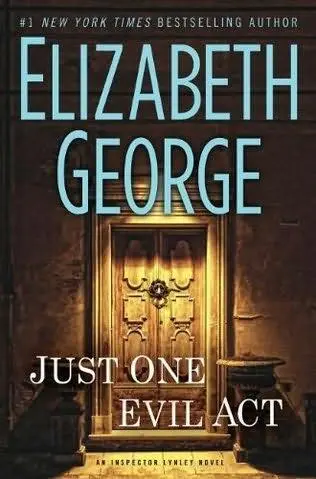
- Название:Just One Evil Act
- Автор:
- Издательство:Dutton
- Жанр:
- Год:2013
- ISBN:978-0-698-13828-5
- Рейтинг книги:5 / 5. Голосов: 1
-
Избранное:Добавить в избранное
- Отзывы:
-
Ваша оценка:
Just One Evil Act: краткое содержание, описание и аннотация
Предлагаем к чтению аннотацию, описание, краткое содержание или предисловие (зависит от того, что написал сам автор книги «Just One Evil Act»). Если вы не нашли необходимую информацию о книге — напишите в комментариях, мы постараемся отыскать её.
bestselling author Elizabeth George offers the latest in her Inspector Lynley series: a gripping child-in-danger story featuring fan favorite Barbara Havers. Detective Sergeant Barbara Havers is at a loss: The daughter of her friend Taymullah Azhar has been taken by her mother, and Barbara can't really help—Azhar had never married Angelina, and his name isn't on Hadiyyah's, their daughter's, birth certificate. He has no legal claim. Azhar and Barbara hire a private detective, but the trail goes cold.
Azhar is just beginning to accept his soul-crushing loss when Angelina reappears with shocking news: Hadiyyah is missing, kidnapped from an Italian marketplace. The Italian police are investigating, and the Yard won't get involved, until Barbara takes matters into her own hands. As she attempts to navigate the complicated waters of doing anything for the case against her superior's orders, her partner, Inspector Thomas Lynley, is dispatched to Italy as the liaison between the Italian police and Hadiyyah's distraught parents.
In time, both Barbara and Lynley discover that the case is far more complex than just a kidnapping, revealing secrets about Angelina; her new lover, Lorenzo; and even Azhar—secrets Barbara may not be willing to accept. With both her job and the life of a little girl on the line, Barbara must decide what matters most and how far she's willing to go to protect it.
Just One Evil Act — читать онлайн бесплатно полную книгу (весь текст) целиком
Ниже представлен текст книги, разбитый по страницам. Система сохранения места последней прочитанной страницы, позволяет с удобством читать онлайн бесплатно книгу «Just One Evil Act», без необходимости каждый раз заново искать на чём Вы остановились. Поставьте закладку, и сможете в любой момент перейти на страницу, на которой закончили чтение.
Интервал:
Закладка:
The we got him as she’d hope it might. The we meant more was in the offing. The we meant there was a chance for The Source to lead a charge against the Met, and both of them knew that when it came to news, leading charges against the Met was a close second to having a salacious scoop on a Member of Parliament or a picture of an inebriated naked prince clutching at the crown jewels as someone snapped away with a mobile’s camera.
But still he was cautious, Mitchell Corsico. Caution in moments like these had got him where he was today, with a page-one by-line two or three times each week and every other tabloid in the country willing to offer him six figures to start digging up dirt. So he said, careful to sound noncommittal, “Why’s no other paper got this tale, then?”
“Because none of them have the whole story, Mitch.”
“Sordid, is it?” He meant sordid enough , of course.
“Oh, I think it’s right up your alley,” she told him.
21 April
VICTORIA
LONDON
Dorothea Harriman was the one who gave the word that Detective Superintendent Ardery had been called over to Tower Block. Sent for was the actual term she used. When Barbara heard this from the departmental secretary as she herself was depositing coins into one of the vending machines to score a Fanta, she knew that the assistant commissioner was the likeliest person to have given the order for Ardery to make haste to Tower Block. This probably wasn’t good for the super, but Barbara was no mourner for that news. If she was condemned to continue working with DI Stewart as a bloody typist till Ardery saw fit to assign her elsewhere, then whatever Ardery had to suffer was fine by her.
It didn’t occur to Barbara that Sir David Hillier’s request for the detective superintendent might have to do with her and her machinations on the Mitchell Corsico front. She’d been ringing Corsico practically hourly since their meeting at Postman’s Park, and as far as she’d been able to gather, “working on it” was the extent to which he’d gone.
She was at the point of gnashing her teeth with impatience to see something happen. She had heard only single words from Azhar since he’d left with Angelina and her lover. But it was always the same word, “Nothing,” and the sound of his voice was like a lump of ice in her throat, freezing off words of comfort that she might have said to him.
That something was about to happen became clear the moment Isabelle Ardery returned from Tower Block. She barked, “ Sergeant Havers, into my office at once,” and added, “Inspector Lynley, you as well,” in a voice only slightly less hostile. Murmurs rose from the rest of the officers bent to various tasks. Only DI Stewart looked pleased. Any dressing-down that was delivered to Barbara Havers had always been fine with him.
Barbara shot Lynley a what’s-going-on look. He shook his head in an I-don’t-know. He led the way to Ardery’s office and stepped aside to let Barbara enter first. He did the honours with the door at Ardery’s request.
The superintendent had thrown something on her desk. That something was a tabloid. That tabloid was The Source . The day of reckoning for the Met had arrived—not bad, Barbara thought, as Mitch had managed it within forty-eight hours—and finally something was going to be done about the matter of a British child’s disappearance in Italy.
Mitch had done a fine job, from what Barbara could see. UK Schoolgirl Kidnap! comprised a three-inch headline, Mitchell Corsico comprised the by-line, and a photograph of Hadiyyah looking utterly winsome took up half the page. There was an inset of an aerial photo as well. Top of a huge wall, a paroxysm of European cobbled streets, the tops of market stalls, masses of people . . . The hold-up in the story, Barbara reckoned, had had to do with getting a decent shot of the place from which Hadiyyah had disappeared. She angled closer to see if the story made a jump from page one and, if so, where. Page three! She wanted to crow when she saw it. This signalled to one and all that the story was going to have significant legs. Those legs would have feet, those feet would be in metal-toed Doc Martens, and those Doc Martens would be stamping all over the Met from now till the kidnapping of Hadiyyah Khalidah was resolved. Hillier would have known that the moment the press office got the tabloid to him hot off the metaphorical presses. Which was, naturally, what Isabelle Ardery wished to discuss with Detective Sergeant—“And believe me, I’d kick you down to filing clerk if I could”—Barbara Havers.
She gathered up the tabloid, threw it at Barbara, and told her to regale herself, Inspector Lynley, and Ardery as well with an oral reading of what she’d “clearly been determined to see publicised.”
Barbara said, “Guv, I didn’t—”
“Your jelly-covered fingers are all over this, Sergeant,” Ardery said. “Do not presume to believe that I’m quite so stupid.”
“Guv,” Lynley said, and his tone spoke of an attempt at appeasement.
She said sharply to him, “I want you to hear this as well. You need to be entirely up-to-date and completely in the picture, Thomas.”
Barbara felt her first niggle of discomfort at this. It presaged something she didn’t want to consider. She cooperated with Ardery’s command to read the story aloud. When she reached each significant point—and there were many—Ardery had her stop and repeat it.
So what they all came to learn and hear repeated was that no British police were involved in the search for a missing English child snatched from a market in Lucca, Italy; that no British police had been sent to Tuscany to be of assistance to the Italian coppers; that no British police had been assigned to liaise with the desperate family of the kidnap victim here in the UK or in Italy either. There were hints aplenty as to why this state of affairs was this state of affairs: The girl in question was a mixed-race child; as a result this was not a crime destined to be heavily investigated in either country, where foreigners—particularly those with origins in the Middle East—were looked upon daily with more and more suspicion and equal distaste. Bradford was given as an example of this. So was the condition of the housing estates in “the worst of our inner cities.” Mosques were attacked; women in chadors or headscarves were harassed; young dark-skinned men were chased down and frisked for weapons or bombs . . . Tsk, tsk, tsk, declared the tabloid piously. What was the world coming to?
Corsico had included every possible detail that might juice up the story and produce follow-ups via the sorts of hush-hush phone calls that had long been every tabloid’s bread and butter in London: the father’s position as a professor of microbiology at University College; the maternal grandparents’ upper-middle-class status as denizens of Dulwich; the maternal aunt’s career as an award-winning designer of furniture; the mother’s late-autumn disappearance with the now-missing child into regions heretofore unknown but now suspected to have been Tuscany all along; the unwillingness of all parties to comment upon anything that had occurred. All of this begged for someone with inside information on any person whose name appeared in the story to ring The Source and spill beans of the reputation-ruining kind. This would happen in due course, naturally. It always did.
Assistant Commissioner Hillier had, it seemed, called Isabelle onto his Wilton carpet for a proper caning, and she was bound and determined to pass the joy on to Barbara. The AC had done his homework in advance as well. So what he’d known when Ardery had entered his office was that the story was true from start to finish, with the possible embellishment of the women in chadors. No police from the UK were involved, not even the coppers in north London where the girl’s father apparently lived. Had she, Isabelle, heard from the Camden police at all in this matter? No, of course not. Well, get on it, then. Because the press office wants something to report in the morning and it had better be of the nature of someone’s being assigned to this.
Читать дальшеИнтервал:
Закладка:
Похожие книги на «Just One Evil Act»
Представляем Вашему вниманию похожие книги на «Just One Evil Act» списком для выбора. Мы отобрали схожую по названию и смыслу литературу в надежде предоставить читателям больше вариантов отыскать новые, интересные, ещё непрочитанные произведения.










Обсуждение, отзывы о книге «Just One Evil Act» и просто собственные мнения читателей. Оставьте ваши комментарии, напишите, что Вы думаете о произведении, его смысле или главных героях. Укажите что конкретно понравилось, а что нет, и почему Вы так считаете.