Elizabeth George - Just One Evil Act
Здесь есть возможность читать онлайн «Elizabeth George - Just One Evil Act» весь текст электронной книги совершенно бесплатно (целиком полную версию без сокращений). В некоторых случаях можно слушать аудио, скачать через торрент в формате fb2 и присутствует краткое содержание. Год выпуска: 2013, ISBN: 2013, Издательство: Dutton, Жанр: Детектив, на английском языке. Описание произведения, (предисловие) а так же отзывы посетителей доступны на портале библиотеки ЛибКат.
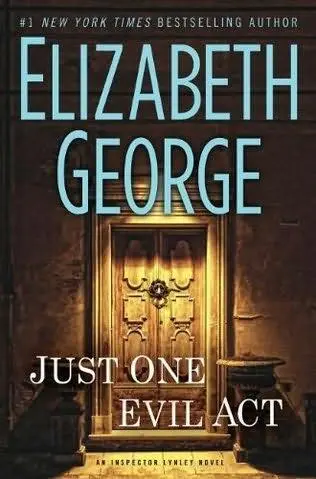
- Название:Just One Evil Act
- Автор:
- Издательство:Dutton
- Жанр:
- Год:2013
- ISBN:978-0-698-13828-5
- Рейтинг книги:5 / 5. Голосов: 1
-
Избранное:Добавить в избранное
- Отзывы:
-
Ваша оценка:
Just One Evil Act: краткое содержание, описание и аннотация
Предлагаем к чтению аннотацию, описание, краткое содержание или предисловие (зависит от того, что написал сам автор книги «Just One Evil Act»). Если вы не нашли необходимую информацию о книге — напишите в комментариях, мы постараемся отыскать её.
bestselling author Elizabeth George offers the latest in her Inspector Lynley series: a gripping child-in-danger story featuring fan favorite Barbara Havers. Detective Sergeant Barbara Havers is at a loss: The daughter of her friend Taymullah Azhar has been taken by her mother, and Barbara can't really help—Azhar had never married Angelina, and his name isn't on Hadiyyah's, their daughter's, birth certificate. He has no legal claim. Azhar and Barbara hire a private detective, but the trail goes cold.
Azhar is just beginning to accept his soul-crushing loss when Angelina reappears with shocking news: Hadiyyah is missing, kidnapped from an Italian marketplace. The Italian police are investigating, and the Yard won't get involved, until Barbara takes matters into her own hands. As she attempts to navigate the complicated waters of doing anything for the case against her superior's orders, her partner, Inspector Thomas Lynley, is dispatched to Italy as the liaison between the Italian police and Hadiyyah's distraught parents.
In time, both Barbara and Lynley discover that the case is far more complex than just a kidnapping, revealing secrets about Angelina; her new lover, Lorenzo; and even Azhar—secrets Barbara may not be willing to accept. With both her job and the life of a little girl on the line, Barbara must decide what matters most and how far she's willing to go to protect it.
Just One Evil Act — читать онлайн бесплатно полную книгу (весь текст) целиком
Ниже представлен текст книги, разбитый по страницам. Система сохранения места последней прочитанной страницы, позволяет с удобством читать онлайн бесплатно книгу «Just One Evil Act», без необходимости каждый раз заново искать на чём Вы остановились. Поставьте закладку, и сможете в любой момент перейти на страницу, на которой закончили чтение.
Интервал:
Закладка:
“ La macchina, la macchina .” This from Lorenzo to Angelina. He opened the car door and bundled her inside. Barbara half expected him to follow her and lock the doors, but he didn’t do so. He seemed to be a bloke who liked to mix things up. He might have had no love for Azhar. But when it came to a street fight? No problema .
Between the Urdu being shouted by the older men and the Italian being shouted by Lorenzo, Barbara had no idea who was accusing whom of what. But the target of the Pakistani men was clearly Azhar, and she didn’t intend him to get hurt. The older men came in swinging their tools. She pushed Azhar out of the way. She yelled, “Police!” at the top of her lungs. This didn’t impress. Lorenzo swung.
She reckoned he was swearing in Italian. He didn’t sound pleasant as he chose his words. He was good with his fists and better with his feet and, farm implements or not, the potential assailants were on the ground before they knew what had hit them. But they didn’t remain there. They threw themselves back into the fray as Sayyid came roaring out of the house. Then an older woman and two other men debouched from the house next door as Sayyid barreled into his father and drove his fist into Azhar’s throat.
Someone screamed. Barbara thought it might have been herself except she had her mobile phone in her hand and was punching in the nines to bring the local rozzers. Clearly, her declaration of identity wasn’t going to stop this lot.
Azhar’s father got to him. He pulled Sayyid off and fell upon him himself. Lorenzo went after the man only to be jumped by the former hoe wielder. The older woman pounced upon Azhar and his father, screaming what sounded to Barbara like a name as she pulled and dragged and did what she could to put an end to things. Barbara did the same to the bloke on Lorenzo. Nafeeza came out of the house and grabbed Sayyid. But three more teenage boys came into the street with cricket bats and two women began to shout imprecations from the pavement on the opposite side.
It took the police to break everything up. Two panda cars and four uniformed constables handled things. It was down to Barbara that no one ended up arrested, although all of them ended up explaining themselves in the local nick. She offered her identification once they got there. She said it was a family dispute. Azhar’s father spat, “He is not family,” but the cops brought in an officer who spoke good Urdu and he gave everyone a chance to say what needed to be said on the matter. The end of it all was time wasted, anguish caused, horrors visited upon everyone, and nothing learned. They rode back to Chalk Farm in near silence.
Azhar didn’t speak. Angelina only wept.
18 April
VICTORIA
LONDON
You’ve gone quite mad” was how Isabelle Ardery dealt with Barbara’s request. She added to this, “Get back to work, Sergeant, and let’s not talk of this again.”
“You know they need a liaison officer” was how Barbara countered her superior officer’s command.
“I know nothing of the sort,” Ardery told her. “And I have no intention of sending you or anyone else barging into a foreign investigation.”
She’d been finishing up with someone on the phone when Barbara had entered her office. Planning an extended celebration, no doubt. The announcement had descended from on high thirty minutes earlier in the person of Assistant Commissioner Sir David Hillier gracing their side of New Scotland Yard’s two tower blocks with his florid-faced presence. He’d imparted upon the assembly of officers the news that Acting had been dropped—permanently—from the Detective Superintendent that until that precise moment had preceded Isabelle Ardery’s name. Kudos all around and let flow the champers. Whatever hoops she’d needed to jump through for the past nine months, Isabelle Ardery had apparently managed to catapult herself through them.
Azhar had left early that morning, accompanying Angelina Upman and Lorenzo Mura to Lucca, Italy. Barbara had been determined to follow hard upon their heels. She had it all worked out—how this would happen—and she had just concluded presenting the matter to the superintendent.
It had seemed perfectly logical to her. A British national had disappeared upon foreign soil. A British national may well have been kidnapped. When a crime such as this occurred, a liaison officer was generally assigned to breach the cultural, linguistic, investigatory, and legal gaps between the two countries involved. Barbara wished to be that officer. She knew the family, and all that was needed was Detective Superintendent Ardery’s okay on the matter, and off she could go.
Ardery didn’t see things that way. She heard Barbara out, taking in the entire subject, beginning with Hadiyyah’s November disappearance in the company of her mother and ending with her current disappearance from a crowded market in Italy. She listened without asking questions other than to clarify names, locations, and relationships, and when Barbara concluded and waited for the logical “of course you must go to Tuscany at once” that she believed would be coming on the verbal wings of a hundred angels, Ardery pointed out what she called “a few salient details that the sergeant had apparently overlooked.”
First among them was the fact that the British embassy was not involved in this matter. No one had rung them or paid a call upon them or sent them a telegram, email, fax, or smoke signal, and without the involvement of the embassy—diplomats pouring oil on potentially troubled waters in advance of the Met’s incursion into someone else’s patch—they did not barge round like bulls among the Belleek attempting an investigation where they were not wanted.
Second, the superintendent pointed out, the purpose of the liaison officer was to liaise, which, as they both knew, meant to keep the family in the UK apprised of everything relative to the investigation that was occurring on foreign soil. But the parents of the child were in Italy, no? Or at least on their way to Italy, according to the sergeant’s own words. Indeed, the mother of the child lived in Italy, no? Somewhere in Lucca? Outside of Lucca? In the vicinity of Lucca? And with an Italian national, yes? So she had no reason to request a liaison officer. Hence, there was no case to present as to the need of sending Detective Sergeant Barbara Havers into Tuscany to be of assistance in whatever was going on.
“What’s going on,” Barbara said, “is the disappearance of a nine-year-old girl. A nine-year-old British girl. No one saw it happen, and whatever it was that happened, it happened in the middle of a market. A crowded market with hundreds of witnesses who apparently saw nothing.”
“As of yet,” Ardery said. “They can’t all have been talked to at this point. How long has the child been gone?”
“What difference does it make?”
“I wouldn’t think I’d need to explain that to you.”
“Bloody hell, you know the first twenty-four hours are crucial. And now it’s been more than forty-eight.”
“And I assure you, the Italian police know that as well.”
“They’re telling Angelina—”
“Sergeant.” Isabelle’s voice had been firm but not unsympathetic despite her words. Now, however, it had an edge. “I’ve told you the facts. You seem to think I have power in this matter when I don’t. When a foreign country—”
“What part of this don’t you bloody understand?” Barbara cut in. “She’s been snatched in public. She might be dead by now.”
“She might well be. And if that’s the case—”
“Listen to yourself!” Barbara shrieked. “This is a kid we’re talking about. A kid I know. And you’re declaring ‘she might well be’ like you’re talking about a cake left too long in the oven. It might well be burnt. The cheese might well be mouldy. The milk might well be sour.”
Читать дальшеИнтервал:
Закладка:
Похожие книги на «Just One Evil Act»
Представляем Вашему вниманию похожие книги на «Just One Evil Act» списком для выбора. Мы отобрали схожую по названию и смыслу литературу в надежде предоставить читателям больше вариантов отыскать новые, интересные, ещё непрочитанные произведения.











Обсуждение, отзывы о книге «Just One Evil Act» и просто собственные мнения читателей. Оставьте ваши комментарии, напишите, что Вы думаете о произведении, его смысле или главных героях. Укажите что конкретно понравилось, а что нет, и почему Вы так считаете.