Elizabeth George - Just One Evil Act
Здесь есть возможность читать онлайн «Elizabeth George - Just One Evil Act» весь текст электронной книги совершенно бесплатно (целиком полную версию без сокращений). В некоторых случаях можно слушать аудио, скачать через торрент в формате fb2 и присутствует краткое содержание. Год выпуска: 2013, ISBN: 2013, Издательство: Dutton, Жанр: Детектив, на английском языке. Описание произведения, (предисловие) а так же отзывы посетителей доступны на портале библиотеки ЛибКат.
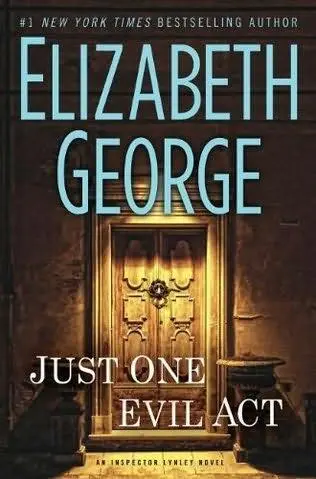
- Название:Just One Evil Act
- Автор:
- Издательство:Dutton
- Жанр:
- Год:2013
- ISBN:978-0-698-13828-5
- Рейтинг книги:5 / 5. Голосов: 1
-
Избранное:Добавить в избранное
- Отзывы:
-
Ваша оценка:
Just One Evil Act: краткое содержание, описание и аннотация
Предлагаем к чтению аннотацию, описание, краткое содержание или предисловие (зависит от того, что написал сам автор книги «Just One Evil Act»). Если вы не нашли необходимую информацию о книге — напишите в комментариях, мы постараемся отыскать её.
bestselling author Elizabeth George offers the latest in her Inspector Lynley series: a gripping child-in-danger story featuring fan favorite Barbara Havers. Detective Sergeant Barbara Havers is at a loss: The daughter of her friend Taymullah Azhar has been taken by her mother, and Barbara can't really help—Azhar had never married Angelina, and his name isn't on Hadiyyah's, their daughter's, birth certificate. He has no legal claim. Azhar and Barbara hire a private detective, but the trail goes cold.
Azhar is just beginning to accept his soul-crushing loss when Angelina reappears with shocking news: Hadiyyah is missing, kidnapped from an Italian marketplace. The Italian police are investigating, and the Yard won't get involved, until Barbara takes matters into her own hands. As she attempts to navigate the complicated waters of doing anything for the case against her superior's orders, her partner, Inspector Thomas Lynley, is dispatched to Italy as the liaison between the Italian police and Hadiyyah's distraught parents.
In time, both Barbara and Lynley discover that the case is far more complex than just a kidnapping, revealing secrets about Angelina; her new lover, Lorenzo; and even Azhar—secrets Barbara may not be willing to accept. With both her job and the life of a little girl on the line, Barbara must decide what matters most and how far she's willing to go to protect it.
Just One Evil Act — читать онлайн бесплатно полную книгу (весь текст) целиком
Ниже представлен текст книги, разбитый по страницам. Система сохранения места последней прочитанной страницы, позволяет с удобством читать онлайн бесплатно книгу «Just One Evil Act», без необходимости каждый раз заново искать на чём Вы остановились. Поставьте закладку, и сможете в любой момент перейти на страницу, на которой закончили чтение.
Интервал:
Закладка:
Daniele didn’t ask why he—of all the brothers Bruno—had been brought to the questura to answer questions. It was always the small mistakes like these, Salvatore thought, that ultimately gave away the game.
“Let us suppose a bacteria is used to test the worth of an incubator. This is a possibility, no?” And when Bruno nodded, Salvatore said, “So this bacteria would be right there in Alessandro’s quality control department.” Bruno nodded. He glanced at Barbara. “I see,” Salvatore said. He made a great show of thinking about this. He got up, walked from one side of the room to the other. Then he opened the door and called out for Ottavia Schwartz. Could she bring him, he asked, all of the materials from his desktop, per favore , as he seemed to have left them behind. He closed the door and returned to the table. He sat, thought, nodded as if reaching a profound conclusion, and said, “A family business, no? This DARBA Italia.”
Sì , he had already confirmed this. It was a family business. His great-grandfather Antonio Bruno had started it in the day when medical equipment was confined to centrifuges and microscopes. His grandfather Alessandro Bruno had expanded it. His father Roberto had made it the jewel in his paternal crown, the inheritance of the brothers Bruno.
“Providing employment for all of you,” Salvatore said. “ Va bene , Daniele . How nice this must be. To work among the members of your family. To see them daily. To stop by with an invitation to dinner. To chat about the nieces and nephews. This must be a very welcome kind of work.”
Daniele said this was so. Family, after all, was everything.
“I have two sisters. I know what you mean,” Salvatore told him. “ La famiglia è tutto . You talk often with these brothers of yours? At home, at work, over caffè , over vino .” When Daniele said again this was so, Salvatore said, “At work and at play, eh? The brothers Bruno, everyone knows you at DARBA Italia. Everyone sees you and calls you by name.”
Daniele said that this was the case, but he pointed out that the company was not large and that most employees knew everyone there.
“ Certo, certo ,” Salvatore said. “You come, you go, they call out, ‘ Ciao, Daniele. Come stanno Sua moglie e i Suoi figli? ’ And you do the same. They are used to you. You are used to them. You are . . . Let us say you are a fixture there, like a piece of medical equipment yourself. You pop in to talk to Antonio one day, to Bernardo another, to Alessandro a third. On some days you pop in to talk to every one of your brothers.”
He loved his brothers, Daniele asserted. He did not think there was a crime in this.
“No, no,” Salvatore told him. “Love for one’s brothers . . . this is a gift.”
The door opened. All of them turned as Ottavia Schwartz came into the room. She passed the requested manila folders to Salvatore. She nodded, shot a glance at Daniele Bruno and another at Barbara Havers—particularly at her shoes—and left them. With much ceremony Salvatore set the folders on the table, but he did not open them. Bruno’s gaze flicked to them and then away.
“ Allora ,” Salvatore said expansively, “another question if you please. Back to this testing we were speaking of. I would assume that dangerous substances—of the sort that cause illness, death, disease?—are kept under close watch at DARBA Italia. Under lock and key perhaps? But safely away from anyone who might use them for mischief. Would that be true, my friend?” Bruno nodded. “And in order to test these equipments you make, I would assume more than one dangerous substance is used, eh? Because incubators . . . they differ, no? Some are used for this, some are used for that, and you at DARBA Italia make them all.”
Bruno’s gaze went to the folders again. He couldn’t control it, nerves not allowing him this small amount of discipline. He was, after all, not a bad man, Salvatore reasoned. He’d done something stupid, but stupidity was not a crime.
“Alessandro knows all these bacteria that are part of the testing of the equipments, vero ? And you have no need to answer this, Signor Bruno, because my colleague has already ascertained this. He named all the bacteria for her. He was curious, naturally, about our questions. He said there are many controls in place that guard these substances so that they cannot be abused. Do you know what he means by that, signore? Me, I think it means that employees cannot put their hands upon these substances. Nor would they want to, eh? They are too dangerous, what is contained in the testing area. Exposed to them, someone could fall ill. At the extreme, someone could even die.”
Bruno’s forehead had begun to shine, and his lips had begun to dry. Salvatore imagined how thirsty he must be. Once again he offered something to drink. Bruno shook his head, one shake like a tremor seizing his brain.
“But one of the Bruno brothers . . . He comes and goes, and if he carefully takes some of the more dangerous bacteria, there is no one to notice. Perhaps he does it after hours. Perhaps early in the morning. And even if he is seen in Alessandro Bruno’s department, no one thinks about it because he is often there. The brothers live in and out of each other’s pockets, eh? So no one would think about his appearance in a place where he does not belong because he does belong there, because he belongs everywhere, because that is how things are at DARBA Italia. So for him to take this bacteria—and let us say his choice was . . . well, let us say E. coli —no one would notice. And he would be wise and not take all of it. And since it is in the incubator to reproduce itself, no?, whatever he takes will soon enough be replaced.”
Bruno lifted a hand to his mouth and squeezed his lips between thumb and fingers.
Salvatore said, “It was meant to look like a natural death. Indeed, he could not be sure death would even be the consequence although he was willing to try nearly anything, I expect. When there is so much hate—”
“He did not hate her,” Bruno said. “He loved her. She was . . . She did not die as you think she died. She had not been well. There were such difficulties with her pregnancy. She had been in hospital. She had been—”
“And yet the autopsy does not lie, signore . And a single terrible case like this one . . . ? A single case of E. coli does not happen, unless of course, it is deliberate.”
“He loved her! I did not know . . .”
“No? What did he tell you he needed this bacteria for?”
Bruno said, “You have proof of nothing. And I say nothing more to you.”
“This is, of course, your choice.” Salvatore opened the folders he’d asked for. He showed Daniele Bruno the photos of himself in earnest conversation with Lorenzo Mura. He showed him the autopsy report. He showed him the pictures of Angelina’s dead body. He said, “You must ask yourself if a woman who carries a child should die a painful death for any reason.”
“He loved her,” Daniele Bruno repeated. “And this—what you have—is evidence of nothing.”
“Just circumstances, sì . This I know,” Salvatore said. “Without a confession from someone, all I can lay before the magistrato is a set of circumstances that look suspicious but prove nothing. And yet, the magistrato is not a man who quails in the face of mere circumstances. You may not know this about Piero Fanucci, but you will.”
“I want my lawyer here,” Daniele Bruno said. “I say nothing more to you without my lawyer.”
Which, as it happened, was fine with Salvatore. He had Daniele Bruno where he wanted him. For the first time Piero Fanucci’s reputation for prosecuting based on virtually no evidence was actually a boon.
Читать дальшеИнтервал:
Закладка:
Похожие книги на «Just One Evil Act»
Представляем Вашему вниманию похожие книги на «Just One Evil Act» списком для выбора. Мы отобрали схожую по названию и смыслу литературу в надежде предоставить читателям больше вариантов отыскать новые, интересные, ещё непрочитанные произведения.










Обсуждение, отзывы о книге «Just One Evil Act» и просто собственные мнения читателей. Оставьте ваши комментарии, напишите, что Вы думаете о произведении, его смысле или главных героях. Укажите что конкретно понравилось, а что нет, и почему Вы так считаете.