Elizabeth George - Just One Evil Act
Здесь есть возможность читать онлайн «Elizabeth George - Just One Evil Act» весь текст электронной книги совершенно бесплатно (целиком полную версию без сокращений). В некоторых случаях можно слушать аудио, скачать через торрент в формате fb2 и присутствует краткое содержание. Год выпуска: 2013, ISBN: 2013, Издательство: Dutton, Жанр: Детектив, на английском языке. Описание произведения, (предисловие) а так же отзывы посетителей доступны на портале библиотеки ЛибКат.
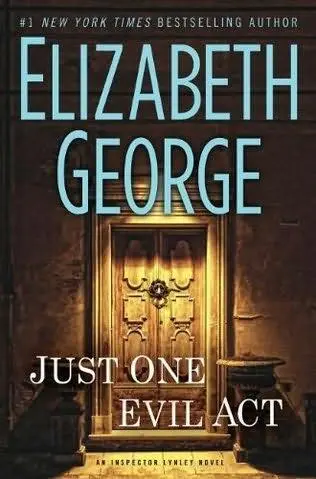
- Название:Just One Evil Act
- Автор:
- Издательство:Dutton
- Жанр:
- Год:2013
- ISBN:978-0-698-13828-5
- Рейтинг книги:5 / 5. Голосов: 1
-
Избранное:Добавить в избранное
- Отзывы:
-
Ваша оценка:
Just One Evil Act: краткое содержание, описание и аннотация
Предлагаем к чтению аннотацию, описание, краткое содержание или предисловие (зависит от того, что написал сам автор книги «Just One Evil Act»). Если вы не нашли необходимую информацию о книге — напишите в комментариях, мы постараемся отыскать её.
bestselling author Elizabeth George offers the latest in her Inspector Lynley series: a gripping child-in-danger story featuring fan favorite Barbara Havers. Detective Sergeant Barbara Havers is at a loss: The daughter of her friend Taymullah Azhar has been taken by her mother, and Barbara can't really help—Azhar had never married Angelina, and his name isn't on Hadiyyah's, their daughter's, birth certificate. He has no legal claim. Azhar and Barbara hire a private detective, but the trail goes cold.
Azhar is just beginning to accept his soul-crushing loss when Angelina reappears with shocking news: Hadiyyah is missing, kidnapped from an Italian marketplace. The Italian police are investigating, and the Yard won't get involved, until Barbara takes matters into her own hands. As she attempts to navigate the complicated waters of doing anything for the case against her superior's orders, her partner, Inspector Thomas Lynley, is dispatched to Italy as the liaison between the Italian police and Hadiyyah's distraught parents.
In time, both Barbara and Lynley discover that the case is far more complex than just a kidnapping, revealing secrets about Angelina; her new lover, Lorenzo; and even Azhar—secrets Barbara may not be willing to accept. With both her job and the life of a little girl on the line, Barbara must decide what matters most and how far she's willing to go to protect it.
Just One Evil Act — читать онлайн бесплатно полную книгу (весь текст) целиком
Ниже представлен текст книги, разбитый по страницам. Система сохранения места последней прочитанной страницы, позволяет с удобством читать онлайн бесплатно книгу «Just One Evil Act», без необходимости каждый раз заново искать на чём Вы остановились. Поставьте закладку, и сможете в любой момент перейти на страницу, на которой закончили чтение.
Интервал:
Закладка:
From all this, Barbara reckoned that wine tasting went on at Fattoria di Santa Zita, and she discovered soon enough that she was not wrong. Perhaps a quarter of a mile along the unpaved lane, she came to the driveway into the fattoria . Not much farther and she saw an ancient barn with a heavy arbour of wisteria draping lavender flowers towards a scattering of rustic tables and chairs.
The doors to the barn were open, and Barbara parked close by in the space designated for tasters. She crossed the gravel and then the flagstone terrace where the tables stood. It was dim in the barn, so when she went inside, she paused for her eyes to adjust to the change in light.
She expected to see Lorenzo Mura, but she did not. What she saw was a roughly hewn bar set up with wineglasses, a display of the wines ostensibly made on the property, a basket of savoury biscuits, and four wedges of cheese contained beneath a glass dome on a cutting board. The air was so fragrant with the scent of wine that she reckoned she could get tipsy just by breathing deeply. She did so and her mouth watered in anticipation. A glass of wine wouldn’t have gone down half bad, and she wouldn’t have minded a few pieces of cheese either.
A young man emerged from a cavernous room beyond the tasting area, where Barbara could see three stainless steel vats and row upon row of empty green bottles. He said, “ Buongiorno. Vorrebbe assaggiare del vino? ” and she stared at him uncomprehendingly. Apparently, he read this for what it was because he switched to English, which he spoke with what sounded like a Dutch accent. He said, “English? Would you like to try some Chianti?”
Barbara showed her police identification. She was there to speak to Lorenzo Mura, she said.
“Up at the villa” was his reply. He waved towards the interior of the barn, as if the villa could be accessed from there. He went on to explain how to get to the place. Drive or walk, he told her, it wasn’t far. Follow the road, curve past the old farmhouse, go through the gates, and then you’ll see it. “He might be on the roof,” he told her.
“You work for him, I s’pose?” Barbara said. He looked to be somewhere in his twenties, probably a European student having a spring-through-summer work/study/play in Italy. He said that he did, and when she asked if there were more of his ilk about the property, he said no. He was the only one working on the farm at present, aside from the blokes who were working on the farmhouse and the villa.
“Been here long, then?” she asked.
He’d arrived only the week before, he told her. She scratched him from her list of potential suspects.
She went by foot the rest of the way to the villa. She noted the size of the operation that Lorenzo Mura had going at the fattoria . Not only did vineyards fall down a hillside overlooking a rather stupendous view of mountain villages, more vineyards in the distance, and other farms, but olive groves promised a source of income from oil, and cattle grazing near a stream far below suggested beef products as well.
An old farmhouse was under renovation, and so, it seemed, was the villa when she finally came to it. It sat at the top of a sloping lawn, and scaffolding covered the sides of it. On the roof swarmed half a dozen men. They were in the process of removing its tiles, which they were tossing to the ground three floors below them. This was a noisy business, accompanied by enormous clouds of dust as well as a great deal of shouting in Italian. Over the shouting music played at a volume sufficient for most of Tuscany to hear quite easily. It was old rock ’n’ roll sung in English: Chuck Berry was asking Maybellene why she couldn’t be true.
One of the workers clocked her approach, for which she was grateful since she didn’t think she’d be capable of outshouting Chuck. This man waved and disappeared from view for a moment. Into his place stepped Lorenzo Mura.
He stood, backlit by the afternoon sun, arms akimbo, as Barbara approached the villa. She wondered if he would recognise her from their meeting in London the previous month. Apparently he did because he descended the rickety scaffolding quickly and, in her opinion, with insufficient care. By the time she reached the area in front of the building’s great loggia, he was coming round the side of the place and his expression didn’t indicate that the red carpet was about to be unrolled.
He spoke first, saying, “Why are you here?”
She took a moment before she replied. He looked about as bad as Azhar, she thought. Sleepless nights, too much daytime labour, insufficient food, forcing himself to move forward through every day, grief . . . These would take the stuffing out of any man. But so would a bout with E. coli , she thought. He looked shaky, and his colour was pasty. The port wine stain on his face appeared deeply purple.
She said to him, “Have you been ill, Mr. Mura?”
“My woman and our child are in a cimitero five days,” he said. “How you think me to look?”
“I’m sorry,” she said. “For what’s happened, I’m sorry.”
“There is no sorry for this,” he replied. “What want you here?”
“I’ve come for Hadiyyah,” she told him. “It’s her father’s wish that—”
He swiped the air with a chopping motion of his hand that stopped her words. He said, “Do not . There are things we not know. One of them is Hadiyyah’s father. Angelina said Azhar but me she tells it can be another.” And taking a moment to register the expression on Barbara’s face at this bit of news, he added, “You did not know. It is among many things you do not know. Taymullah Azhar was not the . . .” He looked for the word. He settled on “the solo man when he and Angelina first become lovers.”
“I know Angelina slept round like a ten-quid tart, but I expect that’s not exactly where you’d like this conversation to head. Past actions tend to indicate future actions, if you know what I mean, Mr. Mura.”
Colour swept his face.
Barbara said, “So that knife cuts in both directions, doesn’t it? You hooked yourself up with a woman with a colourful past, and for all we know till the day she died she had a colourful present as well. Now, I expect you’d like Azhar to doubt Hadiyyah is his, and I expect Angelina would’ve liked that also, all the better to keep her from him. But you and I both know what a DNA test can prove and, believe me, I c’n arrange for one as fast as you can ring up your solicitor and try to stop me. Are we clear on this?”
“He wants Hadiyyah, he comes for her himself. When he’s able to come, certo . Meantime—”
“In the meantime, you have a British subject in your digs, and I’m here to collect her.”
“I telephone her grandparents to come for her.”
“And her grandparents are going to do what? Cooperate with that idea? Fly over, scoop her up in their arms, and take her home to a bedroom they’ve just redecorated in her honour? That’s not bloody likely. Believe me, Lorenzo, they’d never even seen Hadiyyah before Angelina died, if they saw her then. Did they come to the funeral? Yes? It was probably to dance on Angelina’s grave, that’s how much of a nothing she was to them once she got herself involved with Azhar. They’d’ve seen her death as her finally receiving what she deserved for getting herself pregnant by a Pakistani Muslim in the first place. I’d like to see Hadiyyah now.”
Mura’s face had darkened to nearly the colour of his port wine birthmark during Barbara’s speech. But he seemed unwilling to argue further. After all, he had work to do on the crumbling villa, and his hanging on to Hadiyyah was only intended to thrust the sword deeper into Azhar’s chest, as was handing her over to her grandparents.
Читать дальшеИнтервал:
Закладка:
Похожие книги на «Just One Evil Act»
Представляем Вашему вниманию похожие книги на «Just One Evil Act» списком для выбора. Мы отобрали схожую по названию и смыслу литературу в надежде предоставить читателям больше вариантов отыскать новые, интересные, ещё непрочитанные произведения.










Обсуждение, отзывы о книге «Just One Evil Act» и просто собственные мнения читателей. Оставьте ваши комментарии, напишите, что Вы думаете о произведении, его смысле или главных героях. Укажите что конкретно понравилось, а что нет, и почему Вы так считаете.