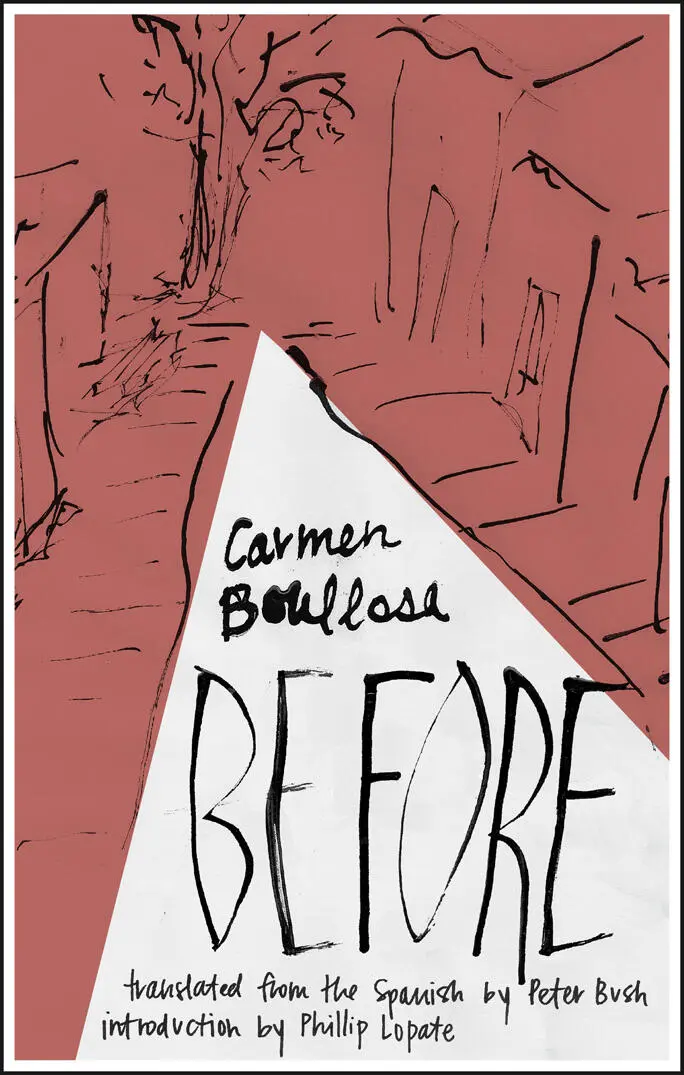
Carmen Boullosa - Before
Здесь есть возможность читать онлайн «Carmen Boullosa - Before» весь текст электронной книги совершенно бесплатно (целиком полную версию без сокращений). В некоторых случаях можно слушать аудио, скачать через торрент в формате fb2 и присутствует краткое содержание. Год выпуска: 2016, Издательство: Deep Vellum Publishing, Жанр: Старинная литература, на английском языке. Описание произведения, (предисловие) а так же отзывы посетителей доступны на портале библиотеки ЛибКат.
- Название:Before
- Автор:
- Издательство:Deep Vellum Publishing
- Жанр:
- Год:2016
- ISBN:нет данных
- Рейтинг книги:4 / 5. Голосов: 1
-
Избранное:Добавить в избранное
- Отзывы:
-
Ваша оценка:
Before: краткое содержание, описание и аннотация
Предлагаем к чтению аннотацию, описание, краткое содержание или предисловие (зависит от того, что написал сам автор книги «Before»). Если вы не нашли необходимую информацию о книге — напишите в комментариях, мы постараемся отыскать её.
Part bildungsroman, part ghost story, part revenge novel,
tells the story of a woman who returns to the landscape of her childhood to overcome the fear that held her captive as a girl. This powerful exploration of the path to womanhood and lost innocence won Mexico's two most prestigious literary prizes.
Carmen Boullosa
Texas: The Great Theft
Before — читать онлайн бесплатно полную книгу (весь текст) целиком
Ниже представлен текст книги, разбитый по страницам. Система сохранения места последней прочитанной страницы, позволяет с удобством читать онлайн бесплатно книгу «Before», без необходимости каждый раз заново искать на чём Вы остановились. Поставьте закладку, и сможете в любой момент перейти на страницу, на которой закончили чтение.
Интервал:
Закладка:
As soon as I returned to Mexico, I realized the territory I’d lost on my journey was perhaps greater than what would have been snatched from me if I hadn’t gone away, feeling the millimeters of loss night after night as a tragedy. If before I left I thought I’d barely any territory left to defend on my return I just crossed my arms and waited for a rapid denouement. Panicking, naturally. I wasn’t Miriam.
My house was never as big as it was then. I walked around some nights when everyone was asleep, tiptoeing, ducking under tables, looking for the equivalent of the well of eternal youth, El Dorado, the philosopher’s stone, and not in broad expanses of uninhabited territory and on horseback, but on a carpet, under furniture, next to the pictures painted by the painters whose names I’ll never be able to forget and who lived on the walls of our house — Fernando García Ponce, Lilia Carrillo, Manuel Felguérez, Juan Soriano — people who at the time were the painters of my city, and who had swapped paintings with Esther so each could have their own collection.
I brushed against furniture, climbed on armchairs, kept my distance from walls, made futile gestures trying to distract them and myself.
There were few parts of the house I didn’t visit by night: the utility room, the patio, the terrace, the garden, and of course, Esther’s studio, which I didn’t visit by day either. I’d never been back there since the serviam competition, since I’d painted that figure that I’d baptized Nails . Why did I return that night? Because when I put my ear to the door I realized I could hear nothing inside, which meant I’d be safe inside. I thought, “They won’t dare go in here.”
I opened the door to the studio; dark, under a starry sky, it was really beautiful. A full moon, as perfect as in her drawings, its round, innocent face smiling down at me, I took another step inside and a shadow jumped (jumped!) out of the dark.
It was Esther. “Oh!” she spluttered. I stood watching her. She seemed younger than by day in a thin cotton nightdress, her face without makeup and her long hair loose.
“What are you doing here?” she asked. I’d liked to have explained, to have told her once and for all about the crazy race I’d become embroiled in, but I didn’t have time.
“What are those noises?” she asked. They flocked into the room. Clung to the walls where I saw them, as if I’d caught glimpses of fragments of them before, I saw them bound to each other, creating the puzzle to that day I’d not understood, the fragments congealed around the Nails that Esther kept framed, hanging on the studio wall.
“But what is it?” she shouted or something similar as she rushed to protect me. All those things on the wall turned on her enraged, feeling disturbed, wounded in their hidden selves, began to separate out, bits of some from bits of others, bits of others from bits of others, till they formed a mass of fragments I knew so well. The pursuers set upon her. I took her hand and said, “Run, Esther, come on…”
“Please say Mom at least now!” she shouted in a panicky voice. “But what is this!?” she kept shouting as I tried to save her, I had been the one who’d drawn the pack to her study, till I heard Dad shout, “But what is this!?” and I saw Esther wasn’t depending on my hand anymore, that I was by myself dodging them in the lounge, and I ran to my bed and cried and cried still hearing them and listening to Dad calling the doctor and then the shrill, deafening, strident, blinding call of the ambulance. I peered out of the door and saw two nurses carrying Esther on a stretcher. Esther (can I say Mom at this point in the story?) turned her head around to see me. I ran after her. The stretcher-bearers stopped. Her head turned around, lips half-open, she said, “Poor little thing,” and burst into tears as well; oh Esther, I loved you so much, so much, Mom, Mom, Mom, Mom…
The hospital had strict visiting hours. We couldn’t see her in hospital because Dad decided we should go to school as normal.
The doctors didn’t understand her symptoms: she was seeing images in reverse (not all the time, but suddenly they’d volte-face), hearing a constant thud, vomiting uncontrollably — and it all lasted three days before she died of what they diagnosed in the post-mortem as a brain tumor.
Dad insisted on her body lying at home. I couldn’t stand it. Now I was afraid of Esther as well. Amid all the steps, I made out hers in the slippers she wore around the house, trailing them in her usual manner. One night I even thought I saw her in her pink flannel dressing gown coming toward me until just as she was about to touch my shoulder I shouted from within my dream: “No! No!..” Dad ran into my room.
“What’s the matter?”
“I was dreaming.”
Why didn’t I go with her? She wouldn’t have saved my life, of course, no need to say I’d have lost that with her as well, but what is the point of thinking about that now. It’s too late, too late for me to regret anything, anything at all.
14
Although I almost never liked going to play in my girlfriends’ houses I accepted Edna’s invitation because the oppression I felt at home from the ebullient steps, sated on Esther’s body, bloated and arrogant, was veined in sadness. We arrived (I wasn’t the only guest) and they decided we were going to swim in their pool. Edna lent me a swimsuit. Maite, Rosi, Tinina, and Edna chatted as they took their clothes off. I didn’t know what to do. I held the swimsuit between my palms like an altar boy and distractedly looked at the garden through the window.
“Don’t you like it?” asked Edna. “Shall I give you another costume?” “No I like it, I’m off to the bathroom,” I replied, or something to that effect. I shut the door in order to change and heard them continue their conversation. In a flash I heaped my uniform on the ground and slipped on the swimsuit. I went out with my clothes in a ball under my arm; I was embarrassed to find a pretty young girl in the mirror. I tried to catch the familiar look sunk between the eyebrows: I met a pair of cat’s eyes. I drew my face back: a cat’s face. I stepped back to the wall to see as much of myself as possible in the mirror: I managed to check myself out from head to shin, a pretty girl who set off walking to the pool.
Someone pushed me, two timid hands on my waist and I fell in, barely clearing the side of the pool. I opened my eyes under the water, clean and glinting, rippling, waving and pulsating gently like a huge heart: tum, tum, tum…I tried to propel myself and felt my body burning, felt my body about to burn up, and felt the water wouldn’t allow me to strike out to reach the surface. I stretched out my hand and grabbed onto a rung of the bars. I gripped tight, closing my stinging, blinking eyes in the water and when I opened them I looked at the boys’ shoes. One of them most have thrown me in.
Edna handed me a towel. “You didn’t even wet your hair,” she said in amazement. “How did you fall in?” “Did you dive in on purpose?” “Did you hurt yourself?” “Did you hurt yourself?” The boys stayed silent. Nobody looked as if they’d pushed me in. I touched my hair: it was dry, totally dry, as neat and tidy as I’d just seen it in the mirror, parted down the center and the ends slightly shaped toward my body.
“That’s Jaime, my brother, José Luis Valenzuela, the Cyclone, Manuel Barragán.”
“Pleased to meet you.”
“Let’s get changed.”
I wanted to go home. I telephoned. Only Inés was in. I’d have to wait.
There was something in the garden I couldn’t understand, something I couldn’t hear although it was pursuing me. I took my time changing, but they waited for me. Something was trying to undermine me. We sat on the bed to chat as I pulled my socks on. I looked up, searching for my shoes and took the opportunity to glance into the garden. I heard laughter. “It’s my sister, the cocky one,” Edna said. The laughter entered the room next door, crossed over and out into the passageway and stopped opposite the door. They opened without knocking.
Читать дальшеИнтервал:
Закладка:
Похожие книги на «Before»
Представляем Вашему вниманию похожие книги на «Before» списком для выбора. Мы отобрали схожую по названию и смыслу литературу в надежде предоставить читателям больше вариантов отыскать новые, интересные, ещё непрочитанные произведения.







Обсуждение, отзывы о книге «Before» и просто собственные мнения читателей. Оставьте ваши комментарии, напишите, что Вы думаете о произведении, его смысле или главных героях. Укажите что конкретно понравилось, а что нет, и почему Вы так считаете.