Carmen Boullosa - Before
Здесь есть возможность читать онлайн «Carmen Boullosa - Before» весь текст электронной книги совершенно бесплатно (целиком полную версию без сокращений). В некоторых случаях можно слушать аудио, скачать через торрент в формате fb2 и присутствует краткое содержание. Год выпуска: 2016, Издательство: Deep Vellum Publishing, Жанр: Старинная литература, на английском языке. Описание произведения, (предисловие) а так же отзывы посетителей доступны на портале библиотеки ЛибКат.
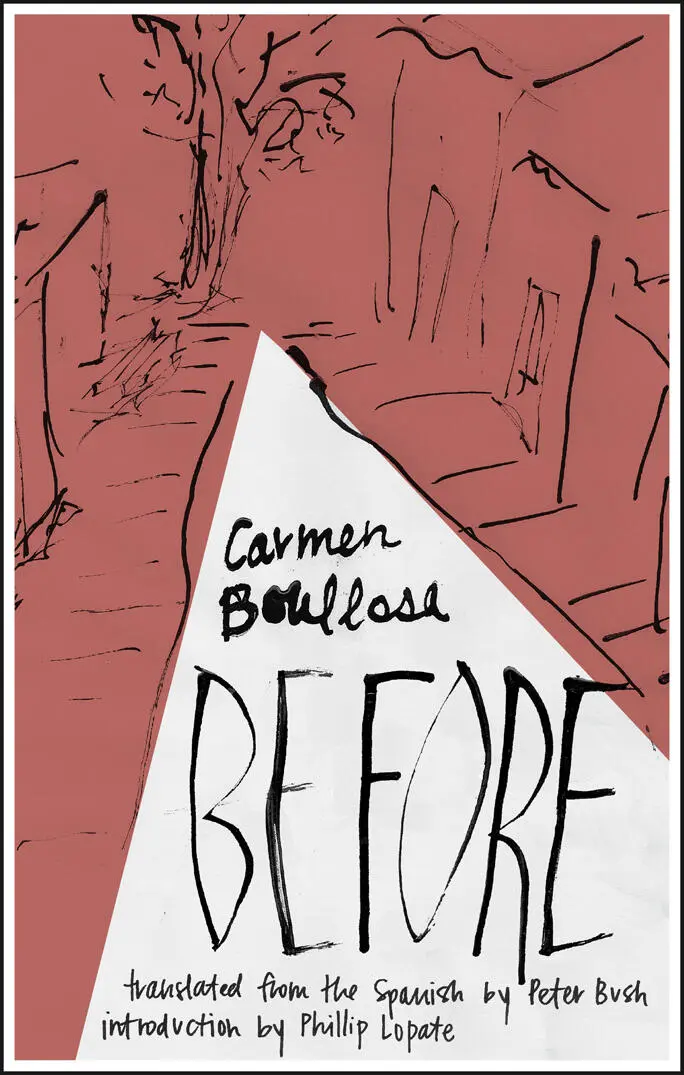
- Название:Before
- Автор:
- Издательство:Deep Vellum Publishing
- Жанр:
- Год:2016
- ISBN:нет данных
- Рейтинг книги:4 / 5. Голосов: 1
-
Избранное:Добавить в избранное
- Отзывы:
-
Ваша оценка:
Before: краткое содержание, описание и аннотация
Предлагаем к чтению аннотацию, описание, краткое содержание или предисловие (зависит от того, что написал сам автор книги «Before»). Если вы не нашли необходимую информацию о книге — напишите в комментариях, мы постараемся отыскать её.
Part bildungsroman, part ghost story, part revenge novel,
tells the story of a woman who returns to the landscape of her childhood to overcome the fear that held her captive as a girl. This powerful exploration of the path to womanhood and lost innocence won Mexico's two most prestigious literary prizes.
Carmen Boullosa
Texas: The Great Theft
Before — читать онлайн бесплатно полную книгу (весь текст) целиком
Ниже представлен текст книги, разбитый по страницам. Система сохранения места последней прочитанной страницы, позволяет с удобством читать онлайн бесплатно книгу «Before», без необходимости каждый раз заново искать на чём Вы остановились. Поставьте закладку, и сможете в любой момент перейти на страницу, на которой закончили чтение.
Интервал:
Закладка:
Juanita had followed us. In front of us she clenched the eye of the needle between her teeth and pulled it out cleanly, as if it had pierced material rather than entering flesh.
We three looked at each other, I swear with the same unblinking look, parties to something beyond our understanding.
When Dad, Esther, and Don Pedro arrived, they found us washing in the tub (Malena and Fina were washing and doing my hair at the same time, trying to fix my soaking hair with some of the big, pink curlers Dad had brought Esther from the United States with the innovation that they avoided the use of hairgrips to keep them in place, since there was a kind of plastic mold in the same color to keep the hair shaped), while Juanita, in the kitchen, listened unthinkingly engrossed to her favorite concerto: suite for mixer and wooden table. We caused such a flood we almost wet Juanita’s shoes without her even noticing.
The following morning, Esther packed Juanita off in the return bus to Michoacán to the same training school, surely to take more classes that would teach her to do nothing, to hold in contempt all that was her world with a greater degree of perfection.
8
My school motto was serviam (the hymn said: serviam, forever serviam, though life may lead us faraway ). We were told ad nauseam that serviam meant serve, to work toward the glory and veneration of God, and to be of service to one’s neighbor.
The word was written on the lower part of the school shield that lived with us daily on the white blouses and gray sweaters of our uniform: green and gold, embroidery thick like a growth, superimposed like a second heart of unerring goodness. It was at Esther’s suggestion that they organized a drawing competition for possible interpretations of the school motto.
This wasn’t Esther’s first intervention; now, as on other occasions, she had interfered out of a sense of indignation: las monjas , the mothers, the sisters, or las madres (depending on who it was) had allowed a fifth-year teacher (my teacher) to set up a doll contest: the girl with the prettiest doll would win. The idea hugely annoyed Esther: Why reward something that didn’t depend on a girl’s will but was something brought from a shop? All the girls (except ourselves because we came empty-handed to signal Esther’s protest) arrived with brand-new dolls competing with the most expensive, the one nobody had ever seen before, the doll from the most distant land with a designer brand.
The dolls were paraded before the eyes of the teachers who’d been elected as competition judges, who observed them perched on the hands of owners who’d never played with them, never changed their clothes, never cradled them, and never combed their hair so they would have a chance to win.
As an act of protest Esther proposed a competition in which the girls’ skills would be valued and “not their parents’ money or travels.” She spoke to la madre Gabriela (being Cuban, she wasn’t a Mother; being vigorous and intelligent, she wasn’t a nun) and convinced her: “sensitivity,” “intelligence,” “work,” “the value of work”—what other arguments did she use? I picked out these words from their conversation on the sunny terrace when Esther handed her a drawing that she gave as a present because she liked her so much: who knows how long they’d talked before I saw them, but they certainly loved each other dearly.
The graphic representation of serviam opened Esther’s studio — for my sisters and me — on a single afternoon.
It was a spacious room. The light was what first caught your attention when you went in: a huge French window in the back, two skylights, windows on three walls, a large, vertical mirror — in which two people could be reflected if one stood on the other’s head — as long as the wall and almost reaching the ceiling, bringing into the room a stream of light I would describe (now that I remember it) as scientific —a light seemingly able to illuminate anything. It smelled of eucalyptus branches, their transparent fragrance filling the open field of the room, the endless blue sky melding with our city air in the study, revealing volcanoes and mountains.
We’d never entered the study. I observed it with the same feeling I later observed a frog’s heart in the live, open body of a drugged specimen in the school laboratory: I knew the heart existed, but seeing it — seeing it was something else. No fantasy was equal to the reality, no representation was an equal, ad nauseam I’d seen imitation (graphic, plastic) hearts as I had also seen photographs of Esther’s studio, of fragments of Esther’s studio, but they’d given me no idea what it would be like.
As if wanting to pluck out the gazes scavenging her bright study, Esther hurriedly produced big sheets of paper and endless packs of colors so we could draw what we thought denoted serviam .
In colors they never dreamed they’d have, my sisters recreated the houses that bordered on the school, the hovels of la baranca as the mothers called these settlements of “newcomers” to the city (some of whom were three times my age as they reached, tried to reach, the paradise they’d imagined the city to be) and drew uniformed girls, with big serviam shields gleaming on their chests, giving out sweets, injecting children or whatever other act they thought would heal or relieve the misery (like giving out gansitos , industrially produced cakes sold wrapped in cellophane bags, which was one of the drawings entered in the competition), while I couldn’t outdo the light in the studio; leisurely, in ochre colors, I drew a small child, curled up like a baby but older, its body covered in clavitos , small nails, which would be small outside the proportions of the drawing, otherwise enormous hooks with nail heads sunk into its motionless body and face that if it didn’t stop smiling, one could almost say it did. No tear, no wound, no sign of pain. Then I painted a bed behind him, a teddy bear, and a smiling sun that gleamed in the top part of the picture, almost burning the wings of some seagulls (or something resembling seagulls) flying past.
Underneath I wrote NAILS. Esther stood and looked. Said nothing.
“It’s not for the serviam thing,” I told her.
“I gathered that.”
“A present for you.”
She nailed it to the studio wall with a nail head identical to those in the drawing and kept looking as I hurriedly drew a girl washing dishes, the motto serviam enclosed in a bubble the edge of which was near her lips indicating the girl was saying the word serviam as she carried out her “Christian” action. This drawing on the sheet she’d given me was as ridiculous as all the competition entries if we stopped to think what washing dishes meant in our house that had a woman whose job it was to do it for us and whom I would never have been allowed to stop, what “helping” the baranca children meant when our very presence was an insult to them, what serviam and “to serve” meant if between us we made sure the whole country served us.
9
I wasn’t a timid child. There are children afraid of anything and everything, of dangling their legs from chairs, for example, because they fear someone or something will grab them, or they’re afraid of the shapes streetlights project from plants, plants already disturbing in themselves, changing shape in the dark, as alive as insects, or more so, shining like opaque jewels in the city night, swaying to and fro, scary; and there are children who are afraid of the dark because they just are, or who are afraid of being by themselves, of going to the bathroom by themselves, of walking around their home by themselves (let alone going out unaccompanied!), who are frightened in the cinema, frightened of going to the fair, who are terrified by the sight of a clown, who believe in child-snatchers…and there are also those who become frightened by dint of being filled with fear: the bogeyman, the devil, their dad, or, “Just you see what happens if…”
Читать дальшеИнтервал:
Закладка:
Похожие книги на «Before»
Представляем Вашему вниманию похожие книги на «Before» списком для выбора. Мы отобрали схожую по названию и смыслу литературу в надежде предоставить читателям больше вариантов отыскать новые, интересные, ещё непрочитанные произведения.









Обсуждение, отзывы о книге «Before» и просто собственные мнения читателей. Оставьте ваши комментарии, напишите, что Вы думаете о произведении, его смысле или главных героях. Укажите что конкретно понравилось, а что нет, и почему Вы так считаете.