Doreen Tovey - Donkey Work
Здесь есть возможность читать онлайн «Doreen Tovey - Donkey Work» весь текст электронной книги совершенно бесплатно (целиком полную версию без сокращений). В некоторых случаях можно слушать аудио, скачать через торрент в формате fb2 и присутствует краткое содержание. Год выпуска: 2013, Издательство: Summersdale Publishers Ltd, Жанр: Старинная литература, на английском языке. Описание произведения, (предисловие) а так же отзывы посетителей доступны на портале библиотеки ЛибКат.
- Название:Donkey Work
- Автор:
- Издательство:Summersdale Publishers Ltd
- Жанр:
- Год:2013
- ISBN:нет данных
- Рейтинг книги:3 / 5. Голосов: 1
-
Избранное:Добавить в избранное
- Отзывы:
-
Ваша оценка:
Donkey Work: краткое содержание, описание и аннотация
Предлагаем к чтению аннотацию, описание, краткое содержание или предисловие (зависит от того, что написал сам автор книги «Donkey Work»). Если вы не нашли необходимую информацию о книге — напишите в комментариях, мы постараемся отыскать её.
Donkey Work — читать онлайн бесплатно полную книгу (весь текст) целиком
Ниже представлен текст книги, разбитый по страницам. Система сохранения места последней прочитанной страницы, позволяет с удобством читать онлайн бесплатно книгу «Donkey Work», без необходимости каждый раз заново искать на чём Вы остановились. Поставьте закладку, и сможете в любой момент перейти на страницу, на которой закончили чтение.
Интервал:
Закладка:
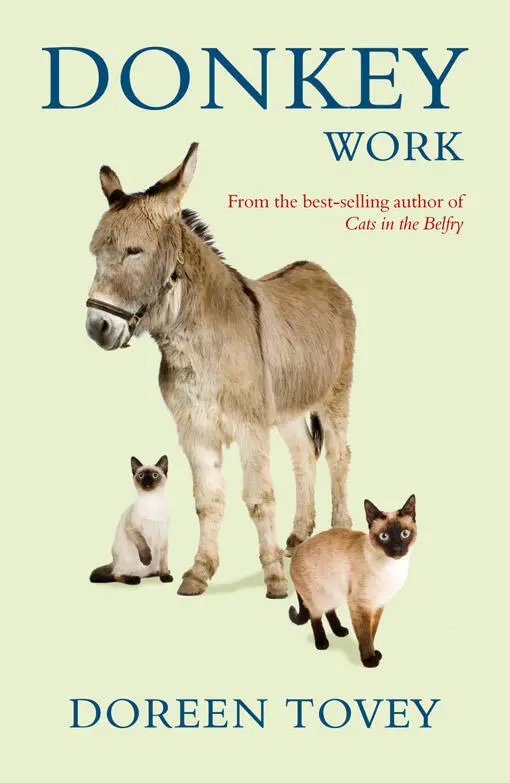
So there we were. Ripe, as I said, as a couple of plums. Telling ourselves that donkeys were different. That one could live out on the hillside without the cats being worried about its wanting to come indoors. They might, we envisaged, even think it was a little horse and like it. Solomon was particularly fond of horses... Imagining it following us across the hills like a dog – with Solomon and Sheba sitting one each side in panniers, said Charles enthusiastically, which I couldn't quite see coming off myself judging by the hell they created when we put them in their baskets ready for the cat kennels at holiday times, but there was no harm in hoping. We could, we told one another excitedly, hardly wait.
As a matter of fact we had to wait for six months. Donkeys, we found, weren't so easy to get. Particularly a baby donkey, which was what we'd decided on both from the point of view of bringing it up with the cats and because the first thing our neighbour Father Adams said when he heard we were getting one was that we'd have to watch the horse dealers. Do you soon as look, he said encouragingly, and we'd better watch their teeth. As we hadn't a clue as to how to watch either a donkey's teeth or a horse dealer's – and neither, when it came to the point, did Father Adams; only that it had been a maxim of his Dad's before him and his Dad, he said, had had his head screwed on when it came to horses – we decided a foal was safer. See it with its mother, we said (making sure that 'twas its mother, adjured Father Adams darkly, and not a little old dwarf donkey bunged up against a big 'un) and there we were.
There, to begin with, we nearly were indeed. Almost immediately Sidney heard of a donkey and foal in the very next village. The property, it appeared, of a lady who ran a guest house, liked getting up amateur theatricals for her visitors, and had, in a moment of over-enthusiasm, purchased a she-donkey eighteen months before to take part in a Christmas masque.
For, it seemed, one performance only. (Twice round the table-tennis room and that was that; never believe it, would us? said Sidney wonderingly.) After which the donkey had rested in the orchard until Spring, gone – her owner thinking she might be feeling lonely – to join the donkeys on the local beach for the summer; come back – to the consternation of her owner, who hadn't reckoned on her being as lonely as that – in foal. And now, said Sidney explicitly, there were two of 'em.
Not by the time we got there there weren't. Dolly pottering round the orchard on her ageing own had been one thing. Dolly with romance in the field behind the seaside gasworks in mind, and a jaunty little he-colt at her side, was quite another. You'd think they had wire-cutters the way they kept getting out, said their owner despairingly, and always it seemed to be at mealtimes, with visitors clattering their forks for service and somebody ringing up to say Dolly and Desmond had just passed by en route for the seaside and her having to hare down the road after them. In the end, she said – showing us with a sentimental sigh a photograph of two donkeys giving such old-fashioned looks at the camera that for a moment we almost wavered in our decision... Did it, enquired Charles, remind me of Anyone? I'll say it did. Solomon and Sheba to the life, but then I remembered we were only having one donkey and the apprehension passed. In the end she'd sold them, only the week before, to some people who lived near Manchester. People who liked donkeys, she said, and would keep the two of them together. Manchester, she added, brightening considerably as she thought of the advantages, was two hundred miles away.
It didn't occur to us that if donkeys could get out of a wired-in field how were we going to manage on rambling hillside land with gaps big enough for elephants in the hedges and not a gate to the place. It didn't occur to us that if we followed our plan of having a dear little she-foal (because, we imagined, she'd be more amenable and affectionate) sooner or later we'd either have a neurotic spinster donkey on our hands or have to let her have a dear little foal herself and keep two of them willy-nilly. We hadn't thought ahead as far as that. All we knew was that we wanted a donkey. Which was why the following weekend saw us down at the seaside, the lady at the guest house having given us the address of the place where she got hers, interviewing a donkey man.
TWO
Sleuthing on the Sands
We didn't get a little donkey from him. He didn't breed 'em, he said; only kept 'em for riding. When Charles mentioned Dolly having had a foal he said it was a surprise to him, too, Mate; the only stallion he had was over thirty-five and the fairies must have had a hand in it. He might, he said, spare us a mare at the end of the season like he had the lady at the guest house and we could hope the fairies had had a word with her, too... But that wasn't what we wanted.
We didn't get one from our next port of call either, though we did – against a background of small boys screaming to get on, small girls screaming to get off, and Charles trying to look dignified with a horse-drawn coach labelled the Deadwood Stage standing ostentatiously behind him – get quite a lot of information. That male donkeys are called jacks, for instance, and females are called jennies, and that what we thought were light little ponies cantering up and down the sands were in fact jennets. Crosses between horses and donkeys, said the man, and when we said weren't those mules he said that was when the father was a donkey. When the father was a horse, he said, you got a jennet.
Actually when we looked it up in the dictionary it said that what you got was a hinny, while a jennet was a small Spanish horse. That, said Charles, was genealogically very interesting. Donkey men were often of gypsy stock, lots of the English gypsies came originally from Spain – what was more likely than that they should call their donkey crosses after the small Spanish horse?
What struck me as even more genealogically interesting was that when I asked the man was it true that donkeys lived to be around forty, as it said in the article, he said sixty was more like it. He had a donkey at home, he said, that had belonged to his father, and his father had been dead sixty years so it showed how old the donkey was, didn't it? It did indeed, particularly as he himself couldn't have been a day over fifty. I puzzled over it for hours.
He didn't have any donkey foals either. He had a couple of jennies, he said helpfully, who'd be throwing 'em in the Spring and we could come back and have one then. The next two owners we enquired of also said their jennies would be throwing them in the Spring. Come April, it seemed, foals would be being thrown in all directions like apple blossom at a Spring wedding. What we wanted was one right then.
We didn't get it. The nettles grew and faded. The grapes ripened in the conservatory. We, having first waited till the grapes had ripened so that we could eat them, went on holiday to Provence so that we could eat some more. Up through the lavender fields to St. Paul de Vence where, in the last place on earth we expected it, right up there in the mountains, we met a Siamese cat. Sitting in a wood-carver's shop daring us to enter, and when we spoke to her and she was rude back her owner came rushing out to grab her and said not to mind Mignonne, she was a Siamoise. We, we assured her, understood. We had two Siamois. Aaah, she said, shaking her head sympathetically, at which point a small girl came round a corner hugging a black kitten. 'Mignette!' she said, holding it happily up for our approval. We looked from Mignette to Mignonne to the shopkeeper and raised our eyebrows. She raised hers too, and spread her hands in abnegation. What would we? she deplored. Mignonne, without waiting for the nice Siamois husband they had planned for her from a lady in Grasse, had gone out one night and been trumped. Mignonne had the final word about that. Surveying us loftily as she stalked across the shop to retrieve Mignette – it was Dark, she said over her shoulder.
Читать дальшеИнтервал:
Закладка:
Похожие книги на «Donkey Work»
Представляем Вашему вниманию похожие книги на «Donkey Work» списком для выбора. Мы отобрали схожую по названию и смыслу литературу в надежде предоставить читателям больше вариантов отыскать новые, интересные, ещё непрочитанные произведения.




Обсуждение, отзывы о книге «Donkey Work» и просто собственные мнения читателей. Оставьте ваши комментарии, напишите, что Вы думаете о произведении, его смысле или главных героях. Укажите что конкретно понравилось, а что нет, и почему Вы так считаете.