Dan Singer - Start-up Nation
Здесь есть возможность читать онлайн «Dan Singer - Start-up Nation» весь текст электронной книги совершенно бесплатно (целиком полную версию без сокращений). В некоторых случаях можно слушать аудио, скачать через торрент в формате fb2 и присутствует краткое содержание. Жанр: Старинная литература, на английском языке. Описание произведения, (предисловие) а так же отзывы посетителей доступны на портале библиотеки ЛибКат.

- Название:Start-up Nation
- Автор:
- Жанр:
- Год:неизвестен
- ISBN:нет данных
- Рейтинг книги:3.5 / 5. Голосов: 2
-
Избранное:Добавить в избранное
- Отзывы:
-
Ваша оценка:
Start-up Nation: краткое содержание, описание и аннотация
Предлагаем к чтению аннотацию, описание, краткое содержание или предисловие (зависит от того, что написал сам автор книги «Start-up Nation»). Если вы не нашли необходимую информацию о книге — напишите в комментариях, мы постараемся отыскать её.
Start-up Nation — читать онлайн бесплатно полную книгу (весь текст) целиком
Ниже представлен текст книги, разбитый по страницам. Система сохранения места последней прочитанной страницы, позволяет с удобством читать онлайн бесплатно книгу «Start-up Nation», без необходимости каждый раз заново искать на чём Вы остановились. Поставьте закладку, и сможете в любой момент перейти на страницу, на которой закончили чтение.
Интервал:
Закладка:
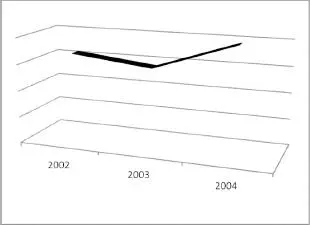
FIGURE 9.1
“Look at this graph,” he told us (figure 9.1).
“What do you see here?” Medved probed. The horizontal x -axis showed the years 2002 through 2004; the vertical y -axis was unlabeled. And there was a line heading—in a relatively linear, diagonal direction—up into the upper-right corner of the graph. But with no y -axis label, the graph was incomplete. We figured Medved had posed a trick question.
“Well, there is something increasing over the 2002-to-2004 time frame,” we hazarded. “But the vertical y -axis doesn’t tell us what the ‘it’ is.”
“Exactly,” he quickly responded. “The ‘it’ could be a number of things. For one: violence. It was, tragically, one of Israel’s most violent periods in our history, during the second intifada and leading up to the second Lebanon war. The graph illustrates the number of rockets that hit Israel over those years.”
But, Medved told us, the graph also illustrates the performance of Israel’s economy, which also rose steeply in the first half of the decade. He then pulled out another slide that was virtually identical to the first (figure 9.2 ).
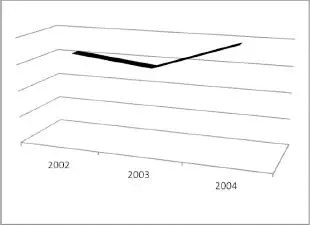
FIGURE 9.2
The vertical y -axis on this next slide was labeled “Foreign Investment in Israeli High Tech.” Remarkably, during the same period, there was an increase in investments coming in as the rocket attacks were increasing.
In fact, as we researched other economic metrics, we found that a number of sets of data would fit roughly along this generic graph structure. For example, foreign direct investment (FDI)—another macroeconomic metric—measures the total amount of overseas direct investment in any form that comes into a country. During the period from 2000 to 2005, Israel’s FDI tripled, and Israel’s share of the global venture dollars invested inside Israel doubled.
Medved was not suggesting that there was a correlation between violence in Israel and its attractiveness to investors. Rather, he believes that Israel has managed to divorce the security threat from its economic growth opportunities. In other words, Israelis are confident that their start-ups will survive during war and turbulence. And Israeli entrepreneurs have managed to convince investors of this, too.
Alice Schroeder, the author of The Snowball , is the only authorized biographer of Warren Buffett. We asked her about the perceived risk of investing in Israel. “Warren has been in the insurance business for a long time, and looks at every investment decision through that lens,” she told us. “It’s all about assessing risk like you would in an insurance policy. The things you really worry about are the potential for earthquakes and hurricanes. Warren asks: What kind of catastrophic risk is there, and can I live with it?” 5
Iscar, the Israeli company Buffett bought, has its main factory and R&D facilities in the northern part of Israel and was twice threatened by missile attacks—in 1991, when the whole country was targeted by Iraq’s Saddam Hussein during the Gulf War, and during the 2006 Lebanon war, when Hezbollah fired thousands of missiles at Israel’s northern towns. “Doesn’t this constitute catastrophic risk?” we asked her.
Buffett’s view, she told us, is that if Iscar’s facilities are bombed, it can go build another plant. The plant does not represent the value of the company. It is the talent of the employees and management, the international base of loyal customers, and the brand that constitute Iscar’s value. So missiles, even if they can destroy factories, do not, in Buffett’s eyes, represent catastrophic risk.
During the 2006 Lebanon war, just two months after Buffett acquired Iscar, 4,228 missiles landed in Israel’s north. 6Located less than eight miles from the Lebanese border, Iscar was a prime target for rocket fire.
Eitan Wertheimer, chairman of Iscar, who’d made the sale to Buffett, told us that he called his new boss on the first day of the war. “Our sole concern was for the welfare of our people, since wrecked machines and shattered windows can always be replaced,” Wertheimer recalled of his conversation with Buffett. “ ‘But I am not sure that you understand our mind-set,’ I told him. ‘We’re going to carry on with half the workforce, but we will ensure that all the customers get their orders on time or even earlier.” 7
One rocket did slam into Tefen Industrial Park, which was founded by the Wertheimer family and centered around Iscar, and a slew of rockets landed nearby. And though, during the war, many workers did temporarily relocate, with their families, to the southern part of the country, Iscar’s customers would never have known it. “It took us a brief time to adjust, but we didn’t miss a single shipment,” Wertheimer said. “For our customers around the world, there was no war.”
By responding to the threat this way, Wertheimer and others have transformed the very dangers that may make Israel seem risky into evidence of Israel’s inviolable assets—the same assets that attracted Buffett, Google, Microsoft, and so many others in the first place.
Few illustrate Israeli grit better than Dov Frohman, who was born in Amsterdam just months before the onset of World War II. As the Nazis’ grip on Holland tightened, his parents decided to hide Dov with the Van Tilborgh family, devout Christian farmers they found through the Dutch underground. Dov was only three years old when he arrived at their farmhouse in the Dutch countryside, but he remembers having to cover his dark hair with a hat, since the rest of his adopted family was blond. When the Germans periodically searched the house, he would hide under a bed, in a cellar, or in the woods with his adopted brothers. Years later, Dov learned that his father died at Auschwitz; he never knew for sure where his mother was murdered. 8
After the war, Frohman’s aunt, who had escaped to Palestine in the 1930s, tracked down Frohman’s Dutch family and convinced them to put him in a Jewish orphanage, so that he could emigrate to Palestine. In 1949, ten-year-old Dov landed in the brand-new State of Israel.
In 1963, as Dov Frohman was about to graduate from the Technion (Israel Institute of Technology), he decided to pursue graduate studies in the United States in order to “bring a new field of technical expertise back to Israel.” He was admitted to MIT but instead went to the University of California at Berkeley, which offered him a stipend. It was a fortuitous choice.
While still a graduate student, Frohman was hired by Andy Grove to work at Fairchild Semiconductor. A few years later, Grove joined Gordon Moore and Robert Noyce to found Intel. Frohman became one of the new start-up’s first employees. He quickly made his mark by inventing what would become one of Intel’s most legendary and profitable products, a new kind of reprogrammable memory chip. Then, with a senior management position within reach, Frohman announced that he was leaving Intel to teach electrical engineering in Ghana. In his words, he was “looking for adventure, personal freedom, and self-development”—another “person of the Book.”
Colleagues at Intel thought Frohman was crazy to leave just as the company was about to go public and shower its employees with lucrative stock options. But Frohman knew what he wanted: to start an enterprise, not just work for one. He also knew that if he stayed on the management track he might never be able to return to Israel, where he had a revolutionary idea for the local economy: he wanted Israel to become a leader in the chip design industry.
Читать дальшеИнтервал:
Закладка:
Похожие книги на «Start-up Nation»
Представляем Вашему вниманию похожие книги на «Start-up Nation» списком для выбора. Мы отобрали схожую по названию и смыслу литературу в надежде предоставить читателям больше вариантов отыскать новые, интересные, ещё непрочитанные произведения.









Обсуждение, отзывы о книге «Start-up Nation» и просто собственные мнения читателей. Оставьте ваши комментарии, напишите, что Вы думаете о произведении, его смысле или главных героях. Укажите что конкретно понравилось, а что нет, и почему Вы так считаете.