Robert Robert - Scouting for Boys
Здесь есть возможность читать онлайн «Robert Robert - Scouting for Boys» весь текст электронной книги совершенно бесплатно (целиком полную версию без сокращений). В некоторых случаях можно слушать аудио, скачать через торрент в формате fb2 и присутствует краткое содержание. Жанр: Старинная литература, und. Описание произведения, (предисловие) а так же отзывы посетителей доступны на портале библиотеки ЛибКат.
- Название:Scouting for Boys
- Автор:
- Жанр:
- Год:неизвестен
- ISBN:нет данных
- Рейтинг книги:3 / 5. Голосов: 1
-
Избранное:Добавить в избранное
- Отзывы:
-
Ваша оценка:
Scouting for Boys: краткое содержание, описание и аннотация
Предлагаем к чтению аннотацию, описание, краткое содержание или предисловие (зависит от того, что написал сам автор книги «Scouting for Boys»). Если вы не нашли необходимую информацию о книге — напишите в комментариях, мы постараемся отыскать её.
Scouting for Boys — читать онлайн бесплатно полную книгу (весь текст) целиком
Ниже представлен текст книги, разбитый по страницам. Система сохранения места последней прочитанной страницы, позволяет с удобством читать онлайн бесплатно книгу «Scouting for Boys», без необходимости каждый раз заново искать на чём Вы остановились. Поставьте закладку, и сможете в любой момент перейти на страницу, на которой закончили чтение.
Интервал:
Закладка:
Generally speaking, soft woods— pine, fir, spruce and larch—make good kindling and give quick fires for short jobs such as boiling water. Hard woods— oak, beech, maples and others—give lasting fires with many embers for longer jobs such as roasting, stewing and baking.
In America they say, “One tree may make a million matches—one match may destroy a million trees.” A Scout is very careful about fires. When he uses one he sees that it is completely out before he leaves the place, by dousing the last spark with water.
Other Plants
You ought to know what plants are useful to you in providing you with food.
Supposing you were out in a jungle without any food and knew nothing about plants— you might die of starvation or of poisoning, from not knowing which fruits or roots were wholesome and which dangerous to eat.
Eatable Plants
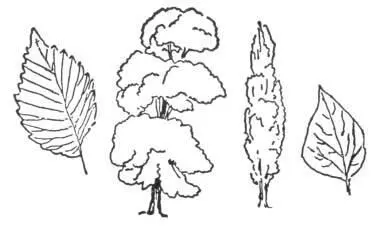
European elm has a distinctive form. So has Lombardy poplar.
There are numbers of berries, nuts, roots, barks, and leaves that make good eating. Find out which of these are found near your camp site, and try to make a camp meal of them.
Crops of different kinds of corn and seed, vegetable roots, and many grasses are also edible. Certain kinds of moss are used for food. Some types of seaweed can also be eaten.
You will want to be able to recognize the common flowers of the field and wood. Some of these are related to our garden flowers, and have some of the same beauty. Others are herbs which are useful for flavouring in cooking and for medicine.
PATROL PRACTICES IN PLANT OBSERVATION
Take out the Scouts to get specimens of leaves, fruits, or blossoms of various trees and shrubs, and observe the shape and nature of trees both in summer and in winter.
Collect leaves of different trees. Let Scouts make tracings of them and write the name of the tree on each.
In the country have Scouts examine crops in all stages of their growth, so that they know pretty well by sight what kind of crop is coming up.
Find all the local wild plants that may be used for food.
Make a collection of leaf impressions: Get some carbon copying paper. Lay the leaf vein side downwards on the carbon, place a piece of thin paper on top and rub the whole firmly. Remove the paper and pick up the leaf. Now lay it, again vein side downwards, on the paper you are using for the impressions ; again place a piece of paper on top and rub firmly This should give a very clear impression of the leaf.
Encourage Scouts to collect specimens of wild flowers and press them between sheets of blotting paper in a heavy book.
GAMES IN PLANT OBSERVATION
What Is It?
Two Scouts start out and make a trail with trail marks. They have decided upon an uncommon sign to signify “What is it? such as a circle with a line drawn through it, and a number next to it.
The remainder of the Patrol or Troop start out, say, ten minutes after the first two, either as a body or separately, and take notebooks and pencils with them.
The game consists of entering in their notebooks the “What is it? “s that have been noticed and write down the nature of the article closest to the sign, such as “Oak”, “Dandelion”, etc.
Marks should be given according to the number of signs observed and for the correct answers to the “What is it?”s.
Besides being very interesting, this game develops observation, strengthens the memory and is a good botany instruction.
Plant Race
The Patrol Leader starts off his Scouts, either cycling or on foot, to go in any direction they like, to get a specimen of any ordered plant. This may be a maple seed pod, an acorn, a thistle, ragweed, a milkweed pod, a choke cherry twig, or something similar that will tax their knowledge of plants, test their memory as to where they noticed one of the kind required, and make them quick in getting there and back.
CHAPTER VI
ENDURANCE FOR SCOUTS
CAMP FIRE YARN NO. 17
HOW TO GROW STRONG
Need for Scouts to Be Strong - Exercises
- Care of Body - Nose - Ears - Eyes – Teeth Nails
Practices
HINTS TO INSTRUCTORS
PRACTICES IN DEVELOPING STRENGTH
It is of paramount importance to teach the young citizen to assume responsibility for his own development and health.
Physical drill is all very well as a disciplinary means of development, but it does not give the lad any responsibility in the matter.
It is therefore deemed preferable to tell each boy, according to his age, what ought to be his weight, height, and various measurements (such as chest, waist, arm, leg, etc.). He is then measured, and learns in which points he fails to come up to the standard. He can then be shown which exercises to practise for himself in order to develop those particular points.
Encouragement must afterwards be given by periodical measurements, say, every three months or so.
Teach how to make camp tooth-brushes out of sticks.
A SCOUT LAY SICK IN HOSPITAL in India with that most fatal disease called cholera. The doctor told the native attending him that the only chance of saving his life was to warm up his feet and keep the blood moving in his body by constantly rubbing him.
The moment the doctor’s back was turned, the native gave up rubbing and squatted down to have a quiet smoke.
The poor patient, though he could not speak, understood all that was going on, and he was so enraged at the conduct of the native attendant that he resolved then and there that he would get well if only to give the native a lesson. Having made up his mind to get well he got well.
A Scout saying is “Never say die till you’re dead”— and if he acts up to this, it will pull him out of many a bad place when everything seems to be going wrong for him. It means a mixture of pluck, patience, and strength, which we call “endurance.”
A Sample of Endurance
The great South African hunter and scout, F. C. Selous, gave a good example of scouts’ endurance on a hunting expedition in Barotseland, north of the Zambesi River, some years ago. In the middle of the night his camp was suddenly attacked by a hostile tribe, that fired into it at close range and charged in.
He and his small party of natives scattered at once into the darkness and hid themselves away in the long grass. Selous himself had snatched up his rifle and a few cartridges and got safely into the grass. But he could not find any of his men, and, seeing that the enemy had taken possession of his camp, and that there were still a few hours of darkness before him in which to make his escape, he started off southward, using the stars of the Southern Cross as his guide.
He crept past an outpost of the enemy whom he overheard talking, then swam across a river and finally got well away, only dressed in a shirt, shorts, and shoes. For the next few days and nights he kept walking southward, frequently hiding to avoid hostile natives. He shot deer for food.
But one night, going into what he thought was a friendly village, he had his rifle stolen from him, and was again a fugitive, without any means of protecting himself or of getting food. However, he was not one to give in while there was a chance of life left, and he pushed on and on till at length he reached a place where he met some of his men who had also escaped. After further tramping they got safely back into friendly country.
Читать дальшеИнтервал:
Закладка:
Похожие книги на «Scouting for Boys»
Представляем Вашему вниманию похожие книги на «Scouting for Boys» списком для выбора. Мы отобрали схожую по названию и смыслу литературу в надежде предоставить читателям больше вариантов отыскать новые, интересные, ещё непрочитанные произведения.
![Роберт Баден-Пауэлл - Искусство скаута-разведчика[Scouting for boys ; Искусство Разведки для мальчиков]](/books/70572/robert-baden-pauell-iskusstvo-skauta-thumb.webp)











Обсуждение, отзывы о книге «Scouting for Boys» и просто собственные мнения читателей. Оставьте ваши комментарии, напишите, что Вы думаете о произведении, его смысле или главных героях. Укажите что конкретно понравилось, а что нет, и почему Вы так считаете.