Robert Robert - Scouting for Boys
Здесь есть возможность читать онлайн «Robert Robert - Scouting for Boys» весь текст электронной книги совершенно бесплатно (целиком полную версию без сокращений). В некоторых случаях можно слушать аудио, скачать через торрент в формате fb2 и присутствует краткое содержание. Жанр: Старинная литература, und. Описание произведения, (предисловие) а так же отзывы посетителей доступны на портале библиотеки ЛибКат.
- Название:Scouting for Boys
- Автор:
- Жанр:
- Год:неизвестен
- ISBN:нет данных
- Рейтинг книги:3 / 5. Голосов: 1
-
Избранное:Добавить в избранное
- Отзывы:
-
Ваша оценка:
Scouting for Boys: краткое содержание, описание и аннотация
Предлагаем к чтению аннотацию, описание, краткое содержание или предисловие (зависит от того, что написал сам автор книги «Scouting for Boys»). Если вы не нашли необходимую информацию о книге — напишите в комментариях, мы постараемся отыскать её.
Scouting for Boys — читать онлайн бесплатно полную книгу (весь текст) целиком
Ниже представлен текст книги, разбитый по страницам. Система сохранения места последней прочитанной страницы, позволяет с удобством читать онлайн бесплатно книгу «Scouting for Boys», без необходимости каждый раз заново искать на чём Вы остановились. Поставьте закладку, и сможете в любой момент перейти на страницу, на которой закончили чтение.
Интервал:
Закладка:
About bees alone whole books have been written—for they have wonderful powers in making their honeycomb, in finding their way for miles, sometimes as far as six miles, to find the right kind of flowers for giving them the sugary juice for making honey, and getting back with it to the hive. They are quite a model community, for they respect their queen and kill those who won’t work.
Then some insects are useful as food. Locusts—a big kind of grasshopper—are eaten in India and South Africa. We were very glad to get a flight or two of them over Mafeking. When they settled on the ground we beat them down, with empty sacks, as they turned to rise. They were then dried in the sun and pounded up and eaten. And make a substitute for salt.
Ants as Life Savers
I have known another case of ants being useful—in fact they were not only useful but saved the lives of several men.
These men were a party of scientific professors who were hiking in the wilds of Australia, searching for rare plants and animals, reptiles and bugs.
Out in the desert they ran out of water. For hours they struggled on, maddened with thirst and weak with exhaustion. It looked as though, like many explorers before them, they would collapse and die. Luckily, to their great relief, a small native girl appeared. They made a sign to her that they were dying of thirst and wanted her to go and fetch water.
In reply she pointed to a string of ants which were climbing up a baobab tree. (This tree has a great fat hollow trunk which thus forms a sort of water tank.)
The little girl picked a long stalk of dried grass and climbed up to a little hole in the trunk which the ants were running into.
She put one end of the straw down this hole and the other end into her mouth and sucked up water.
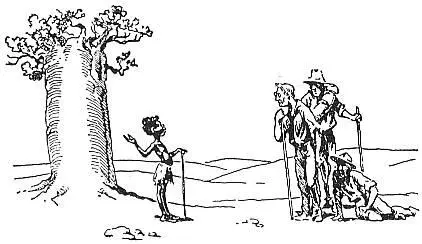
A small native girl came to the aid of the scientific professors who ran out of water when hiking in the wilds of Australia.
In this way the wild little imp of the desert taught the learned gentlemen a valuable bit of knowledge which with all their school and college education they did not possess.
I hope that had a Scout been with them he would have been wise to the idea, or at any rate would have used his eyes and wits and would have noticed the ants at their work and guessed why they were using that hole in the tree.
Watching Insects
It doesn’t sound very exciting to watch insects, but the great French naturalist, Henri Fabre, the son of peasants, spent days in studying the lives and habits of insects, and found out all kinds of curious things about them. He became world famous for his studies. Some insects are our friends—such as the silkworm and the ladybird or “ladybug”—but others are our enemies: They destroy vegetables and attack flowers. You all know how the mosquito spreads such dangerous diseases as malaria and yellow fever. And I need not remind you of how the house-fly can carry disease germs—that is why, in camp as well as at home, all food should be kept carefully covered, and no dirt or rubbis h be allowed to lie about.
PATROL PRACTICES IN ANIMAL OBSERVATION
In the country, send out the Scouts to find out by observation, and to report on such points as these:
How does a wild rabbit dig its hole? When a lot of rabbits are alarmed, does a rabbit merely run because the others do, or does he look around to see what is the danger before he goes?
Does a woodpecker break the bark away to get at insects on a tree trunk, or does he pick them out of holes, or how does he gets at them?
Does a trout when disturbed by people passing along the bank go up or down stream? Does he go away altogether or return to his place?
If in a large town, take the Scouts to the Zoological Garden or to the Natural History Museum. About half a dozen animals would be quite enough to study for one day.
Find out all about your Patrol animal. Learn its call. Discover its haunts, its tracks and habits. If it is not a local animal, study it in a museum or zoo.
Get each Patrol to keep an outdoors log for a month, then compare results. Each Scout should contribute something to the log, such as a note of something seen or a sketch of a bird or animal. Or have a nature scrap book, with cuttings from newspapers and magazines of nature photographs, notes on outdoor life, nature calendars, etc.
Encourage the taking of photographs. Even the cheapest camera can be used for showing the surroundings in which each kind of bird makes its nest.
Bird-feeding can be practised both in town and country, particularly in the winter. A window-sill feeding-tray in town can attract many different birds. The provision of water in summer is also important.
Build up a Patrol library of well-illustrated books for recognizing animals, bird, reptiles fish and insects.
Try to get a pair of good field glasses for the Patrol so that the Scouts can learn the fun of watching birds and animals. Also introduce the Scouts to the use of the magnifying glass, and, if possible, the microscope. Any instrument attracts a boy, and the new world it opens up will fascinate many of the Scouts.
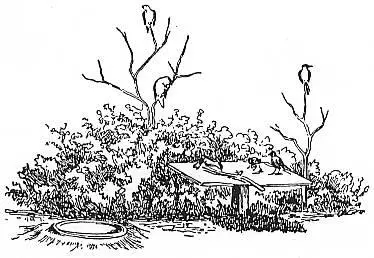
In the country you can make a “club” for the birds, with a “dining room”,
a basin of fresh water, and branches to lounge on.
CAMP FIRE YARN NO. 16
PLANTS
Trees and Their Leaves - Eatable Plants
Plant Observation
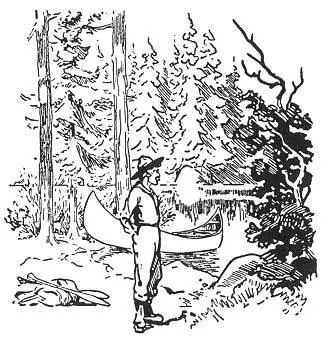
A backwoodsman who lives far away from human habitations in the deep forests must know about useful trees and other plants.
A Scout often has to describe the country he has been through. If he reports that it is “well wooded,” it might be of great importance for the reader of his report to know what kind of trees the woods were composed of.
For instance, if the wood were of fir or larch trees it would mean you could get poles for building bridges. If it were cocoa palm trees, you know you could get nuts for eating and “milk” for drinking. Willow trees mean water close by. Pine or sugar bush or gum trees would mean lots of good fuel.
A Scout should therefore make a point of learning the names and appearances of trees in his country.
He should get hold of a leaf of each kind and compare it with the leaf on the tree, and then get to know the general shape and appearance of each kind of tree, so he can recognize it at a distance—not only in summer, but also in winter. Some trees have typical shapes—as the Oak, Elm and Poplar in the sketches. See if you can find others, say of Pine, Birch, Willow, and so on.
Guardian of the Woods
As a Scout, you are the guardian of the woods. A Scout never damages a tree by hacking it with his knife or axe. It does not take long to fell a tree, but it takes many years to grow one, so a Scout cuts down a tree for a good reason only—not just for the sake of using his axe. For every tree felled, two should be planted.
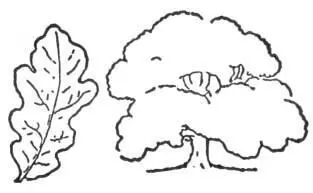
Learn to sketch the leaves and outline of trees, such as this oak.
Firewood
It is seldom necessary to chop trees even for firewood, as usually there is plenty of dead wood lying about on the ground. Or a dead branch can be broken off a tree. Dead wood burns far more easily than green wood.
Читать дальшеИнтервал:
Закладка:
Похожие книги на «Scouting for Boys»
Представляем Вашему вниманию похожие книги на «Scouting for Boys» списком для выбора. Мы отобрали схожую по названию и смыслу литературу в надежде предоставить читателям больше вариантов отыскать новые, интересные, ещё непрочитанные произведения.
![Роберт Баден-Пауэлл - Искусство скаута-разведчика[Scouting for boys ; Искусство Разведки для мальчиков]](/books/70572/robert-baden-pauell-iskusstvo-skauta-thumb.webp)










Обсуждение, отзывы о книге «Scouting for Boys» и просто собственные мнения читателей. Оставьте ваши комментарии, напишите, что Вы думаете о произведении, его смысле или главных героях. Укажите что конкретно понравилось, а что нет, и почему Вы так считаете.