Bernard Cornwell - Gallows Thief
Здесь есть возможность читать онлайн «Bernard Cornwell - Gallows Thief» — ознакомительный отрывок электронной книги совершенно бесплатно, а после прочтения отрывка купить полную версию. В некоторых случаях можно слушать аудио, скачать через торрент в формате fb2 и присутствует краткое содержание. Жанр: Старинная литература, на английском языке. Описание произведения, (предисловие) а так же отзывы посетителей доступны на портале библиотеки ЛибКат.
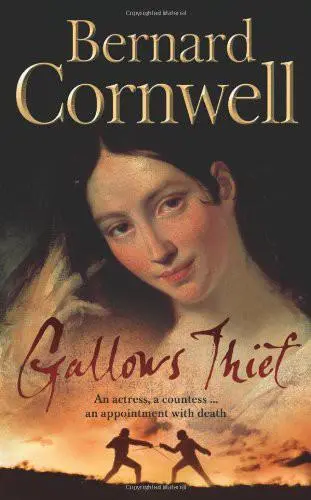
- Название:Gallows Thief
- Автор:
- Жанр:
- Год:неизвестен
- ISBN:нет данных
- Рейтинг книги:4 / 5. Голосов: 1
-
Избранное:Добавить в избранное
- Отзывы:
-
Ваша оценка:
Gallows Thief: краткое содержание, описание и аннотация
Предлагаем к чтению аннотацию, описание, краткое содержание или предисловие (зависит от того, что написал сам автор книги «Gallows Thief»). Если вы не нашли необходимую информацию о книге — напишите в комментариях, мы постараемся отыскать её.
Gallows Thief — читать онлайн ознакомительный отрывок
Ниже представлен текст книги, разбитый по страницам. Система сохранения места последней прочитанной страницы, позволяет с удобством читать онлайн бесплатно книгу «Gallows Thief», без необходимости каждый раз заново искать на чём Вы остановились. Поставьте закладку, и сможете в любой момент перейти на страницу, на которой закончили чтение.
Интервал:
Закладка:
How long before the horsemen arrived? Ten minutes? Probably less. Sandman thought of turning the coach and going back to the village where there had been a crossroads, but there was no room to turn the vehicle and so, when Meg was safely bundled aboard, Mackeson urged the horses on and Sandman told him to take the first turning off the road. Any lane or farm track would do, but perversely there was none, and as the coach lurched on Sandman expected to see the horsemen appear at any second. He stared ahead, watching for the dust to show above the trees. At least the countryside was heavily wooded here, which meant that the coach would be hidden almost until they encountered the riders, and then, just as Sandman was despairing of ever finding an escape route, a narrow lane fell off to the right and he ordered Mackeson to take it.
'Rough old road, that,' Mackeson warned him.
'Just take it!'
The vehicle swung into the lane, narrowly missing the gnarled bole of an oak tree as it negotiated the sharp bend. 'I hope this goes somewhere,' Mackeson sounded amused, 'or else we're stuck to buggery.'
The coach lurched and swayed alarmingly, for the lane was nothing but deep old cart ruts that had solidified in the dry mud, but it ran between thick hedges and wide orchards and every yard took them farther from the London road. Sandman made Mackeson stop after a couple of hundred yards and then stood on the carriage roof and stared back, but he could see no horsemen on the road. Had he let his fears make him too cautious? Then Meg screamed, screamed again, and Sandman, scrambling down off the roof, heard a slap. The scream stopped and he jumped down to the road. Berrigan dropped the unbroken window. 'Only a bleeding wasp,' he said, flicking the dead insect into the hedge. 'You'd think it was a bleeding crocodile the fuss she bleeding makes!'
'I thought she was murdering you,' Sandman said, then he started to climb back up onto the coach, only to be checked by Berrigan's raised hand. He stopped, listened and heard the sound of hoofbeats.
The sound passed. The group of horsemen was on the main road, but they were not coming down this narrow lane. Sandman touched the hilt of the pistol stuck into his belt and he remembered a day up in the Pyrenees when, with a small forage party, he had been hunted by a score of dragoons. He had lost three men that day, all cut down by the straight French swords and he had only escaped because a Greenjacket officer had chanced by with a dozen men who had used their rifles to drive the horsemen away. There was no chance of a friendly rifle officer today. Would the horsemen search the lane? The hoofbeats had faded, but Sandman was reluctant to order the coach on for the vehicle was noisy, but he reflected that Meg's scream had been noisier still and that had brought no pursuers, so he hauled himself up to the box and nodded to Mackeson. 'Gently now,' he said, 'just ease her on.'
'Can't do nothing else,' Mackeson said, nodding ahead to where the lane bent sharply to the left. 'I'll have to take her on the verge, Captain, and it's a tight turn.'
'Just go slowly.' Sandman stood and looked back, but no horsemen were in sight.
'So what are we going to do?' Mackeson asked.
'There'll be a farm down here somewhere,' Sandman said, 'and if the worst comes to the worst we'll unhitch the horses, manhandle the coach round, and harness up again.'
'She ain't a vehicle built for rough roads,' Mackeson said reprovingly, but he clicked his tongue and gave an almost imperceptible tremor to the reins. The lane was narrow and the turn was excruciatingly tight, but the horses took it slowly. The carriage lurched as the wheels mounted the verge and the horses, sensing the resistance, slackened their pull so that Mackeson cracked the whip above their heads and twitched the reins again and just then the leading left wheel slid down a bank obscured by grass and dock leaves and the whole carriage tilted and Mackeson flailed for balance as Sandman gripped the handrail on the roof. The horses neighed in protest, Meg screamed in alarm, then the spokes of the wheel, taking the weight of the whole carriage in the hidden ditch, snapped one after the other and, inevitably, the wheel rim shattered and the coach lurched hard down. Mackeson had somehow managed to stay on his seat. 'I told you she ain't built for the country,' he said resentfully, 'it's a town vehicle.'
'It ain't any kind of bloody vehicle now,' Berrigan said. He had scrambled out of the canted passenger compartment and helped the two women down to the road.
'Now what will you do?' Mackeson demanded of Sandman.
Sandman teetered on the top of the coach. He was watching the road behind and listening. The wheel had broken loudly and the body of the carriage had thumped noisily onto the ditch's bank, and he thought he could hear hoofbeats again.
He drew the pistol. 'Everyone!' he snapped. 'Be quiet!'
Now he was sure he could hear the hooves, and he was certain the sound was getting closer. He cocked the pistol, jumped down to the road and waited.
===OO=OOO=OO===
The Reverend Horace Cotton, Ordinary of Newgate, seemed to crouch in his pulpit, eyes closed, as though he gathered all his forces, physical and mental, for some supreme effort. He took a breath, clenched his fists, then gave an anguished cry that echoed from the high beams of the Newgate chapel. 'Fire!' he wailed. 'Fire and pain and flames and agony! All the bestial torments of the devil await you. Fire everlasting and pain unimaginable and unassuaged weeping and the gnashing of teeth and when the pain will seem to you to be unbearable, when it will seem that no soul, not even one as rotten as yours, can endure such inflictions for a moment longer, then you will learn that it is but the beginning!' He let that last word ring about the chapel for a few seconds, then lowered his voice to a tone of sweet reason that was scarce above a whisper. 'It is but the beginning of your anguish. It is but the commencement of your punishment which will torment you through eternity. Even as the stars die and new firmaments are born, so you will scream in the fire which will rend your flesh like the tearing of a hook and like the searing of a brand.' He leant from the pulpit, his eyes wide, and stared down into the Black Pew where the two condemned men sat beside the black-painted coffin. 'You will be the playthings of demons,' he promised them, 'racked and burnt and beaten and torn. It will be pain without end. Agony without surcease. Torment without mercy.'
The silence in the chapel was broken by the sound of mallets erecting the scaffold beyond the high windows and by Charles Corday's weeping. The Reverend Cotton straightened, pleased that he had broken one of the wretches. He looked at the pews where the other prisoners sat, some waiting for their own turn in the Black Pew and others biding their time before they were taken to the ships that would carry them to Australia and oblivion. He looked higher up at the public gallery, crowded as it ever was on the day before a hanging. The worshippers in that gallery paid for the privilege of watching condemned felons listen to their burial service. It was a warm day and earlier in the service some of the women in the gallery had tried to cool themselves with fans, but no painted cardboard fluttered now. Everyone was still, everyone was silent, everyone was caught up in the terrible words that the Ordinary span like a web of doom above the heads of the two condemned men.
'It is not I who promises you this fate,' the Reverend Cotton said in warning, 'it is not I who foresees your soul's torment, but God! God has promised you this fate! Through all eternity, when the saints are gathered beside the crystal river to sing God's praises, you will scream in pain.' Charles Corday sobbed, his thin shoulders heaving and his head lowered. His leg irons, joined to an iron band about his waist, chinked slightly as he shuddered with each sob. The Keeper, in his own family pew just behind the Black Pew, frowned. He was not sure these famous sermons were of much help in keeping order within the prison, for they reduced men and women to quivering terror or else prompted an impious defiance. The Keeper would have much preferred a quiet and dignified service, mumbled and sedate, but London expected the Ordinary to put on a display and Cotton knew how to live up to those expectations.
Читать дальшеИнтервал:
Закладка:
Похожие книги на «Gallows Thief»
Представляем Вашему вниманию похожие книги на «Gallows Thief» списком для выбора. Мы отобрали схожую по названию и смыслу литературу в надежде предоставить читателям больше вариантов отыскать новые, интересные, ещё непрочитанные произведения.




Обсуждение, отзывы о книге «Gallows Thief» и просто собственные мнения читателей. Оставьте ваши комментарии, напишите, что Вы думаете о произведении, его смысле или главных героях. Укажите что конкретно понравилось, а что нет, и почему Вы так считаете.