Bernard Cornwell - Gallows Thief
Здесь есть возможность читать онлайн «Bernard Cornwell - Gallows Thief» — ознакомительный отрывок электронной книги совершенно бесплатно, а после прочтения отрывка купить полную версию. В некоторых случаях можно слушать аудио, скачать через торрент в формате fb2 и присутствует краткое содержание. Жанр: Старинная литература, на английском языке. Описание произведения, (предисловие) а так же отзывы посетителей доступны на портале библиотеки ЛибКат.
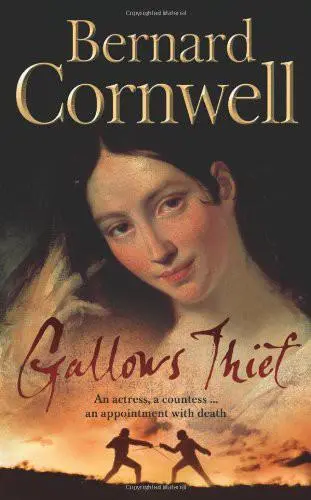
- Название:Gallows Thief
- Автор:
- Жанр:
- Год:неизвестен
- ISBN:нет данных
- Рейтинг книги:4 / 5. Голосов: 1
-
Избранное:Добавить в избранное
- Отзывы:
-
Ваша оценка:
Gallows Thief: краткое содержание, описание и аннотация
Предлагаем к чтению аннотацию, описание, краткое содержание или предисловие (зависит от того, что написал сам автор книги «Gallows Thief»). Если вы не нашли необходимую информацию о книге — напишите в комментариях, мы постараемся отыскать её.
Gallows Thief — читать онлайн ознакомительный отрывок
Ниже представлен текст книги, разбитый по страницам. Система сохранения места последней прочитанной страницы, позволяет с удобством читать онлайн бесплатно книгу «Gallows Thief», без необходимости каждый раз заново искать на чём Вы остановились. Поставьте закладку, и сможете в любой момент перейти на страницу, на которой закончили чтение.
Интервал:
Закладка:
Sandman edged a woman aside so he could sit opposite Corday. 'I need to talk to you about the maid,' he said softly, 'about Meg. I don't suppose you knew her surname? No? So what did Meg look like?'
'Your friend shouldn't have hit him!' Corday, still distracted by his companion's pain, complained to Sandman.
'What did she bloody look like, son?' Berrigan shouted in his best sergeant's manner, and Corday twitched with sudden terror, then set aside the half-finished portrait and, without a word, began to sketch on a clean sheet of paper. He worked fast, the charcoal making a small scratching noise in the silence of the big room.
'She's young,' Corday said, 'maybe twenty-four or-five? She has a pockmarked skin and mouse-coloured hair. Her eyes have a greenish tint and she has a mole here.' He flicked a mark on the girl's forehead. 'Her teeth aren't good. I've only drawn her face, but you should know she had broad hips and a narrow chest.'
'Small tits, you mean?' Berrigan growled.
Corday blushed. 'She was small above the waist,' he said, 'but big beneath it.' He finished the drawing, frowned at it for a moment, then nodded in satisfaction and handed the sheet to Sandman.
Sandman stared at the picture. The girl was ugly, and then he thought she was more than ugly. It was not just the pox-scarred skin, the narrow jaw, the scrawny hair and small eyes, but a suggestion of knowing hardness that sat strangely on such a young face. If the portrait was accurate then Meg was not just repulsive, but evil. 'Why would the Countess employ such a creature?' he asked.
'They worked together in the theatre,' Corday said.
'Worked together? Meg was an actress?' Sandman sounded astonished.
'No, she was a dresser.' Corday looked down at the portrait and seemed embarrassed. 'She was more than a dresser, I think.'
'More than?'
'A procuress,' Corday said, looking up at Sandman.
'How do you know?'
The painter shrugged. 'It's strange how people will talk when you're making their portrait. They forget you're even there. You just become part of the furniture. So the Countess and Meg talked, I listened.'
'Did you know,' Sandman asked, 'that the Earl didn't commission the portrait?'
'He didn't?' That was plainly news to Corday. 'Sir George said he did.'
Sandman shook his head. 'It was commissioned by the Seraphim Club. Have you heard of it?'
'I've heard of it,' Corday said, 'but I've never been there.'
'So you wouldn't know why they commissioned the portrait?'
'How would I know that?' Corday asked.
Berrigan had come to stand at Sandman's shoulder. He grimaced at the sight of Meg's portrait and Sandman turned the drawing so Berrigan could get an even better look. 'Did you ever see her?' he asked, wondering if the girl had ever been taken to the Seraphim Club, but Berrigan shook his head.
Sandman looked back to Corday. 'There is a chance,' he said, 'that we shall find her.'
'How great a chance?' Corday's eyes were glistening.
'I don't know,' Sandman said. He saw the hope fade in Corday's eyes. 'Do you have ink here?' he asked. 'A pen?'
Corday had both and Sandman tore one of the big pieces of drawing paper in half, dipped the steel nib in the ink, let it drain and began to write. 'Dear Witherspoon,' he began, 'the bearer of this letter, Sergeant Samuel Berrigan, is a companion of mine. He served in the First Foot Guards and I trust him absolutely.' Sandman was not certain those last four words were entirely true, but he had little choice now but to assume Berrigan was trustworthy. He dipped the nib into the ink again, conscious that Corday was reading the words from across the table. 'The regrettable possibility occurs that I might need to communicate with his lordship on Sunday next and, in the presumption that his lordship will not be at the Home Office on that day, I beg you to tell me where he might be found. I apologise for prevailing upon your time, and assure you I do it only because I may have matters of the gravest urgency to report.' Sandman read the letter over, subscribed it, and blew on the ink to dry it. 'He won't like that,' he said to no one in particular, then folded the letter and stood.
'Captain!' Corday, his eyes full of tears, appealed to Sandman.
Sandman knew what the boy wanted to hear, but he could not offer him any kind of assurance. 'I am doing my best,' he said lamely, 'but I can promise you nothing.'
'You're going to be all right, Charlie,' the bearded West Countryman consoled Corday and Sandman, who could add nothing more helpful, thrust the portrait inside his coat and led Berrigan back to the prison entrance.
The Sergeant shook his head in apparent wonder when they reached the Lodge. 'You didn't tell me he was a bloody pixie!'
'Does it matter?'
'It would be nice to think we was making an effort for a proper man,' Berrigan growled.
'He's a very good painter.'
'So's my brother.'
'He is?'
'He's a house-painter, Captain. Gutters, doors and windows. And he ain't a pixie like that little worm.'
Sandman opened the prison's outer door and shuddered at the sight of the pelting rain. 'I don't much like Corday either,' he confessed, 'but he's an innocent man, Sergeant, and he doesn't deserve the rope.'
'Most of those who hang don't.'
'Maybe. But Corday's ours, pixie or not.' He gave Berrigan the folded letter. 'Home Office. You ask to see a man called Sebastian Witherspoon, give him that, then meet me at Gunter's in Berkeley Square.'
'And all for a bloody pixie, eh?' Berrigan asked, then he thrust the letter into a pocket and, with a grimace at the rain, dashed out into the traffic. Sandman, limping painfully, followed more slowly.
He feared that the rain might have persuaded Eleanor and her mother to abandon their expedition, but he walked to Berkeley Square anyway and was soaked by the time he arrived at the door of Gunter's. A footman stood under the shelter of the shop's awning and looked askance at Sandman's shabby coat, then opened the door reluctantly as if to give Sandman time to reflect on whether he really wanted to go inside.
The front of the shop was made of two wide windows behind which were gilded counters, spindly chairs, tall mirrors and spreading chandeliers that had been lit because the day was so gloomy. A dozen women were shopping for Gunter's famous confections; chocolates, meringue sculptures and delicacies of spun-sugar, marzipan and crystallised fruit. The conversation stopped as Sandman entered and the women stared at him as he dripped on the tiled floor, then they began talking again as he made his way to the large room at the back where a score of tables were set beneath the wide skylights of stained glass. Eleanor was not at any of the half-dozen occupied tables, so Sandman hung his coat and hat on a bentwood stand and took a chair at the back of the room where he was half hidden by a pillar. He ordered coffee and a copy of the Morning Chronicle.
He idly read the newspaper. There had been more rick-burnings in Sussex, a bread riot in Newcastle, and three mills burnt and their machines broken in Derbyshire. The militia had been summoned to keep the peace in Manchester, where flour had been selling at four shillings and ninepence a stone. The magistrates in Lancashire were calling on the Home Secretary to suspend habeas corpus as a means of restoring order. Sandman looked at his watch and saw that Eleanor was already ten minutes late. He sipped the coffee and felt uncomfortable because the chair and table were too small, making him feel as though he were perched in a school room. He looked back to the newspaper. A river had flooded in Prussia and it was feared there were at least a hundred drowned. The whale ship Lydia out of Whitehaven was reported lost with all hands off the Grand Banks. The East Indiaman Calliope had arrived in the Pool of London with a cargo of porcelain, ginger, indigo and nutmegs. A riot at the Covent Garden Theatre had left heads and bones broken, but no serious casualties. Reports that a shot had been fired in the theatre were being denied by the managers. There was the click of footsteps, a wafting of perfume and a sudden shadow fell across his newspaper. 'You look gloomy, Rider,' Eleanor's voice said.
Читать дальшеИнтервал:
Закладка:
Похожие книги на «Gallows Thief»
Представляем Вашему вниманию похожие книги на «Gallows Thief» списком для выбора. Мы отобрали схожую по названию и смыслу литературу в надежде предоставить читателям больше вариантов отыскать новые, интересные, ещё непрочитанные произведения.








Обсуждение, отзывы о книге «Gallows Thief» и просто собственные мнения читателей. Оставьте ваши комментарии, напишите, что Вы думаете о произведении, его смысле или главных героях. Укажите что конкретно понравилось, а что нет, и почему Вы так считаете.