Bernard Cornwell - Gallows Thief
Здесь есть возможность читать онлайн «Bernard Cornwell - Gallows Thief» — ознакомительный отрывок электронной книги совершенно бесплатно, а после прочтения отрывка купить полную версию. В некоторых случаях можно слушать аудио, скачать через торрент в формате fb2 и присутствует краткое содержание. Жанр: Старинная литература, на английском языке. Описание произведения, (предисловие) а так же отзывы посетителей доступны на портале библиотеки ЛибКат.
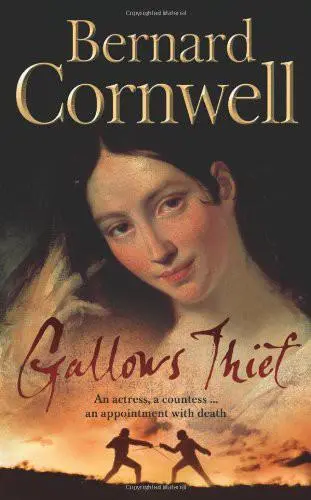
- Название:Gallows Thief
- Автор:
- Жанр:
- Год:неизвестен
- ISBN:нет данных
- Рейтинг книги:4 / 5. Голосов: 1
-
Избранное:Добавить в избранное
- Отзывы:
-
Ваша оценка:
Gallows Thief: краткое содержание, описание и аннотация
Предлагаем к чтению аннотацию, описание, краткое содержание или предисловие (зависит от того, что написал сам автор книги «Gallows Thief»). Если вы не нашли необходимую информацию о книге — напишите в комментариях, мы постараемся отыскать её.
Gallows Thief — читать онлайн ознакомительный отрывок
Ниже представлен текст книги, разбитый по страницам. Система сохранения места последней прочитанной страницы, позволяет с удобством читать онлайн бесплатно книгу «Gallows Thief», без необходимости каждый раз заново искать на чём Вы остановились. Поставьте закладку, и сможете в любой момент перейти на страницу, на которой закончили чтение.
Интервал:
Закладка:
'A wish?' Sandman asked.
'It is not a step to b-be taken lightly,' Lord Christopher said sternly.
'Indeed not,' Sandman said.
'And my father knows that when he dies and the family fortune passes to me that it will be used in God's service. That annoys him.'
The conversation, Sandman thought, had passed a long way from Lord Christopher's assertion that his father had committed the murder. 'It is, I understand,' he said carefully, 'a considerable fortune?'
'Very considerable,' Lord Christopher said evenly.
Sandman leant back. Gales of laughter gusted about the taproom which was crowded now, though folk instinctively avoided the booth where Sandman and Lord Christopher talked so earnestly. Lord Alexander was staring with doglike devotion at Sally, oblivious of the other men trying to catch her attention. Sandman looked back to the diminutive Lord Christopher. 'Your stepmother,' he said, 'had a considerable household in Mount Street. What happened to those servants?'
Lord Christopher blinked rapidly as if the question surprised him. 'I have no conception.'
'Would they have gone to your father's estate?'
'They might.' Lord Christopher sounded dubious. 'Why do you ask?'
Sandman shrugged, as if the questions he was asking were of no great importance, though the truth was that he disliked Lord Christopher and he also knew that dislike was as irrational and unfair as his distaste for Charles Corday. Lord Christopher, like Corday, lacked what, for want of a better word, Sandman thought of as manliness. He doubted that Lord Christopher was a pixie, as Sally would put it, indeed the glances he kept throwing towards Sally suggested the opposite, but there was a petulant weakness in him. Sandman could imagine this small, learned man as a clergyman obsessed with his congregation's pettiest sins, and his distaste for Lord Christopher meant he had no wish to prolong this conversation so instead of admitting to Meg's existence he just said that he would like to discover from the servants what had happened on the day of the Countess's murder.
'If they're loyal to my father,' Lord Christopher said, 'they will tell you nothing.'
'Why should that loyalty make them dumb?'
'Because he killed her!' Lord Christopher cried too loudly, and immediately blushed when he saw he had attracted the attention of folk at other tables. 'Or at least he c-caused her to be killed. He has gout, he no longer walks far, but he has men who are loyal to him, men who do his bidding, evil men.' He shuddered. 'You must tell the Home Secretary that Corday is innocent.'
'I doubt it will make any difference if I do,' Sandman said.
'No? Why? In God's name, why?'
'Lord Sidmouth takes the view that Corday has already been found guilty,' Sandman explained, 'so to change that verdict I need either to produce the true murderer, with a confession, or else adduce proof of Corday's innocence that is incontrovertible. Opinion, alas, does not suffice.'
Lord Christopher gazed at Sandman in silence for a few heartbeats. 'You must?'
'Of course I must.'
'Dear God!' Lord Christopher seemed astonished and leant back, looking faint. 'So you have five days to find the real killer?'
'Indeed.'
'So the boy is doomed, is he not?'
Sandman feared Corday was doomed, but he would not admit it. Not yet. For there were still five days left to find the truth and thus to steal a soul from Newgate's scaffold.
===OO=OOO=OO===
At half past four in the morning a pair of lamps glimmered feebly from the windows of the yard of the George Inn. Dawn was touching the roofs with a wan gleam. A caped coachman yawned hugely, then flicked his whip at a snarling terrier that slunk out of the way of the massive coachhouse doors that were dragged open to reveal a gleaming dark-blue mail coach. The vehicle, bright with new varnish and with its doors, windows, harness pole and splinter bar picked out in scarlet, was manhandled onto the yard's cobbles where a boy lit its two oil lanterns and a half-dozen men heaved the mail bags into its boot. The eight horses, high-stepping and frisky, their breath misting the night air, were led from the stables. The two coachmen, both in the Royal Mail's blue and red livery and both armed with blunderbusses and pistols, locked the boot and then watched as the team was harnessed. 'One minute!' a voice shouted, and Sandman drank the scalding coffee that the inn had provided for the mail's passengers. The lead coachman yawned again, then clambered up to the box. 'All aboard!'
There were four passengers. Sandman and a middle-aged clergyman took the front seat with their backs to the horses, while an elderly couple sat opposite them and so close that their knees could not help touching Sandman's. Mail coaches were light and cramped, but twice as fast as the larger stage coaches. There was a squeal of hinges as the inn yard's gates were dragged open, then the carriage swayed as the coachmen whipped the team out into Tothill Street. The sound of the thirty-two hooves echoed sharp from houses and the wheels cracked and rumbled as the coach gathered speed, but Sandman was fast asleep again by the time it reached Knightsbridge.
He woke at about six o'clock to find the coach was rattling along at a fine pace, swaying and lurching through a landscape of small fields and scattered coverts. The clergyman had a notebook on his lap, half-moon spectacles on his nose and a watch in his hand. He was peering through the windows on either side, searching for milestones, and saw that Sandman had woken.
'A fraction over nine miles an hour!' he exclaimed.
'Really?'
'Indeed!' Another milestone passed and the clergyman began working out sums on the page of his notebook. 'Ten and carry three, that's half again, minus sixteen, carry two. Well, I never! Certainly nine and a quarter! I once travelled at an average velocity of eleven miles an hour, but that was in eighteen-o-four and it was a very dry summer. Very dry, and the roads were smooth—' the coach hit a rut and lurched violently, throwing the clergyman against Sandman's shoulder— 'very smooth indeed,' he said, then peered through the window again. The elderly man clutched a valise to his chest and looked terrified, as though Sandman or the clergyman might prove to be a thief, though in truth highwaymen like Sally's brother were a much greater danger. Not this morning, though, for Sandman saw that two robin redbreasts were riding escort. The redbreasts were the Horse Patrol, all retired cavalrymen who, uniformed in blue coats over red waistcoats and armed with pistols and sabres, guarded the roads close to London. The two patrolmen kept the coach company until it clattered through a village and there the pair peeled away towards a tavern where, despite the early hour, a couple of men in long smocks were already sitting in the porch and drinking ale.
Sandman gazed fixedly out of the window, revelling in being out of London. The air seemed so remarkably clean. There was no pervading stench of coal smoke and horse dung, just the morning sunlight on summer leaves and the sparkle of a stream twisting beneath willows and alders beside a field of grazing cattle who looked up as the coachman sounded the horn. They were still close to London and the landscape was flat, but well drained. Good hunting country, Sandman thought, and imagined pursuing a fox beside this road. He felt his dream horse gather itself and leap a hedge, heard the huntsman's horn and the hounds giving tongue.
'Going far?' The clergyman interrupted his reverie.
'Marlborough.'
'Fine town, fine town.' The clergyman, an archdeacon, had abandoned his computations about the coach's speed and now rambled on about visiting his sister in Hungerford. Sandman made polite responses, but still kept looking out of the window. The fields were near harvest and the heads of rye, barley and wheat were heavy. The land was becoming hillier now, but the rattling, swaying and jolting coach kept up its fine pace and spewed a tail of dust that whitened the hedgerows. The horn warned folk of its approach and children waved as the eight horses thundered past. A blacksmith, leather apron blackened by fire, stood in his doorway. A woman shook her fist when her flock of geese scattered from the coach's noise, a child whirled a rattle in a vain attempt to drive predatory jays from rows of pea plants, then the sound of the trace chains and hooves and clattering wheels was echoing back from the seemingly endless wall of a great estate.
Читать дальшеИнтервал:
Закладка:
Похожие книги на «Gallows Thief»
Представляем Вашему вниманию похожие книги на «Gallows Thief» списком для выбора. Мы отобрали схожую по названию и смыслу литературу в надежде предоставить читателям больше вариантов отыскать новые, интересные, ещё непрочитанные произведения.









Обсуждение, отзывы о книге «Gallows Thief» и просто собственные мнения читателей. Оставьте ваши комментарии, напишите, что Вы думаете о произведении, его смысле или главных героях. Укажите что конкретно понравилось, а что нет, и почему Вы так считаете.