Bernard Cornwell - Gallows Thief
Здесь есть возможность читать онлайн «Bernard Cornwell - Gallows Thief» — ознакомительный отрывок электронной книги совершенно бесплатно, а после прочтения отрывка купить полную версию. В некоторых случаях можно слушать аудио, скачать через торрент в формате fb2 и присутствует краткое содержание. Жанр: Старинная литература, на английском языке. Описание произведения, (предисловие) а так же отзывы посетителей доступны на портале библиотеки ЛибКат.
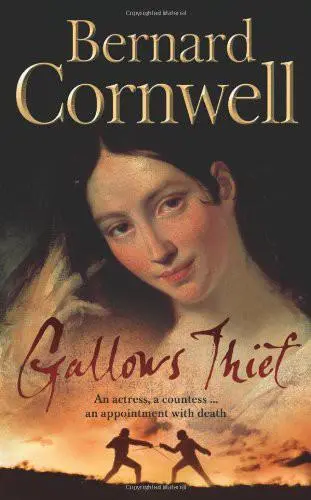
- Название:Gallows Thief
- Автор:
- Жанр:
- Год:неизвестен
- ISBN:нет данных
- Рейтинг книги:4 / 5. Голосов: 1
-
Избранное:Добавить в избранное
- Отзывы:
-
Ваша оценка:
Gallows Thief: краткое содержание, описание и аннотация
Предлагаем к чтению аннотацию, описание, краткое содержание или предисловие (зависит от того, что написал сам автор книги «Gallows Thief»). Если вы не нашли необходимую информацию о книге — напишите в комментариях, мы постараемся отыскать её.
Gallows Thief — читать онлайн ознакомительный отрывок
Ниже представлен текст книги, разбитый по страницам. Система сохранения места последней прочитанной страницы, позволяет с удобством читать онлайн бесплатно книгу «Gallows Thief», без необходимости каждый раз заново искать на чём Вы остановились. Поставьте закладку, и сможете в любой момент перейти на страницу, на которой закончили чтение.
Интервал:
Закладка:
So though Eleanor might not marry where she wanted, she would be allowed to ask her maidservant to delve the gossip from Mount Street. 'I shall write to you,' Eleanor said to Sandman, 'if you tell me where?'
'Care of the Wheatsheaf,' Sandman told her, 'in Drury Lane.'
Eleanor stood and, rising onto tiptoe, kissed her father's cheek. 'Thank you, Papa,' she said.
'Whatever for?'
'For letting me do something useful, even if it is only encouraging Lizzie's propensity for gossip, and thank you, Rider.' She took his hand. 'I'm proud of you.'
'I hope you always were.'
'Of course I was, but this is a good thing you're doing.' She held onto his hand as the door opened.
Lady Forrest came in. She had the same red hair and the same beauty and the same force of character as her daughter, though Eleanor's grey eyes and intelligence had come from her father. Lady Forrest's eyes widened when she saw her daughter holding Sandman by the hand, but she forced a smile. 'Captain Sandman,' she greeted him in a voice that could have cut glass, 'this is a surprise.'
'Lady Forrest,' Sandman managed a bow, despite his trapped hand.
'Just what are you doing, Eleanor?' Lady Forrest's voice was now only a few degrees above freezing.
'Reading Rider's palm, Mama.'
'Ah!' Lady Forrest was immediately intrigued. She feared her daughter's unsuitable attachment to a pauper, but was thoroughly attracted to the idea of supernatural forces. 'She will never read mine, Captain,' Lady Forrest said, 'she refuses. So what do you see there?'
Eleanor pretended to scrutinise Sandman's palm. 'I scry,' she said portentously, 'a journey.'
'Somewhere pleasant, I hope?' Lady Forrest said.
To Scotland,' Eleanor said.
'It can be very pleasant at this time of year,' Lady Forrest remarked.
Sir Henry, wiser than his wife, saw a reference to Gretna Green looming. 'Enough, Eleanor,' he said quietly.
'Yes, Papa,' Eleanor let go of Sandman's hand and dropped her father a curtsey.
'So what brings you here, Rid—' Lady Forrest almost forgot herself, but managed a timely correction. 'Captain?'
'Rider very kindly brought me news of a rumour that the Portuguese might be defaulting on their short-term loans,' Sir Henry answered for Sandman, 'which doesn't surprise me, I must say. We advised against the conversion, as you'll remember, my dear.'
'You did, dear, I'm sure.' Lady Forrest was not sure at all, but she was nevertheless satisfied with the explanation. 'Now, come, Eleanor,' she said, 'tea is being served and you are ignoring our guests. We have Lord Eagleton here,' she told Sandman proudly.
Lord Eagleton was the man whom Eleanor was supposed to be marrying and Sandman flinched. 'I'm not acquainted with his lordship,' he said stiffly.
'Hardly surprising,' Lady Forrest said, 'for he only moves in the best of circles. Henry, must you smoke in here?'
'Yes,' Sir Henry said, 'I must.'
'I do hope you enjoy your visit to Scotland, Captain,' Lady Forrest said, then led her daughter away and closed the door on the cigar smoke.
'Scotland,' Sir Henry said gloomily, then shook his head. 'They don't hang nearly as many in Scotland as we do in England and Wales. Yet, I believe, the murder rate is no higher.' He stared at Sandman. 'Strange that, wouldn't you say?'
'Very strange, sir.'
'Still, I suppose the Home Office knows its business.' He turned and gazed moodily into the hearth. 'It isn't a quick death, Rider, not quick at all, yet the Keeper was inordinately proud of the whole process. Wanted our approbation and insisted on showing us the rest of the prison.' Sir Henry fell silent, frowning. 'You know,' he went on after a while, 'there's a corridor from the prison to the Sessions House? So the prisoners don't need to walk in the street when they go to trial. Birdcage Walk, they call it, and it's where they bury the hanged men. And women, I suppose, though the girl I saw hanged was taken to the surgeons for dissection.' He had been looking into the empty fireplace as he spoke, but now looked up at Sandman. 'The flagstones of Birdcage Walk were wobbling, Rider, wobbling. That's because the graves are always settling underneath them. They had casks of lime there to hasten the decomposition. It was vile. Indescribably vile.'
'I'm sorry you had to experience it,' Sandman said.
'I thought it my duty,' Sir Henry replied with a shudder. 'I was with a friend and he took an indecent delight in it all. The gallows is a necessary thing, of course it is, but not to be enjoyed, surely? Or am I being too scrupulous?'
'You're being very helpful, Sir Henry, and I'm grateful.'
Sir Henry nodded. 'It'll be a day or two before you get your answer, I'm sure, but let's hope it helps. Are you going? You must come again. Rider, you must come again.' He took Sandman through to the hall and helped him with his coat.
And Sandman walked away, not even noticing whether it was raining or not.
He was thinking of Lord Eagleton. Eleanor had not behaved as though she were in love with his lordship, indeed she had made a face expressing distaste when his lordship's name was mentioned, and that gave Sandman hope. But then, he asked himself, what did love have to do with marriage? Marriage was about money and land and respectability. About staying above financial ruin. About reputation.
And love? God damn it, Sandman thought, but he was in love.
===OO=OOO=OO===
It was not raining now, indeed it was a beautiful late afternoon with a rare clear sky above London. Everything looked clean-cut, newly washed, pristine. The rain clouds had flown westwards and fashionable London was spilling onto the streets. Open carriages, pulled by matching teams with polished coats and ribboned manes, clipped smartly towards Hyde Park for the daily parade. Street bands vied with each other, trumpets shrilling, drums banging and collectors shaking their money boxes. Sandman was oblivious.
He was thinking of Eleanor and when he could no longer wring any clue as to her intentions from every remembered glance and nuance, he wondered what he had achieved in the day. He had learnt, he thought, that Corday had mostly told him the truth and he had confirmed to himself that bored young aristocrats were among the least courteous of all men, and he had usefully started Eleanor's maid on her search for gossip, but in truth, he had not learnt much. He could not report anything to Viscount Sidmouth. So what to do?
He thought about that when he returned to the Wheatsheaf and took his laundry down to the woman who charged a penny for each shirt, and he had to stand talking for twenty minutes or else she took offence. Then he stitched up his boots, using a sailmaker's needle and palm leather which he borrowed from the landlord and when his boots were crudely mended he brushed his coat, trying to get a stain out of the tail. He reflected that of all the inconveniences of poverty, the lack of a servant to keep clothes clean was the most time-consuming. Time. It was what he needed most, and he tried to decide what he should do next. Go to Wiltshire, he told himself. He did not want to go because it was far, it would be expensive and he had no assurance that he would find the girl Meg if he went, but if he waited to hear from Eleanor then it might already be too late. There was a chance, even a good chance, that the servants from the London house had all been taken down to the Earl's country estate. So go there, he told himself. Catch the mail coach in the morning and he would be there by early afternoon and he could catch the mail coach back in the next day's dawn, but he cringed at the expense. He thought of using a stage coach and guessed that would cost no more than a pound each way, but the stage coach would not get him to Wiltshire before the evening, it would probably take him at least two or three hours to find the Earl of Avebury's house, and so he was unlikely to reach it before dark, and that meant he would have to wait until next morning to approach the household, while if he used the mail coach he would be at the Earl's estate by mid-afternoon at the latest. It would cost him at least twice as much, but Corday only had five days left and Sandman counted his change and wished he had not been so generous as to buy Sally Hood her dinner, then chided himself for that ungallant thought and walked down to the mail office on Charing Cross where he paid two pounds and seven shillings for the last of the four seats on the next morning's mail to Marlborough.
Читать дальшеИнтервал:
Закладка:
Похожие книги на «Gallows Thief»
Представляем Вашему вниманию похожие книги на «Gallows Thief» списком для выбора. Мы отобрали схожую по названию и смыслу литературу в надежде предоставить читателям больше вариантов отыскать новые, интересные, ещё непрочитанные произведения.




Обсуждение, отзывы о книге «Gallows Thief» и просто собственные мнения читателей. Оставьте ваши комментарии, напишите, что Вы думаете о произведении, его смысле или главных героях. Укажите что конкретно понравилось, а что нет, и почему Вы так считаете.