Thomas Perry - Vanishing Act
Здесь есть возможность читать онлайн «Thomas Perry - Vanishing Act» весь текст электронной книги совершенно бесплатно (целиком полную версию без сокращений). В некоторых случаях можно слушать аудио, скачать через торрент в формате fb2 и присутствует краткое содержание. Жанр: Старинная литература, на английском языке. Описание произведения, (предисловие) а так же отзывы посетителей доступны на портале библиотеки ЛибКат.
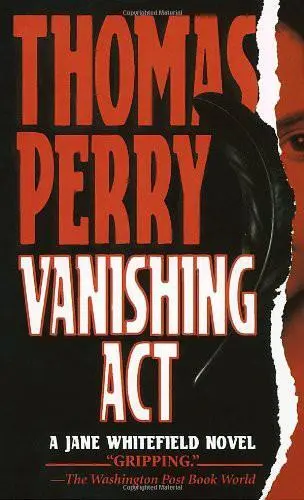
- Название:Vanishing Act
- Автор:
- Жанр:
- Год:неизвестен
- ISBN:нет данных
- Рейтинг книги:4 / 5. Голосов: 1
-
Избранное:Добавить в избранное
- Отзывы:
-
Ваша оценка:
Vanishing Act: краткое содержание, описание и аннотация
Предлагаем к чтению аннотацию, описание, краткое содержание или предисловие (зависит от того, что написал сам автор книги «Vanishing Act»). Если вы не нашли необходимую информацию о книге — напишите в комментариях, мы постараемся отыскать её.
--The New York Times
Jane Whitefield is a Native American guide who leads people out of the wilderness--not the tree-filled variety but the kind created by enemies who want you dead. She is in the one-woman business of helping the desperate disappear. Thanks to her membership in the Wolf Clan of the Seneca tribe, she can fool any pursuer, cover any trail, and then provide her clients with new identities, complete with authentic paperwork. Jane knows all the tricks, ancient and modern; in fact, she has invented several of them herself.
So she is only mildly surprised to find an intruder waiting for her when she returns home one day. An ex-cop suspected of embezzling, John Felker wants Jane to do for him what she did for his buddy Harry Kemple: make him vanish. But as Jane opens a door out of the world for Felker, she walks into a trap that will take all her heritage and cunning to escape....
"Thomas Perry keeps pulling fresh ideas and original characters out of thin air. The strong-willed heroine he introduces in Vanishing Act rates as one of his most singular creations."
--The New York Times Book Review
ONE THRILLER THAT MUST BE READ . . . . Perry has created his most complex and compelling protagonist."
--San Francisco Examiner
Vanishing Act — читать онлайн бесплатно полную книгу (весь текст) целиком
Ниже представлен текст книги, разбитый по страницам. Система сохранения места последней прочитанной страницы, позволяет с удобством читать онлайн бесплатно книгу «Vanishing Act», без необходимости каждый раз заново искать на чём Вы остановились. Поставьте закладку, и сможете в любой момент перейти на страницу, на которой закончили чтение.
Интервал:
Закладка:
When Jake was satisfied that neither shotgun would blow up in his face if he had occasion to pull the trigger, he put them inside the hall closet. He saw that Jane had made the only bed and put the other blanket on the couch. She came out of the kitchen, picked up the shotguns, and pushed four shells into each one. He approved of her not putting a shell in the chamber. She also had enough sense to lay them flat on the floor by the door instead of propping them up. Then she went back into the kitchen to cook two frozen dinners of steaks and mashed potatoes and broccoli, and he approved of this even more, so he left her alone. By now Jane had virtually disappeared; she was living entirely inside her head.
After dinner they washed the two dishes he had bought, and Jake sat on the couch. He had expected Jane to sit down with him, but she brought the two little baby monitors into the living room, got down on the floor, and started doing stretching exercises like dancers did while she listened to the static. As he watched her, he thought about how odd it was to watch children grow up. Miraculously, the little seven-pound animals that looked like hairless monkeys changed into something that looked like this, and what was in their heads at the end of the process seemed to get farther and farther away from what you would expect.
He couldn’t keep silent any longer. "I had a funny thing happen today," he said. "I couldn’t find the Pacific Ocean."
"Remind me not to let you navigate." He could see her move her lips, returning to her counting.
"I found it eventually, through sheer persistence. But it reminded me of the Herndons. Did any Herndons come up with you?"
"There were two. Betty was my age—valedictorian of my class, I think—and she had an older brother. He had a streak of gray when he was about fifteen, and everybody thought he was handsome and mysterious. Actually, I guess he looked like a skunk."
"Paul, that was. He’s an engineer or something way out west. Maybe around here."
"Is, that why the Pacific Ocean reminded you of the Herndons?"
"No. The part about being mysterious did. The one I was thinking of would be Paul’s grandfather’s sister. Amanda was her name. People always said the money came from some Herndon who invented something in the 1800s, but you’d never hear it from them. There used to be rumors about them when I was a kid."
"What kind of rumors?"
"Well, there was never a dumb Herndon. Some people used to say that the good Lord chose to have every Herndon born with a complete knowledge of the principles He uses to make the universe work."
"Come on," said Jane. She stopped doing push-ups and looked at him.
"The secret would have been safe with them. They were, every last one of them, too inert to do anything about it and too secretive to tell anybody who wasn’t another Herndon."
Jane sat up, laughing. "You know, that’s true."
"Of course it is. And things always seemed to go just fine. They bought railroad stock, and the railroads went up. They were the sort of people who would have their lawn infested by sables."
"I still don’t see what this has to do with the ocean."
"I was talking about Amanda. She was a grown woman by the time I remember her. But when she was little, maybe two years old, she was swinging on a swing in the front yard. The sun was right in her eyes, and one of the neighbors heard her say, ’Daddy! Move the sun!’ And he smiled at her and stood there and stared up at the sun for a long time, and that was that."
"That was what?"
"Well, you have to think about it. What was he doing?"
"What was he doing?"
"People said later that he did it. He moved the sun about an hour forward. They say the city people didn’t seem to notice it, since the position of the sun didn’t mean much to them. That evening they just looked at their watches one extra time to be sure the hand was on the number that said, ’Go to bed,’ and that was that. The story goes that the scientists with their equipment sure did, but they hushed it up because they couldn’t explain it. The farm folks talked about it for some time, but there wasn’t much they could do about it except add Herndons to the list of things they couldn’t control, like rain and frost."
"That’s the silliest thing I’ve ever heard."
"Well, you know how these things get going. Little Amanda also told several reliable and veracious children that there were two moons, not one. But people remained divided on that issue since it could have been her idea of a joke, and she never said it again after she reached the age of discretion."
"You made all that up, didn’t you?" she asked. "Admit it."
"Not at all. Myself, I’ve always thought the story had to do with daylight savings time. Once you reached the point when the president of the United States could tell you what time it was, as though the sun, the moon, and the rotation of the earth were mere distractions, people realized that anything could happen. There was no limit, or any reason to have one."
She smiled. "Do you really think that’s what it’s about?"
"Maybe," Jake said. "But maybe it’s only about love."
"And maybe it’s about talk." Now she began to do her sit-ups.
"Well, I’m at the stage of life where I’m examining the things I’ve picked up along the way and trying to distribute them where they’ll do some good. This is how I got them, so I talk."
"You always talked too much," she said. "You can’t pull that deathbed-legacy stuff on me."
"I didn’t say the story was going to change your life," he said. "But we live by picking up the belongings of the dead as they fall. The first few things you learn tend to be the most important—the mental equivalent of a pocket full of money or a serviceable revolver. After you’re a little older—"
She said, "Wait ..." She picked up one of the monitors and listened, then put it down and held the other near her ear. "Did you hear that?"
21
Jane slipped out the door of the laundry room, stepped along the side of the apartment building quietly, then sat down beside a bush against the corner of the building. The scent of the yellow night-blooming wisteria and jasmine and what else—the jacaranda trees, probably—was overpowering. She had seen the petals falling on the ground like purple snow. It must be the jacaranda because the bright explosions of cerise and orange bougainvillea climbing up the walls didn’t smell at all.
She made herself small, hugging her knees and keeping her head down to listen. There was a faint noise of slow, careful footsteps beside the building. It sounded like the walk of a man who was in good shape—he held his body in tension, then eased to the next foot, but he wasn’t very good at this. She kept listening, but she didn’t hear another set of feet. It could be John.
She let the man reach the window of Harry’s apartment and listened to his breathing. He was taking in breaths through his open mouth and blowing them out quietly to keep himself calm. She judged the level, and felt the disappointment. He was only about six feet, a little taller than she was. Not John, then.
Maybe it was a policeman checking the window. Jane waited, holding her crouch. It was too late to slip away now. He was too close. She waited for the flashlight. She could make it over the fence to the next building in a couple of seconds, while he was still saying "Stop or I’ll shoot," but she decided not to. There was no such thing as one policeman: It was like one ant. She could survive what he would do if he saw her. She had rented the apartment, so this would just be a loss of anonymity.
Then she heard the man fiddling with something in his pocket, rattling keys or change or something, and then a click. Next there was a scraping noise, and she decided to look. The man was wide at the shoulders, wearing a sportcoat the way a cop would to cover a weapon, but he was prying out the window screen. When he had set it on the ground, he slipped his knife blade in farther, and she heard a metallic scrape and a clank.
Читать дальшеИнтервал:
Закладка:
Похожие книги на «Vanishing Act»
Представляем Вашему вниманию похожие книги на «Vanishing Act» списком для выбора. Мы отобрали схожую по названию и смыслу литературу в надежде предоставить читателям больше вариантов отыскать новые, интересные, ещё непрочитанные произведения.


Обсуждение, отзывы о книге «Vanishing Act» и просто собственные мнения читателей. Оставьте ваши комментарии, напишите, что Вы думаете о произведении, его смысле или главных героях. Укажите что конкретно понравилось, а что нет, и почему Вы так считаете.