Thomas Perry - The Face-Changers
Здесь есть возможность читать онлайн «Thomas Perry - The Face-Changers» весь текст электронной книги совершенно бесплатно (целиком полную версию без сокращений). В некоторых случаях можно слушать аудио, скачать через торрент в формате fb2 и присутствует краткое содержание. Жанр: Старинная литература, на английском языке. Описание произведения, (предисловие) а так же отзывы посетителей доступны на портале библиотеки ЛибКат.
- Название:The Face-Changers
- Автор:
- Жанр:
- Год:неизвестен
- ISBN:нет данных
- Рейтинг книги:5 / 5. Голосов: 1
-
Избранное:Добавить в избранное
- Отзывы:
-
Ваша оценка:
The Face-Changers: краткое содержание, описание и аннотация
Предлагаем к чтению аннотацию, описание, краткое содержание или предисловие (зависит от того, что написал сам автор книги «The Face-Changers»). Если вы не нашли необходимую информацию о книге — напишите в комментариях, мы постараемся отыскать её.
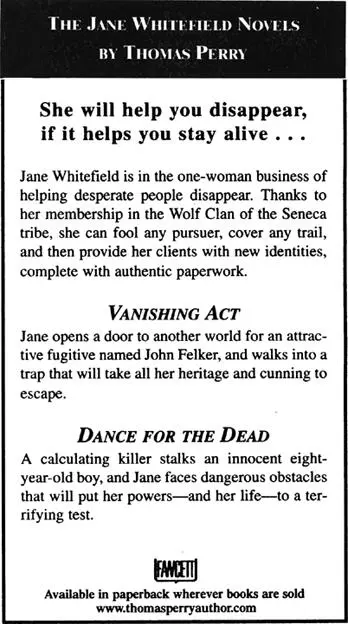
From the Paperback edition.
The Face-Changers — читать онлайн бесплатно полную книгу (весь текст) целиком
Ниже представлен текст книги, разбитый по страницам. Система сохранения места последней прочитанной страницы, позволяет с удобством читать онлайн бесплатно книгу «The Face-Changers», без необходимости каждый раз заново искать на чём Вы остановились. Поставьте закладку, и сможете в любой момент перейти на страницу, на которой закончили чтение.
Интервал:
Закладка:
Folger said, “Thanks very much, Doctor. I assume you’ll be going home from here?”
“I suppose so,” Carey said. “Unless my patient turns up.”
“We’ll let you know if he does.”
“Thanks.” Carey stood up. The others remained seated, waiting for him to leave. He opened the door and stepped out, then turned around to close it. The last thing he saw confirmed his impression. The captain, the female detective, and the uniformed officer were all looking attentively at the man in the dark suit. The man in the dark suit was staring straight into Carey’s eyes until the door closed.
Agent Marshall said quietly, “That’s what I was afraid of.”
Captain Folger shook his head. “It’s hard to believe that a man like that would put himself in this kind of trouble.”
Marshall sighed. “Have you ever read any medical books?”
“Can’t say that I have.”
“There’s not much in them. You don’t learn to be a surgeon by studying. After medical school you do four years of surgical residency at some hospital, helping out and doing the easy ones. Then you go find yourself the best surgeon you can, and you spend the next three or four years finding out how he does it and trying to learn to do it too. Dahlman was the one McKinnon picked out. McKinnon owes him what he has, what he does, who he is.”
“It’s a damned shame to see him paying off like this.”
Marshall looked at the papers in the file in front of him and shook his head. “Fifteen minutes for a nine-millimeter round at twelve feet, and a sixty-seven-year-old is up and running. If I ever take a hit, McKinnon is the one I want to dig it out of me. He would have been, anyway.” He tossed the file on the table and rubbed his eyes wearily, then squared his shoulders. “All right. Can you spare two officers around the clock for McKinnon?”
“I guess we’ll have to.” Folger turned to the policewoman.
“I’ll put a team on it right away,” she said.
“I’ll have them take care of the wiretaps in Washington. The phone company will set it up so his phones can be monitored from there.”
“Thanks. That will save us some man-hours.”
“We’ll do the lab work and print identification on whatever your people find here. Anything else you need, don’t be shy. The worst I can say is no, and you know in advance I won’t want to. I’d like to wrap this up in the next couple of days, but for now let’s act as though it’s going to get long and ugly.”
8
As Jane drove along Route 62, she began to feel the old habits of mind coming back to her. Years of experience had taught her that the decisions she made during the first few hours would determine whether her runner was safe or merely a step ahead.
She was satisfied that she’d had no choice but to take Dahlman out of Buffalo tonight. The authorities would assume that a wounded man could not have gone far. They would look for him hardest in the immediate vicinity, and keep moving outward for a few days. They would knock on doors and interview everyone who could conceivably have seen or heard anything. For at least a month, it was going to be very difficult for a man in his sixties to show his face in Buffalo without getting a lot of inquisitive stares. If Dahlman so much as walked past a window, somebody might call the police. But if she could get Dahlman out of this part of the country, there was a good chance that wherever she took him, few people would have heard of him, and the local police would have their own fugitives to hunt.
The police were the immediate threat, but what they did made sense, so they were predictable. Her mind kept returning to the two men at the hospital. When she had pulled into the parking lot in a police car, they had hidden their guns in the weeds, so there was no possibility that they had anything to do with any police organization.
Who were they? She glanced over her shoulder at Dahlman. He was asleep on the back seat, so for the moment, she couldn’t ask him any questions. The sudden arrival of people Dahlman didn’t seem to have recognized, who were prepared to kill him in police custody, raised Dahlman’s problem to a new level.
Jane had believed Carey when he had said that Dahlman had been framed for a murder. What that had meant to her was that some person who knew both Dahlman and Sarah Hoffman had killed her and hit on some unusually effective way of throwing suspicion in another direction. Jane had only temporarily suspended her disbelief enough to accept Carey’s statement that Dahlman would not be safe from the framer if he went to jail. It was possible. If Dahlman had something to say that the killer was worried about, it wasn’t that difficult to find a prisoner who could be paid to make sure he didn’t live to say it.
But in Jane’s experience, lone killers were shy about the process. The killer had to go to an intermediary, negotiate a deal for the second murder, and then wait to see whether the other side delivered or turned him in. Her skepticism had triggered her reflex to construct alternative plans. She had decided to listen to Dahlman’s story as soon as possible, and then decide whether the threat was real. If she was sure that Dahlman was wrong, she would teach him to recite a plausible tale about why he had been scared enough to leave the hospital, then return to Buffalo and drop him off at the police station.
When she had picked up the guns the two men had hidden in the weeds, her skepticism had been obliterated. In its place was mystification. Dahlman’s adversary wasn’t some solitary amateur who had killed Sarah Hoffman and shifted the blame onto him. He was being hunted by professionals. That raised the possibility that Sarah Hoffman had been killed by professionals, and that the frame had been constructed by professionals.
What attraction would two doctors engaged in medical research have for people like that? Doctors had drugs. They tended to have money, houses and offices full of nice things, and cars that might interest thieves. Doctors engaged in research that had intriguing implications might excite a pharmaceutical manufacturer or a jealous rival. Sarah Hoffman might have had some secrets that Carey didn’t know about—a gambling problem or a boyfriend who called himself a “developer” or “investor” or “consultant” but was actually a gangster. No answer she could think of was more likely than any other. Until she had asked Dahlman all of the questions and listened to all of the answers, she would know nothing. She didn’t even know for sure whether Dahlman was innocent. Having armed men hunting him didn’t exactly prove he had not murdered Sarah Hoffman.
Jane looked at Dahlman again. He was still asleep, so for the moment he was invisible to a casual glance from a distance, but if a policeman were to pull them over, he could hardly fail to notice that there was an old man lying there, and that he looked sick.
Jane was only as far as North Collins when she noticed the headlights behind her. She watched and waited, hoping they would turn off in Lawtons, then Gowanda, Conewango, Clear Creek, but they stayed there, just far enough back so she couldn’t really see the car. When she slowed down, so did they. As she approached Jamestown she began to feel tense. Jamestown was big enough to have policemen who stayed alert at night, and the hour was half past eleven, when traffic was thin. If the ones behind were policemen, they could easily have called ahead and consulted with the local authorities. They would have asked them to pick a spot to set up a blind roadblock.
Pulling over a suspected murderer was a delicate matter. They would want a big complement of policemen waiting, and Jamestown was the last city of sufficient size to have one. They would want to do it in a place where he couldn’t shoot bystanders, so it would be outside of town. No, she couldn’t even count on that. Since it was long after business hours, they might choose to divert him into a cul-de-sac in an industrial area where he would be surrounded on three sides by high walls lined with sharpshooters.
Читать дальшеИнтервал:
Закладка:
Похожие книги на «The Face-Changers»
Представляем Вашему вниманию похожие книги на «The Face-Changers» списком для выбора. Мы отобрали схожую по названию и смыслу литературу в надежде предоставить читателям больше вариантов отыскать новые, интересные, ещё непрочитанные произведения.




Обсуждение, отзывы о книге «The Face-Changers» и просто собственные мнения читателей. Оставьте ваши комментарии, напишите, что Вы думаете о произведении, его смысле или главных героях. Укажите что конкретно понравилось, а что нет, и почему Вы так считаете.