Diane Davidson - Chopping Spree
Здесь есть возможность читать онлайн «Diane Davidson - Chopping Spree» весь текст электронной книги совершенно бесплатно (целиком полную версию без сокращений). В некоторых случаях можно слушать аудио, скачать через торрент в формате fb2 и присутствует краткое содержание. Жанр: Старинная литература, на английском языке. Описание произведения, (предисловие) а так же отзывы посетителей доступны на портале библиотеки ЛибКат.
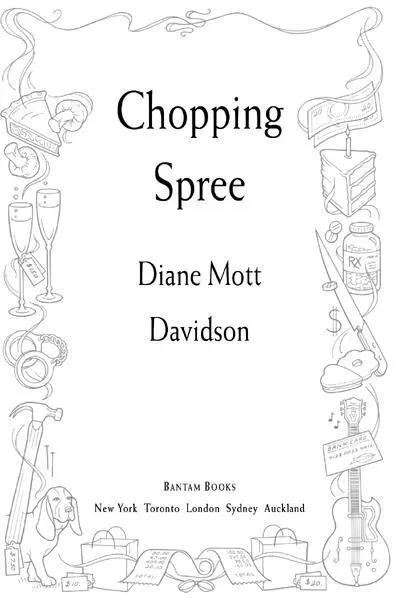
- Название:Chopping Spree
- Автор:
- Жанр:
- Год:неизвестен
- ISBN:нет данных
- Рейтинг книги:5 / 5. Голосов: 1
-
Избранное:Добавить в избранное
- Отзывы:
-
Ваша оценка:
Chopping Spree: краткое содержание, описание и аннотация
Предлагаем к чтению аннотацию, описание, краткое содержание или предисловие (зависит от того, что написал сам автор книги «Chopping Spree»). Если вы не нашли необходимую информацию о книге — напишите в комментариях, мы постараемся отыскать её.
_For Colorado caterer Goldy Schulz, business isn't just booming--it's skyrocketing. But as her friend Marla is constantly warning her, "Success can kill you." Goldy knows she needs to slow down before she breaks down, and she vows she'll do it--right after her next booking: a cocktail party for the Westside Mall's Elite Shoppers Club.
It's the event of the shopping season: the Princess Without a Pricetag party for the wealthy shopaholics who drop at least a thousand dollars a week at the mall. Goldy has been hired by charming mall manager Barry Dean to cater the jewel-encrusted affair. But she has hardly begun setting up when she finds herself in the path of a truck that has no intention of stopping until both she and Barry are crushed beneath it. Muddied, bruised, embarrassed, but determined to do her job, Goldy manages to get the party started on time with the help of her trusted assistants Julian Teller and Liz Fury.
But with the outbreak of an ugly marital spat among the guests, the behavior of Barry's flighty young girlfriend, and Barry's own strange actions after the truck incident, the event is--by Goldy's standards--a catastrophe. And it's about to get worse. When she goes to pick up her check, she finds an old friend lying dead in a pile of sale shoes--stabbed with one of Goldy's new knives. Hours later, Julian is the prime suspect in the murder.To prove Julian's innocence, Goldy must catch the real killer. But to do that, she will have to figure out why the victim was carrying a powerful narcotic. And why was a private investigator called in shortly before the murder? Was the killer connected to a mall renovation project--or the eviction of a disgruntled tenant? Or was the villain the odd lover out in a violent love triangle?
Between whipping up Sweethearts' Swedish Meatballs, Quiche Me Quick, and Diamond Lovers' Hot Crab Dip, and digging up clues, Goldy knows this is going to be one tough case to crack. And her gourmet sleuth's instinct tells her that the final course will be a real killer.
Chopping Spree — читать онлайн бесплатно полную книгу (весь текст) целиком
Ниже представлен текст книги, разбитый по страницам. Система сохранения места последней прочитанной страницы, позволяет с удобством читать онлайн бесплатно книгу «Chopping Spree», без необходимости каждый раз заново искать на чём Вы остановились. Поставьте закладку, и сможете в любой момент перейти на страницу, на которой закончили чтение.
Интервал:
Закладка:
I placed my hot chocolate firmly in the cup holder and turned my attention to the road.
During the drive, the boys joked mercilessly about the dissection and who was going to puke first. I clenched my teeth and decided not to accompany the boys inside. I had calls to make and a stomach to calm. But once in the hospital parking lot, the anatomy teacher hailed the van and said she was hoping all the moms could accompany the class, at least for the first ten minutes. I gulped the rest of my cocoa (for strength), hopped out carefully onto the ice, and told myself to buck up. After all, I’d seen corpses before, hadn’t I?
As we filed into the small, windowless room, the odor of formaldehyde hit me like a slap. Undoubtedly kept as a sterile environment, the hospital classroom reminded me of the Furman County Morgue. A sheet draped the body, which lay on a metal table. Rows of gleaming medical instruments sat at the ready on a nearby wheeled shelf. I took a deep breath—not a smart idea, as the horrid odor flooded my lungs—and did a yoga centering exercise.
No matter how you tell yourself to detach from your feelings, it’s impossible not to be apprehensive and sad when faced with a dead body. Once, the chilled flesh under this sheet had been a child, had played, and loved, and been loved. I shivered. When the teacher pulled back the sheet from the dead man’s face, I squeezed my eyes shut and tried the yoga exercise again. When I reopened my eyes, the corpse’s gray face and dark head of hair came into view. I slid my eyes around the group of students. Their bravado had evaporated. Instead, looks of fear, horror, and shock registered on the kids’ faces. A boy and a girl bolted from the room simultaneously. When the boy threw up on the linoleum floor outside the dissection room, the girl, who was racing to the ladies’, noisily followed suit.
After ten minutes of cleaning up, settling down, and comforting from the nurses and the teacher, the red-faced pair rejoined the class. Quite uncharacteristically, their classmates made no fun, but patted their peers on the back and murmured that they’d almost blown lunch, too.
Once things had calmed down, the teacher explained to the sickly-looking-but-attentive class that the subject was a middle-aged male, a diabetic with heart disease who’d died in his sleep in a small-town motel at the southwestern edge of Colorado. No family had claimed the body. The county coroner had determined the cause and manner of death, that is, that the man had died of a heart attack. There were no signs of a struggle, no foul play was suspected, et cetera. Since the unclaimed body was of a relatively young man who hadn’t been too fat, too thin, or a drug user, the Pueblo County Coroner, instead of doing an autopsy, had contacted the state anatomical board to offer the corpse as a donation for study. The board had accepted the specimen.
I steeled myself as the teacher gently peeled back the sheet. The kids gripped one another’s arms and turned even more pale, but managed to keep their equilibrium. I was proud of them. After a moment, they began to study the specimen, thank God. It took courage to pull out their notebooks, turn academic attention toward the corpse, and start acting as if this really was a lab, and not hell.
The dead man had been short and stocky, with a flat abdomen and wide shoulders. Well-developed muscles had strained under skin that was now as gray as the trunk of a dead tree. Long, thin black hair curled over the cadaver’s ears. An unremarkable face was distinguished by a nose that looked as if it had been broken more than once. The teacher droned on, explaining that at one point this man, an insulin-dependent diabetic, had suffered from gangrene. The effects of that disease were still visible. The class nodded, took notes, and donned surgical gloves while my eyes traveled the length of the body.
And then I gasped.
To distract the students from my gaffe, the teacher hastily murmured about how they needed to check their notebooks carefully, that they needed to follow the procedure they had been taught. I pressed my lips together and forced myself to look again at the cadaver’s right foot.
Yes, this man had once been someone’s son, had loved and played. He’d also once worked as a construction manager at Westside Mall. Unless I was very much mistaken, the deceased was Lucas No-toe Holden.
CHAPTER 16
I made a hand sign to the teacher, mouthing that I’d be right back. The poor woman nodded at me distractedly as I tore out of the classroom, no doubt certain I, too, was about to be sick. In my distress, I nevertheless remembered that cell phones were prohibited in hospitals. A phone , I thought desperately, I need a pay phone. Tom will know what to do.
I raced at a clippety-clop down a linoleum-floored hall with echoing pastel-painted walls. The phone booth, however, boasted walls, a floor, and ceiling completely covered with carpet. It was so quiet I felt paranoid as I whispered my frantic discovery to Tom.
“Goldy, the sheriff’s department can’t touch that body,” Tom replied calmly when I’d finished. “The only person who can deal with it is the county coroner.”
“But… what about the hospital ? Can’t they at least confirm this guy’s identity? I mean, if it is Holden, that has to mean something. Maybe someone murdered him. Maybe the person who murdered Barry killed No-toe—”
“Hold on a sec.” Tom called across to an associate, asking him to call the coroner’s office and check if the cadaver now in the Lutheran Hospital teaching lab was Lucas Holden. In the distance, someone promised to get right on it. Tom returned to me.
“Miss G., the hospital’s not going to know the name of the donor.” He was tapping computer keys. I rubbed my forehead. Maybe I was overreacting. Maybe there were a lot of corpses with missing toes, and I was going overboard. “Yeah,” Tom said, “we’re still looking for Lucas Holden since it’s an open case of a missing person. The coroner will talk to the anatomical board first, I can guarantee you that. He’ll find out exactly how and where they got this body, then send a staff member over to the hospital. OK? But if this guy with the missing toe died of natural causes in a remote area, that really doesn’t tell us much. Well, except why we haven’t been able to find him.”
“If it is Holden, he was a diabetic. If Holden had to inject insulin, he could have been given a shot of something else, something to precipitate a heart attack. Heroin, say. They didn’t do an autopsy, remember.”
“Miss G., please. The anatomical board won’t accept a cadaver where there’s any suspicion of foul play. And you also have to ask yourself why someone would want to kill this Holden. If he was an insulin-dependent diabetic with heart disease, any doctor is going to say you’d expect him to drop dead at the first opportunity. I’m not trying to be negative here. It’s just the truth.”
“Maybe Holden saw something,” I insisted stubbornly. “Maybe he knew something. There must be a link. And you are being negative.” My fingers drummed the vertical carpet. “Did you get anything back on the Page Stockham shoe situation? I just found out Page separated from Marla and Ellie in the parking lot that night.”
He inhaled, an attempt to be patient. “The three women did tell us they were at the shoe sale, Goldy. They all agree they left just before nine. If they hadn’t bought shoes, I’d be suspicious. But I’ll mention to the guys that I think Page Stockham should be questioned again. If she doesn’t have an alibi for the time Barry was killed, and if she was a bona fide enemy of his, they’ll be interested. And before you ask, the Teddy Fury failed car-stealing incident involved a VW bug.”
Читать дальшеИнтервал:
Закладка:
Похожие книги на «Chopping Spree»
Представляем Вашему вниманию похожие книги на «Chopping Spree» списком для выбора. Мы отобрали схожую по названию и смыслу литературу в надежде предоставить читателям больше вариантов отыскать новые, интересные, ещё непрочитанные произведения.


Обсуждение, отзывы о книге «Chopping Spree» и просто собственные мнения читателей. Оставьте ваши комментарии, напишите, что Вы думаете о произведении, его смысле или главных героях. Укажите что конкретно понравилось, а что нет, и почему Вы так считаете.