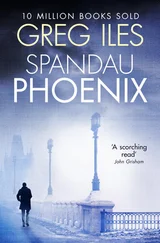
Greg Iles - The Spandau Phoenix
Здесь есть возможность читать онлайн «Greg Iles - The Spandau Phoenix» — ознакомительный отрывок электронной книги совершенно бесплатно, а после прочтения отрывка купить полную версию. В некоторых случаях можно слушать аудио, скачать через торрент в формате fb2 и присутствует краткое содержание. Жанр: Старинная литература, на английском языке. Описание произведения, (предисловие) а так же отзывы посетителей доступны на портале библиотеки ЛибКат.

- Название:The Spandau Phoenix
- Автор:
- Жанр:
- Год:неизвестен
- ISBN:нет данных
- Рейтинг книги:5 / 5. Голосов: 1
-
Избранное:Добавить в избранное
- Отзывы:
-
Ваша оценка:
The Spandau Phoenix: краткое содержание, описание и аннотация
Предлагаем к чтению аннотацию, описание, краткое содержание или предисловие (зависит от того, что написал сам автор книги «The Spandau Phoenix»). Если вы не нашли необходимую информацию о книге — напишите в комментариях, мы постараемся отыскать её.
what was in it? Why did the secret intelligence agencies of every major power want it? Why was a brave and beautiful woman kidnapped and sexually tormented to get it? Why did a chain of deception and violent death lash out across the globe, from survivors of the Nazi past to warriors in the new conflict now about to explode? Why did the world's entire history of World War II have to be rewritten as the future hung over a nightmare abyss?
From Publishers Weekly
A neo-Nazi/South African cartel plots to destroy Israel.
From Library Journal
Rudolph Hess--Spandau prisoner number 7--dies in 1987. When a secret "Hess diary" is found at Spandau by a West German policeman, the various police and intelligence agencies stationed in Berlin become even more interested in Hess's 1941 flight to England. Did Hess have highly placed contacts there? Was he alone? Was his well-trained double captured instead? The chain reaction from the diary's discovery explodes around West Germany, England, and South Africa, uncovering secret alliances and double agents. This first novel, which attempts to fill in history's blanks and to tie the past with the present, has action, characters, and violence to spare. But the body count is high, even for this genre, and the novel loses its impact long before the end of the drawn-out plot.
-
The Spandau Phoenix — читать онлайн ознакомительный отрывок
Ниже представлен текст книги, разбитый по страницам. Система сохранения места последней прочитанной страницы, позволяет с удобством читать онлайн бесплатно книгу «The Spandau Phoenix», без необходимости каждый раз заново искать на чём Вы остановились. Поставьте закладку, и сможете в любой момент перейти на страницу, на которой закончили чтение.
Интервал:
Закладка:
mentioned."
"And the fallout?" Horn asked.
"Twenty percent higher than we predicted."
Horn digested this without emotion. "And these figures ... you believe
they are more reliable than our own?"
"Sir, except for the secret Indian Ocean test, all South African figures
are purely theoretical. By definition they are predictions.
The American figures represent verified data."
Horn nodded thoughtfully. "Apply them to our scenario."
"Everything depends on the target, sir. Obviously, groundzero at the
center of Tel Aviv or Jerusalem would obliterate either city. But if
the weapon were used at the right time, its effects could be greatly
enhanced, possibly even doubled, by a collateral factor: the weather."
"How?"
"By the wind, sir. At this time of year the prevailing winds in Israel
blow southeast. If the weapon were detonated in Jerusalem, the fallout
would probably dissipate over Jordan. But if it were detonated inTel
Aviv, not only would it obliterate the city, but it might well spread a
lethal blanket of strontium-90 over Jerusalem within one or two hours."
Horn closed his eyes and sighed with satisfaction. "And if we get the
cobalt-seeded bomb case in time?"
The Afrikaner turned his palms upward. "We won't, sir.
Not sooner than twenty days. The technical problems are formidable."
"But if we did get it?"
Smuts pursed his lips. "With a cobalt-seeded bomb case and the revised
yield figures, I'd say ... sixty percent of the Israeli population would
be dead within fourteen days, and Palestine would be rendered
uninhabitable for at least a decade."
Horn let out a long sigh. "Increase the bounty, Pieter. Five million
rand in gold to the team that delivers a cobalt bomb case within seven
days."
"Yes, sir."
"Do we have any further information on the Israeli doctrinal response?"
Smuts shook his head. "Our London source dried up after we requested
the American satellite photos. Frankly, I don't even trust his initial
reports on that subject."
"Why?"
"Do you really think Israel would target Russian cities?"
Horn smiled. "Of course. It's the only way the Jews could win a war
against a united Arab force. They must be able to prevent Soviet
resupply of the Arabs, and the only way they can do that is to blackmail
the Soviets. What do they have to lose by doing so?"
"But the deployment plan for Israel's nuclear arsenal is the most
closely guarded secret in the world. How could our London source,know
what he claims to know?"
Horn smiled. "Not the most closely guarded secret, Pieter.
No one has yet proved that South Africa's nuclear arsenal even exists."
"Thanks in no small part to us," Smuts observed. The Afrikaner began
cracking his knuckles. "The Russian matter aside, I think we can safely
assume that if Tel Aviv or Jerusalem were destroyed, Israel would go
beyond a measured response. If they knew the source of the attack, they
would respond with a significant portion of their 'black' bomber and
missile forces."
"They will know the source of the attack," Horn rasped.
"There is one unpredictable factor," Smuts said carefully.
"If our clients were to detonate the weapon at Dimona, Israel's
weapons-production plant, there is a slight chance that the rest of the
world might believe the explosion to be a genuine Israeli accident.
The Americans might coerce the Jews into waiting until an outside
investigation was completed.
By that time cooler heads might prevail."
Horn made a dismissive gesture with his skeletal arm.
"Don't worry. I'm relying on Arab impatience, not stupidity.
Hussein, Assad, these men might have the self-control to wait and try to
develop a cohesive plan. N-of our friend. He will strike swiftly.
Consider how quickly he agreed to our meeting. He won't purposefully
hit Jerusalem-there are too many sacred Muslim sites there. And the
security around Dimona is airtight. We needn't worry on that score.
The target will beTel Aviv."
Horn's one living eye focused on the Afrikaner. "What of the Spandau
matter, Pieter? Have they captured the traitor?
Have they found the papers?"
"Not yet, sir. Berlin-One assures me it is only a matter of time.
However, I received a call from his immediate subordinate, Berlin-Two.
He's a lieutenant, I believe. Jiirgen Luhr."
"And?"
"Lieutenant Luhr doesn't feel the prefect is up to the job.
He's moved some of our German assets into play without the prefect's
knowledge. He checked the files on the two missing officers and
dispatched men to all locations they might possibly run to. I approved
his action. Who knows what those Bruderschaft clowns are really doing.
A little competition might speed up the capture."
"I'm surprised that these policemen were able to escape at all," Horn
remarked.
Smuts shifted uncomfortably. "I did a little checking on my own, sir.
The man who betrayed us-Hauer-he's quite an officer, it seems.
An ex-soldier. Even the young man with him was decorated for bravery."
Horn raised a long, crooked finger in Smuts's tanned face.
"Never underestimate the German soldier, Pieter. He is the toughest in
the world. Let this be a lesson to you."
Smuts colored. "Yes, sir."
"Keep me posted hourly. I'm anxious to see how this exsoldier does."
"You almost sound as if you want them to escape."
"Nonsense, Pieter. By getting hold of the Spandau papers, we might well
buy ourselves extra time. At least we can keep the Russians and the
Jews out of our business, if not the British. But that's it, you see.
At this moment mI-5, the KGB, and the Mossad must be scouring Berlin for
our two German policemen, yet so far they have failed to capture them.
If these men live up to their racial heritage, I suspect they will
manage to evade their pursuers. In the end we will have to find them
ourselves."
The Afrikaner nodded. "I'll find them."
Horn smiled coldly. "I know you will, Pieter. If this Hauer but knew
you as I do, he would already have given himself up."
CHAPTER NINE
10.35 Pm. Goethestrasse: West Berlin "There, " Hauer grunted. He had
wedged Hans's Volkswagen so tightly between two parked cars that the one
behind would have to be moved to reveal the license plate.
"All right, where's the house?"
"I'm not sure," Hans replied, peering through his window.
"I've never been here before."
"Are you joking?"
Hauer stared in disbelief "So why are we here?"' "Because it's just what
you asked for-a place we can't be traced to."
Hans climbed out of the VW and started up the deserted street, skirting
the pools of light from the street lamps.
"That's it," he said, glancing back over his shoulder. Hauer followed a
few paces behind. "See it? Eleven-fifty."
"Quiet!" said Hauer. "You'll wake the whole block."
Hans was already halfway up the walk. He rapped loudly on the front
door, waited half a minute, then knocked again.
Finally, a muffled voice came from behind the wood.
"I'm coming already!"
Someone fumbled with the latch, theri, the door opened wide.
Standing in a pair of blue silk pajamas, a tiny man with silver hair and
a tuft of beard squinted through the darkness. He reached for a light
switch.
"Please leave the light off, Herr Ochs," Hans said.
"What? Who are you?" Finally the uniform registered in the old man's
brain. "Polizei," he murmured. "Is there some problem?"
Hans stepped closer. He took the tattered business card from his pocket
Читать дальшеИнтервал:
Закладка:
Похожие книги на «The Spandau Phoenix»
Представляем Вашему вниманию похожие книги на «The Spandau Phoenix» списком для выбора. Мы отобрали схожую по названию и смыслу литературу в надежде предоставить читателям больше вариантов отыскать новые, интересные, ещё непрочитанные произведения.






Обсуждение, отзывы о книге «The Spandau Phoenix» и просто собственные мнения читателей. Оставьте ваши комментарии, напишите, что Вы думаете о произведении, его смысле или главных героях. Укажите что конкретно понравилось, а что нет, и почему Вы так считаете.