Anthony Summers - The Eleventh Day
Здесь есть возможность читать онлайн «Anthony Summers - The Eleventh Day» весь текст электронной книги совершенно бесплатно (целиком полную версию без сокращений). В некоторых случаях можно слушать аудио, скачать через торрент в формате fb2 и присутствует краткое содержание. Жанр: Старинная литература, на английском языке. Описание произведения, (предисловие) а так же отзывы посетителей доступны на портале библиотеки ЛибКат.
- Название:The Eleventh Day
- Автор:
- Жанр:
- Год:неизвестен
- ISBN:нет данных
- Рейтинг книги:3 / 5. Голосов: 1
-
Избранное:Добавить в избранное
- Отзывы:
-
Ваша оценка:
The Eleventh Day: краткое содержание, описание и аннотация
Предлагаем к чтению аннотацию, описание, краткое содержание или предисловие (зависит от того, что написал сам автор книги «The Eleventh Day»). Если вы не нашли необходимую информацию о книге — напишите в комментариях, мы постараемся отыскать её.
The Eleventh Day — читать онлайн бесплатно полную книгу (весь текст) целиком
Ниже представлен текст книги, разбитый по страницам. Система сохранения места последней прочитанной страницы, позволяет с удобством читать онлайн бесплатно книгу «The Eleventh Day», без необходимости каждый раз заново искать на чём Вы остановились. Поставьте закладку, и сможете в любой момент перейти на страницу, на которой закончили чтение.
Интервал:
Закладка:
Had their tradecraft been better, the two men would not have used long-distance communication as much as they did. KSM, concerned about their ability to function in the West, had told them to contact him with urgent questions. Once they had acquired their own cell phones, however, they often used them to call not KSM but relatives in Saudi Arabia and Yemen. They sent emails—both had addresses on Yahoo.com—using their landlord’s computer and those provided free at San Diego State University.
Hazmi and Mihdhar failed utterly to live up to bin Laden’s early expectations. Though Hazmi enrolled in English classes, he learned hardly anything. Mihdhar apparently did not even start the course. The pair’s effort to learn to fly, meanwhile, was tardy, short-lived when it did get started, and hopeless.
More than two months after arriving, the pair attended a one-hour introductory session at a local San Diego flight school. A month later, at another school, they bought equipment and took a few lessons. They said from the start that they wished to fly jets—Boeing airliners—although they had no previous experience. They had no interest in takeoffs or landings. When taken up in a Cessna, one of them began praying loudly.
“They just didn’t have the aptitude,” instructor Rick Garza would recall. “They had no idea.… They were like Dumb and Dumber.” He told bin Laden’s chosen men that flying was simply not for them. That was the end of that.
On June 9, less than five months after arriving and soon after hearing that his wife had given birth to their first child, Mihdhar dropped out and flew back to the Middle East. By any standard, it was an unforgivable lapse. When KSM said as much, though, he was overruled by bin Laden. The operatives’ pathetic bumbling, KSM was to tell the CIA, was not really a disaster. His planning was progressive, a step-by-step affair, he said, and the next step had already been taken.
As Mihdhar left the United States, more competent accomplices arrived.
ONCE BACK in Germany from Afghanistan, the Hamburg-based conspirators had changed so much as to be unrecognizable. To outward appearances, they were no longer the obvious fundamentalists they had been before leaving. They shed the clothing and the beards that marked them out as Muslim radicals, no longer attended the mosques known as haunts of extremists.
Atta fired off emails to thirty-one U.S. flight schools. “We are a small group of young men from different Arab countries,” he wrote in March 2000. “We would like to start training for the career of professional pilot.” The future hijackers declared their passports “lost,” received new ones, and applied for visas to enter the United States.
As a Yemeni with no proof of permanent residence, Ramzi Binalshibh was turned down. His hopes of becoming a pilot hijacker frustrated, he was thenceforth to function as fixer and middle man, liaison to KSM. Binalshibh’s three companions, however, encountered no problems.
Marwan al-Shehhi flew into New York first, at the end of May 2000, with Atta following soon after. Beyond the fact that they took rooms in the Bronx and Brooklyn, how they spent the month that followed remains a mystery. Atta bought a cell phone and calling card—the first of more than a hundred cards the team was to use during the operation. Ziad Jarrah, the last to arrive, headed straight for a flight school in Florida. He had signed up while still in Germany, having seen its advertisement in a German aviation magazine.
Florida Flight Training Center, still in business today, sits beside the runway of the airport at Venice, a quiet retirement community on the Gulf Coast near Sarasota. It was a small operation, and Jarrah got on well with the man who ran it. “He was,” Arne Kruithof was to remember ruefully, “the kind of guy who wanted to be loved.… I remember him bringing me a six-pack of beer at home when I hurt my knee one time.” Jarrah himself, Kruithof said, liked an “occasional bottle of Bud.”
Jarrah’s course was geared to obtaining a Private Pilot License to fly single-engine aircraft. He already had a handle on the theory, having studied aviation mechanics in Germany, and he made quiet, steady progress. A fellow student, Thorsten Bierman, however, found Jarrah self-centered and uncooperative when they flew together. “He wanted to do everything single-handed.”
Atta and Shehhi had left New York and traveled first to look at a flight school in Norman, Oklahoma, at which one of bin Laden’s personal pilots had once trained to fly. As early as 1998, the FBI’s regional office had been alerted to the large number of Arabs learning to fly in the area.
After a tour of that school, however, Atta and Shehhi decided not to enroll. They made their way instead to Venice, Florida, and Huffman Aviation, just a block from the school where Jarrah was already at work. No reliable source, however, has spoken of seeing Jarrah with Atta and Shehhi in Venice. Their tradecraft was superior to that of the inept fellows who had arrived earlier in California.
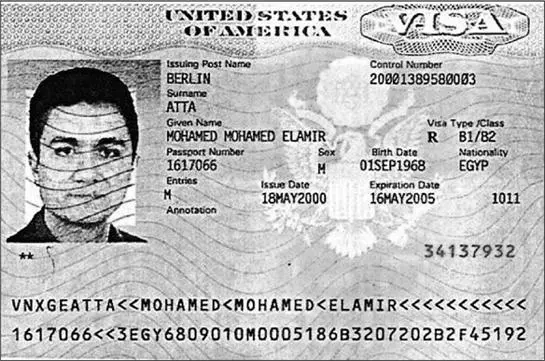
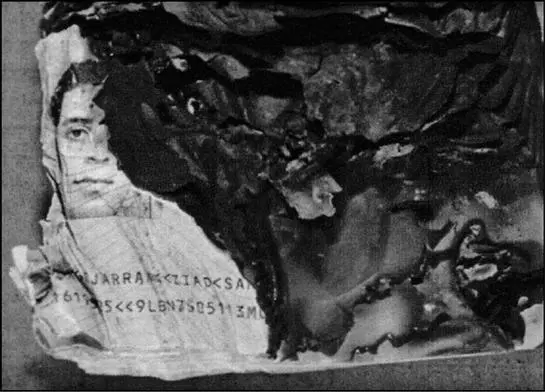
Mohamed Atta’s visa, which got him into the United States in spring 2000, was issued without any prior interview. Ziad Jarrah’s charred visa
(below)
was recovered at the site of the crash of United Flight 93
.
Rudi Dekkers, who ran Huffman, would have nothing good to say about Atta. The hijackers’ team leader, he said, “had an attitude, like he was standing above everybody … very, very arrogant.” Shehhi, by contrast, was a “likeable person, he had fun, he was laughing … this is a male environment, so we talk about girls, planes. But Atta was never socializing.”
Their first flying instructor, Mark Mikarts, was at first just a little nonplussed at the sight of Atta. “When you do flight training,” Mikarts said, “you tend to get a little bit dirty—there’s oil and fuel. You’re sweating. He was always immaculately dressed, with the $200 Gucci shoes, silk shirts, double-hemmed pants. He always overdressed.”
Teaching Atta to handle a Cessna 172, meanwhile, turned out to be a nightmare. “Generally,” said Mikarts,
the first five to ten hours is where a student learns to fly by visual references. Using outside visual references, we’d keep the horizon at a certain part of the windshield. He had a very difficult time learning that. He would always over-rotate, or he couldn’t keep the reference.… But he would not listen.… It was like he had to do it his way.
Then finally one day he over-rotated the airplane and I thought, “I’m going to let him do whatever he wants to do. Let’s see what happens.” He pitches the airplane way up.… The engine is screaming. The stall horn is blaring. The air speed’s bleeding away. We’re about to stall and tumble out of the air. I’m saying, “Nose down!” Next time, louder. Third time, I said, “Nose down!” in a rather nasty tone. [Then] I took my hand and shoved the control wheel forward and stamped on the rudder pedal to get it back where it’s supposed to be. We pitched down so abruptly that he popped out of his seat from the negative g’s—hit his head on the ceiling.
He turned his head towards me and gave me a look like, “You infidel …” or something. Like he wanted to kill me. That’s it, we turned back and he went and complained to my chief pilot.… I said, “If he’s going to be that much of a baby about it and not follow instructions, let him go someplace else. Not worth me breaking my neck and you losing an instructor.”
Читать дальшеИнтервал:
Закладка:
Похожие книги на «The Eleventh Day»
Представляем Вашему вниманию похожие книги на «The Eleventh Day» списком для выбора. Мы отобрали схожую по названию и смыслу литературу в надежде предоставить читателям больше вариантов отыскать новые, интересные, ещё непрочитанные произведения.











Обсуждение, отзывы о книге «The Eleventh Day» и просто собственные мнения читателей. Оставьте ваши комментарии, напишите, что Вы думаете о произведении, его смысле или главных героях. Укажите что конкретно понравилось, а что нет, и почему Вы так считаете.