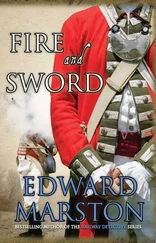
Simon Scarrow - Fire and Sword
Здесь есть возможность читать онлайн «Simon Scarrow - Fire and Sword» весь текст электронной книги совершенно бесплатно (целиком полную версию без сокращений). В некоторых случаях можно слушать аудио, скачать через торрент в формате fb2 и присутствует краткое содержание. Жанр: Старинная литература, на английском языке. Описание произведения, (предисловие) а так же отзывы посетителей доступны на портале библиотеки ЛибКат.
- Название:Fire and Sword
- Автор:
- Жанр:
- Год:неизвестен
- ISBN:нет данных
- Рейтинг книги:5 / 5. Голосов: 1
-
Избранное:Добавить в избранное
- Отзывы:
-
Ваша оценка:
Fire and Sword: краткое содержание, описание и аннотация
Предлагаем к чтению аннотацию, описание, краткое содержание или предисловие (зависит от того, что написал сам автор книги «Fire and Sword»). Если вы не нашли необходимую информацию о книге — напишите в комментариях, мы постараемся отыскать её.
Fire and Sword — читать онлайн бесплатно полную книгу (весь текст) целиком
Ниже представлен текст книги, разбитый по страницам. Система сохранения места последней прочитанной страницы, позволяет с удобством читать онлайн бесплатно книгу «Fire and Sword», без необходимости каждый раз заново искать на чём Вы остановились. Поставьте закладку, и сможете в любой момент перейти на страницу, на которой закончили чтение.
Интервал:
Закладка:
‘I apologise for the delay,’ Arthur explained to Freire, pausing as his words were translated. ‘But my army is far from its home, and I needed to ensure that everything my men required was ready before we marched.’
Freire nodded as he listened. He was a short, wiry man with a neatly clipped beard and moustache. His hair was grey and grizzled and cropped close to the skull. His eyes were deep set and dark and seemed to stare accusingly. As the translator finished he shot back a swift series of comments directed at Arthur.
‘The general asks if all British armies are so slow, or is it that their generals are so cautious?’
Arthur drew a sharp breath before replying.‘Tell the general that my army would have advanced more swiftly if we had received the horses and mules he promised me when we met in Oporto.’
Freire shrugged nonchalantly when the comment was relayed to him.
‘The general says that it was not possible to find any draught animals for you. He says the French had taken them all, and the few that remained were needed by his men.’
‘And what of the supplies that he promised?’ Arthur asked. ‘Where are they?’
‘The general says that without mules and horses he could not transport supplies. In any case, there were few supplies to bring after the French had passed like locusts across the land.What supplies he did find are needed by his men.’
‘I see,’ Arthur muttered, keeping his irritation under control. ‘Please tell the general that we can manage without the things he had promised us for the moment. Now we need to discuss how we might best combine our forces to crush the French invaders.’
Freire raised a hand to stop Arthur and spoke again.
‘The general says that his men are short of food and powder, and that you should supply them with both.’
‘Now, just a minute—’ Somerset started.
Arthur shot a look at his aide. ‘Silence, if you please. Let me deal with this.’ He turned back to Freire. ‘Tell the general that I cannot supply his forces in addition to my own. I am not authorised to do it, and in any case we need all that we can carry as it is.’
‘The general says that without supplies he cannot advance any further towards Lisbon.’
‘Damn it, I will not be blackmailed,’ Arthur said bitterly. ‘Tell him that his government has instructed him to co-operate with me.’
Freire laughed.
‘He says that the government’s word means little to him. He says that his first duty is to his men. He will only co-operate with the British if they supply him with what he needs.’
Arthur clenched his jaws tightly together to avoid giving vent to his growing anger. He turned to Somerset. ‘Can we supply his men?’
‘To a degree, sir. But not for long. There might be a way round this impasse, sir.’
‘Then speak plainly, man!’ Arthur snapped.
‘Yes, sir. Since we lack cavalry we are having to make do with light infantry for some of our scouting.’
‘Yes. So?’
‘Why don’t we offer to feed and supply the general’s light troops, in exchange for having them seconded to our army?’
Arthur considered the idea for a moment and then nodded to the guide to translate. Freire was quiet for a moment as he stroked his beard. Then he nodded and made his reply.
‘He agrees, as long as you provide his men with full rations, and they still remain under his command at all times.’
‘No,’Arthur replied at once.‘As long as I’m feeding ’em, they’re mine to command.’
Freire made a great show of reluctance before finally conceding. Then Arthur moved on to address the matter of the advance on Lisbon. Somerset produced Arthur’s map of the region and spread it out across the cool tiles in the shaded courtyard. Arthur indicated the coastal route leading from Leiria to the capital.
‘This is the route I intend to follow. It is open country and the enemy might well take advantage of the fact to use his cavalry to harass my advance, but until the army is reinforced I must remain in contact with the British fleet following us along the coast. If we combine our forces, we should be able to cope with anything the French can put into the field against us between here and Lisbon.’
The Portuguese general looked at the map and tapped another route, further inland.
‘He says that this is the best route. There are hills here that will conceal the advance. It is safer. He insists we should take this road,’ the guide translated.
‘Out of the question,’ Arthur replied at once. ‘It’s too far from the coast. If it’s mountainous it will only slow down my wagons and artillery. I am taking the coastal road. Tell him.’
Freire was adamant that he would march through the hills and re-join the British outside Lisbon to take part in the liberation of the capital. Then, rising to his feet, Freire announced that he was fatigued and the interview was over. He would give orders for his light infantry to join the British column.With a curt bow, he turned and disappeared inside the house.
Arthur stared after him for a moment. ‘Charming fellow.’
‘Quite,’ Somerset said softly. ‘I just hope this is not typical of the co-operation we can expect from our new allies, sir.’
‘So do I.’ Arthur took a deep breath and smiled. ‘Well, at least we have some extra men to strengthen our army. Pass the word to Colonel Trant. I believe he has some mastery of the local tongue. He can command the Portuguese contingent. Now roll up the map and let us go and hunt the French. Even if our allies prove difficult I am sure we may at least rely on the enemy to be obligingly consistent.’
The British army continued marching south under the blazing sun. To their left, across a small plain, lay the hills where General Freire’s column was supposed to be marching parallel to them, but there was never any sign of Portuguese patrols and Freire might as well be on the moon, Arthur reflected bitterly.To the right lay the sea, and some miles out the British fleet, under reduced sail, kept pace with the army. The sea was calm and sparkled seductively in the sunlight, so that the soldiers were constantly tormented by the prospect of a refreshing swim in the sea, and muttered sourly about the easy life of a sailor.
Towards the end of the fourth day, as they approached the village of Obidos, the faint crackle of musketry came from the direction of a windmill a few miles ahead of the main column. Arthur and Somerset rode ahead to investigate and discovered that a company of the 95th Rifles had driven off some French skirmishers and chased them a short distance before coming in sight of the main body of a sizeable French force.
Arthur felt his pulse quicken as he turned to Somerset with an eager glint in his eye. ‘So it begins. With a bit of luck tomorrow will see the first battle of our campaign in the Peninsula. Now we’ll see how well the French stand up against our boys.’
Chapter 44
The church tower of Obidos provided fine views towards the south, and through his telescope Arthur examined the small French army formed up in front of another village, Roliça, some eight miles away. One of the enemy skirmishers captured the previous day had revealed that the French were led by General Delaborde, a tough, experienced veteran. Even though the French were outnumbered nearly four to one, their commander had chosen a good defensive position. Roliça lay in a flat-bottomed valley surrounded by a horseshoe of steep hills that protected the enemy’s flanks. The sun had risen an hour earlier and the slanting light bathed the landscape in vivid colours. Three columns of British soldiers were already setting off towards Roliça, and the dense ranks of red jackets gleamed brilliantly, like threads of blood flowing across the dusty landscape.
Читать дальшеИнтервал:
Закладка:
Похожие книги на «Fire and Sword»
Представляем Вашему вниманию похожие книги на «Fire and Sword» списком для выбора. Мы отобрали схожую по названию и смыслу литературу в надежде предоставить читателям больше вариантов отыскать новые, интересные, ещё непрочитанные произведения.


Обсуждение, отзывы о книге «Fire and Sword» и просто собственные мнения читателей. Оставьте ваши комментарии, напишите, что Вы думаете о произведении, его смысле или главных героях. Укажите что конкретно понравилось, а что нет, и почему Вы так считаете.