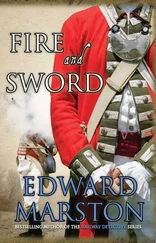
Simon Scarrow - Fire and Sword
Здесь есть возможность читать онлайн «Simon Scarrow - Fire and Sword» весь текст электронной книги совершенно бесплатно (целиком полную версию без сокращений). В некоторых случаях можно слушать аудио, скачать через торрент в формате fb2 и присутствует краткое содержание. Жанр: Старинная литература, на английском языке. Описание произведения, (предисловие) а так же отзывы посетителей доступны на портале библиотеки ЛибКат.
- Название:Fire and Sword
- Автор:
- Жанр:
- Год:неизвестен
- ISBN:нет данных
- Рейтинг книги:5 / 5. Голосов: 1
-
Избранное:Добавить в избранное
- Отзывы:
-
Ваша оценка:
Fire and Sword: краткое содержание, описание и аннотация
Предлагаем к чтению аннотацию, описание, краткое содержание или предисловие (зависит от того, что написал сам автор книги «Fire and Sword»). Если вы не нашли необходимую информацию о книге — напишите в комментариях, мы постараемся отыскать её.
Fire and Sword — читать онлайн бесплатно полную книгу (весь текст) целиком
Ниже представлен текст книги, разбитый по страницам. Система сохранения места последней прочитанной страницы, позволяет с удобством читать онлайн бесплатно книгу «Fire and Sword», без необходимости каждый раз заново искать на чём Вы остановились. Поставьте закладку, и сможете в любой момент перейти на страницу, на которой закончили чтение.
Интервал:
Закладка:
All afternoon, and well into dusk, the boats ferried soldiers and supplies ashore.The surf was even more wild than it appeared from the ships, and some of the lighter boats were tumbled over as they attempted to approach the shore, casting the sailors and soldiers into the foaming spray where several were drowned. But, by nightfall, the first wave of Arthur’s army was ashore and had moved beyond the red rocks lining the shore to make camp. Pickets were posted further inland. Arthur would have liked to send cavalry patrols out to locate the nearest enemy troops, but only a handful of horses had sailed with the expedition and they were still aboard the convoys, awaiting calmer conditions to be brought ashore.
A small tent had been erected for the commanding officer and by the light of a single lantern Arthur conferred with his new aide-de-camp, a young man recommended to him by the Duke of Richmond.
‘So then, Somerset, how long will it take to complete the unloading?’
Lord Fitzroy Somerset consulted his notes in a calm, unhurried manner. ‘We have three thousand men ashore. There’re another twelve and a half to come all told. Food supplies and ammunition will come first, in case we encounter any of the enemy. Then the artillery and engineers. Given the available boats, and time taken to make a round trip, I have calculated that the landing will be completed in six days’ time, sir.’
‘I see.’ Arthur nodded. It was not good news. General Junot was bound to learn of the landing before the following day was out and would instantly begin to concentrate his forces in an attempt to repel the British invasion.The army had to be ready to move before then.The main difficulty was that neither the artillery nor the cavalry had sufficient horses to march on the enemy.The War Office had anticipated that a ready supply of horses could be found in Portugal. However, as Arthur had quickly discovered, the small country was poor and good horses were scarce. Even mules were in short supply and as things stood the infantry would be required to haul some of the supply wagons by hand. Arthur glanced up at Somerset. ‘Any word from our Portuguese friend yet?’
General Freire had been charged by his government in exile to co-operate with the British as fully as possible and had promised to join Arthur with food, horses and another six thousand Portuguese soldiers the moment the redcoats landed. Arthur had met Freire at Oporto when the flagship had stopped there on the way to Lisbon. Freire, like so many local officials, had offered an effusive welcome to Arthur and his staff officers, and had made wild boasts about crushing the French forces on Portuguese soil before joining with his British brothers and liberating Spain. Arthur had thanked him politely and persuaded Freire to meet him on the Lisbon road, at Leiria, and march on the Portuguese capital together.
Somerset shook his head.‘Nothing as yet, sir. Freire might have been delayed. Or he might not have sent out any messengers to advise us of his approach.’
‘Tell me, Somerset, what did you make of Freire?’
Arthur watched his aide closely as Somerset quickly formed his judgement and made his reply. ‘I was impressed by his sense of patriotism, sir. There is no doubting his desire to rid Portugal of the French. However, he did not seem to have any ready answers to your queries about where the supplies and the horses would come from. If I may be honest, sir?’
‘Speak freely, Somerset. I will not have an aide humour me. I must be able to trust you implicitly.’
‘Very well, sir,’ the officer responded in a relieved tone.‘I fear that we may see very little of what he promised us when we reach Leiria. Naturally, I may be wrong.’
‘I hope you are. If we cannot rely on our allies this army is going to be largely dependent on lines of communication that stretch from the shores of Britain to the coast of Portugal. Not a happy prospect, and when winter comes we can look forward to severe disruption of our supplies.’
‘Yes, sir.’
Arthur looked at the map of Portugal that lay across his campaign desk. It was sparsely detailed and was all he had been able to obtain from the War Office before they set off.‘We will keep close to the coast as we advance on Lisbon. That way we can be resupplied by sea and can be evacuated if we suffer any serious reverse.’
Somerset glanced at the map. ‘Yes, sir. That makes sense.’
‘Thank you, young man. I know that.’
Somerset stiffened. ‘Sorry, sir. Is that all?’
‘Yes.You’d better go and get some sleep.You’ll need all your strength for the coming campaign.’
‘Yes, sir. Good night, sir.’
Once his aide had left him, Arthur concentrated his attention on the map again. Lisbon was over a hundred miles away. Perhaps seven days’ march. There was every chance that Dalrymple would arrive and take command of the army long before Arthur had had a chance to prove himself. Be that as it may, he would still do everything in his power to prepare the men to march on Lisbon, even if another officer would take the credit for any success they might achieve. Arthur stood up, stretched his shoulders, left the stifling tent and emerged into the sweltering heat of a summer evening. The air had not yet cooled and was heavy with unfamiliar scents. Around the tent the shrill chorus of cicadas rose in intensity and then stopped dead, before beginning again and gradually building up once more. Arthur smiled to himself. He enjoyed this sense of strangeness, of getting away from the landscapes he took for granted in Ireland and England. He had few illusions about the discomforts of the coming campaign, but there was an undeniable sense of liberation in being so far from home, with all its petty and pedantic social demands, not to mention the endlessly shifting currents of the political scene. Arthur felt at home in the field.The goals were clear enough, the stakes were high, and if he and his men did their duty, then they would contribute to the salvation of their country. What greater satisfaction was there than that, Arthur reflected contentedly.
By the time the first week in August came to an end the army was ready to march. On the tenth, Arthur gave the order to break camp and the column set off for Leiria, some twelve miles away. General Freire had already sent word that he and his force had reached the town, but there was no mention of the promised horses and supplies, as Somerset had rightly suspected. As a precaution Arthur had used some of the gold that had accompanied the army to purchase enough horses and mules from the local people to ensure that the army could advance from its beachhead without having to rely on manpower to shift the guns and wagons.
The redcoats were not used to the midsummer heat of Iberia, and had had little chance to exercise in the close confines of the troopships, with the result that they suffered dreadfully on the first day’s march.The rough cart track that passed for a road was baked solid and the dust and sand that had gathered on either side was quickly kicked up into a choking cloud that irritated eyes and caught in throats and added still further to the torments of thirst the men endured as they tramped along. Very soon, even the most spirited of them had fallen silent and the soft scrape and thud of boots was accompanied only by the shrill, grating protests from the axles of the wagons and carts carrying the supplies.
Late in the afternoon Arthur rode ahead with Somerset and a local man Arthur had hired to act as guide and translator. General Freire was waiting for them at Leiria, and had commandeered a fine house on the edge of the town and received his guests in a small courtyard where a fountain splashed invitingly in a tiled pond. As many of his men as possible had been quartered in the town, and sat silently in the shade as the British officers rode by, making no attempt to stand and salute.
Читать дальшеИнтервал:
Закладка:
Похожие книги на «Fire and Sword»
Представляем Вашему вниманию похожие книги на «Fire and Sword» списком для выбора. Мы отобрали схожую по названию и смыслу литературу в надежде предоставить читателям больше вариантов отыскать новые, интересные, ещё непрочитанные произведения.




Обсуждение, отзывы о книге «Fire and Sword» и просто собственные мнения читателей. Оставьте ваши комментарии, напишите, что Вы думаете о произведении, его смысле или главных героях. Укажите что конкретно понравилось, а что нет, и почему Вы так считаете.