George Bush - Decision Points
Здесь есть возможность читать онлайн «George Bush - Decision Points» весь текст электронной книги совершенно бесплатно (целиком полную версию без сокращений). В некоторых случаях можно слушать аудио, скачать через торрент в формате fb2 и присутствует краткое содержание. Жанр: Старинная литература, на английском языке. Описание произведения, (предисловие) а так же отзывы посетителей доступны на портале библиотеки ЛибКат.
- Название:Decision Points
- Автор:
- Жанр:
- Год:неизвестен
- ISBN:нет данных
- Рейтинг книги:3 / 5. Голосов: 1
-
Избранное:Добавить в избранное
- Отзывы:
-
Ваша оценка:
Decision Points: краткое содержание, описание и аннотация
Предлагаем к чтению аннотацию, описание, краткое содержание или предисловие (зависит от того, что написал сам автор книги «Decision Points»). Если вы не нашли необходимую информацию о книге — напишите в комментариях, мы постараемся отыскать её.
Decision Points In gripping, never-before-heard detail, President Bush brings readers inside the Texas Governor’s Mansion on the night of the hotly contested 2000 election; aboard Air Force One on 9/11, in the hours after America’s most devastating attack since Pearl Harbor; at the head of the table in the Situation Room in the moments before launching the war in Iraq; and behind the Oval Office desk for his historic and controversial decisions on the financial crisis, Hurricane Katrina, Afghanistan, Iran, and other issues that have shaped the first decade of the 21st century.
President Bush writes honestly and directly about his flaws and mistakes, as well as his accomplishments reforming education, treating HIV/AIDS in Africa, and safeguarding the country amid chilling warnings of additional terrorist attacks. He also offers intimate new details on his decision to quit drinking, discovery of faith, and relationship with his family.
A groundbreaking new brand of memoir,
will captivate supporters, surprise critics, and change perspectives on one of the most consequential eras in American history – and the man at the center of events.
Decision Points — читать онлайн бесплатно полную книгу (весь текст) целиком
Ниже представлен текст книги, разбитый по страницам. Система сохранения места последней прочитанной страницы, позволяет с удобством читать онлайн бесплатно книгу «Decision Points», без необходимости каждый раз заново искать на чём Вы остановились. Поставьте закладку, и сможете в любой момент перейти на страницу, на которой закончили чтение.
Интервал:
Закладка:
Yet over his six months in power, Maliki had matured as a leader. He had endured death threats, potential coups, and numerous congressional delegations traveling to Iraq to berate him. A few days before our scheduled summit in Jordan, radical Shia leader Moqtada al Sadr threatened to withdraw his supporters from the government if the prime minister met with me. Maliki came anyway.
“Here is my plan,” he said proudly as he handed me a document with the new seal of the Iraqi government on the cover. Inside was an ambitious proposal to retake Baghdad with Iraqi forces. I knew his army and police were not ready for such a major undertaking. What mattered was that Maliki recognized the problem of sectarian violence and was showing a willingness to lead.
“Americans want to know whether your plan allows us to go against both Sunni and Shia killers,” I asked.
“We don’t distinguish by ethnicity,” he replied.
I asked to meet with the prime minister alone. Maliki seemed ready to confront the violence. I decided to test his commitment by raising the prospect of a surge.
“The political pressure to abandon Iraq is enormous,” I said, “but I am willing to resist that pressure if you are willing to make the hard choices.”
I continued: “I’m willing to commit tens of thousands of additional American troops to help you retake Baghdad. But you need to give me certain assurances.”
I ran through the list: He had to commit more Iraqi forces, and they had to show up. There could be no political interference in our joint military operations—no more forbidding us from going into Shia neighborhoods. He would have to confront the Shia militias, including Sadr’s army. And as security improved, he had to make progress on political reconciliation among Shia, Sunnis, and Kurds.
On every point, Maliki gave me his word that he would follow through.
On the flight home from Jordan, I thought about the options for a new strategy. Accelerating the handover to the Iraqis was not a viable approach. That sounded a lot like our current strategy, which was failing.
I didn’t think it was practical to withdraw from the cities and let the violence burn out. I couldn’t ask our troops to stand back and watch innocent people being slaughtered by extremists. I worried Iraq could be broken so badly that it would be impossible to put back together.
The surge option brought risks of its own. Increasing our troop levels would be deeply unpopular at home. The fighting would be tough, and casualties could be high. If Maliki let us down, we might not be able to stem the violence.
After seeing Maliki, I believed we could count on his support. The surge was our best chance, maybe our last chance, to accomplish our objectives in Iraq.

Over weeks of intense discussion in November and December, most of the national security team came to support the surge. Dick Cheney, Bob Gates, Josh Bolten, and Steve Hadley and his NSC warriors were behind the new approach. Condi would be, too, so long as the plan didn’t send more troops under the same old strategy.
On a decision this controversial and important, it was essential to have unity. Congress and the press would probe for any rift within the administration. If they found one, they would exploit it to justify their opposition and block the plan. To reach that consensus, one more group needed to be on board, the Joint Chiefs of Staff.
Established by the National Security Act of 1947, the Joint Chiefs included the heads of each service branch, plus a chairman and vice-chairman. The chiefs are not part of the chain of command, so they have no direct responsibility for military operations. A key part of their role is to advocate the health and strength of our armed forces. By law, the chairman of the Joint Chiefs is the president’s principal military adviser.
The chairman of the Joint Chiefs in 2006 was General Pete Pace. Pete was the first Marine to serve as chairman and one of the great officers of his generation. As a young lieutenant in Vietnam, Pete led a platoon that endured heavy fighting. For the rest of his career, he carried the photos of the Marines who gave their lives under his command. When he took office as chairman, he made a point of telling me their names. He never forgot them, or the cost of war.
Pete had launched a strategy review within the Joint Chiefs, and I asked Steve Hadley to make sure the surge concept had a place in their discussions. I decided to go see the chiefs at the Pentagon to listen to their thoughts in person.
Two days before the meeting, Pete came to the Oval Office. He told me I would hear a number of concerns from the chiefs, but they were prepared to support the surge. He also gave Steve an estimate on how many troops might be needed to make a difference: five brigades, about twenty thousand Americans.
On December 13, 2006, I walked into the Tank, the Joint Chiefs’ secure wood-paneled conference room at the Pentagon. Coming to their territory was a way to show my respect. I opened by telling them I was there to hear their opinions and ask their advice.
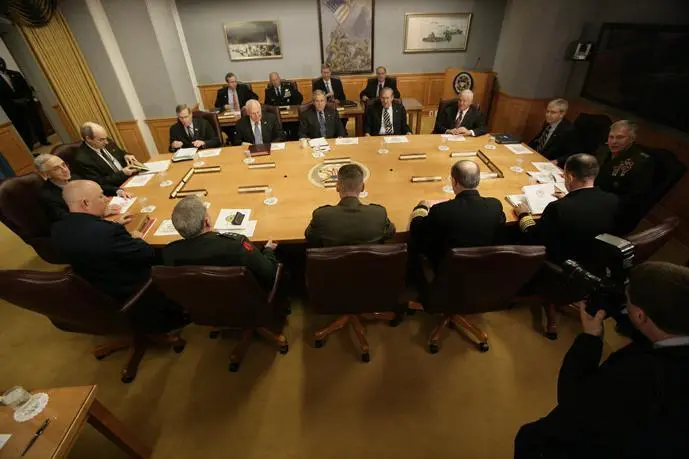
Discussing the surge strategy with the Joint Chiefs of Staff in the Tank. White House/Eric Draper
I went around the table one by one. The chiefs laid out their concerns. They worried about Maliki’s level of commitment. They felt other agencies of the government needed to contribute more in Iraq. They questioned whether the demands of a surge would leave us unprepared for other contingencies, such as a flare-up on the Korean Peninsula.
Their overriding worry was that a troop increase would “break the military” by putting too much strain on service members and their families. Many of our troops in Iraq were serving their second or third tours in the country. To make the surge possible, we would have to extend some tours from twelve to fifteen months. The effect on recruitment, morale, training, preparedness, and military families could be profound.
Army Chief of Staff Pete Schoomaker and Marine Commandant James Conway recommended an increase in the size of their services. They believed an expansion would ease the stress on our forces and help ensure we were ready for potential conflicts elsewhere in the world. I liked the idea and promised to consider it.
At the end of the meeting, I summarized my thinking. “I share your concern about breaking the military,” I said. “The surest way to break the military would be to lose in Iraq.”
My initial plan was to announce the new Iraq strategy a week or two before Christmas. But as the date approached, I concluded we needed more time. I wanted Bob Gates, who was sworn in as secretary of defense on December 18, to visit Iraq.
Two days before Christmas, Bob came to see me at Camp David. He told me he had visited with Maliki, who had refined his plan for an Iraqi surge to match ours. Maliki would declare martial law, deploy three additional Iraqi brigades to Baghdad, appoint a military governor, and name two deputy commanders with free rein to go after extremists of any sectarian background. Bob had also decided on his recommendation for a new commander. It would be General David Petraeus. We agreed to nominate General Casey for a promotion to Army chief of staff. George had a long and distinguished record of service, and his experience would benefit the Army. I also wanted to make clear that I did not blame him for the problems in Iraq.
The final question to resolve was the size of the surge. Some in the military proposed that we commit two additional brigades initially—a mini-surge of about ten thousand troops—with the possibility of sending up to three more brigades later. Pete Pace reported that General Petraeus and General Ray Odierno, the number-two commander in Iraq, wanted all five brigades committed up front.
Читать дальшеИнтервал:
Закладка:
Похожие книги на «Decision Points»
Представляем Вашему вниманию похожие книги на «Decision Points» списком для выбора. Мы отобрали схожую по названию и смыслу литературу в надежде предоставить читателям больше вариантов отыскать новые, интересные, ещё непрочитанные произведения.










Обсуждение, отзывы о книге «Decision Points» и просто собственные мнения читателей. Оставьте ваши комментарии, напишите, что Вы думаете о произведении, его смысле или главных героях. Укажите что конкретно понравилось, а что нет, и почему Вы так считаете.