Уильям Шекспир - Othello
Здесь есть возможность читать онлайн «Уильям Шекспир - Othello» — ознакомительный отрывок электронной книги совершенно бесплатно, а после прочтения отрывка купить полную версию. В некоторых случаях можно слушать аудио, скачать через торрент в формате fb2 и присутствует краткое содержание. Жанр: Старинная литература, на английском языке. Описание произведения, (предисловие) а так же отзывы посетителей доступны на портале библиотеки ЛибКат.
- Название:Othello
- Автор:
- Жанр:
- Год:неизвестен
- ISBN:нет данных
- Рейтинг книги:4 / 5. Голосов: 1
-
Избранное:Добавить в избранное
- Отзывы:
-
Ваша оценка:
Othello: краткое содержание, описание и аннотация
Предлагаем к чтению аннотацию, описание, краткое содержание или предисловие (зависит от того, что написал сам автор книги «Othello»). Если вы не нашли необходимую информацию о книге — напишите в комментариях, мы постараемся отыскать её.
Othello — читать онлайн ознакомительный отрывок
Ниже представлен текст книги, разбитый по страницам. Система сохранения места последней прочитанной страницы, позволяет с удобством читать онлайн бесплатно книгу «Othello», без необходимости каждый раз заново искать на чём Вы остановились. Поставьте закладку, и сможете в любой момент перейти на страницу, на которой закончили чтение.
Интервал:
Закладка:
Historically, Desdemona has traditionally been represented in terms of innocence and victimhood, but in more recent times more attention has perhaps been paid to her independence of spirit and adventurousness—she rebels against her father and insists on going to Cyprus. Was yours a spunky Desdemona?TN: How Desdemona came to be seen and presented—as in Verdi’s Otello —as a creature of angelic innocence is bewildering when so much evidence points in a different direction. Certainly in our production, we stressed that it was Brabantio’s trust in Desdemona that had been betrayed, that she had colluded to the full in the elopement, both out of her independence and a sense of adventure, and indeed out of passionate feelings of love in anticipation of sexual and sensual fulfillment.We explored how different the reality of Cyprus was for Desdemona, compared with her imaginings. In our production, she found herself in a military fort on the edge of civilization, surrounded entirely by sex-starved men in uniform who were, almost without exception, undressing her with their eyes whenever she appeared, and making her the subject of ribald fantasy. In this world of sexual tension, Emilia represents a haven, and Cassio appears to be a mild-mannered articulate young man (obviously with no head for alcohol) who is something of an exception to the rule.MA: Yes. It was one of the reasons why I wanted to do the play. Zoë Waites had been a very spirited Juliet. I think Juliet is much more intelligent and imaginative than Romeo, and I wanted the same scale of pluck, intelligence, imagination, independence, and sheer bloody fight. Desdemona is the victim of the play, but she’s not to be played as a victim. She, also, is blinkered; she’s blinkered because even in the scene with Emilia she still religiously believes in Othello, despite the fact that he’s attacked her. But, that aside, she’s a very bright kid. One of the genius moments in the writing, and genius moments from Iago, is when he says to Othello in Act 3 Scene 3, “She deceived her father brilliantly, why do you think she couldn’t deceive you?” He turns her intelligence, her sophistication, and her ability against Othello. Iago has spotted that Desdemona is shrewd and bright and no fool at all. It seems to me to dilute and weaken the play if she’s played in any way as passive.In the “brothel scene” I did something which I would never have done with two actors whom I didn’t know very well. We were only in the second week of rehearsals; we had a rough physical shape for the scene and we knew what we wanted it to be about—Othello torn between love and hate. It was fundamentally a scene about him punishing her, but then finding at least half a dozen moments where his whole stomach turns over and he thinks,“Oh my God, you’re beautiful,” or “Oh my God, I love you so much.” The truth of the situation just wells up in his stomach and grabs him by the throat. The actors were still on the book and I said (and it’s about as complicated a scene as there is in the play), “Look, let’s just throw ourselves at it.” It was one of the most astonishing things I have ever seen in a rehearsal room. It just blew the top of your head off. I was crying, the stage manager was crying, it was astonishing. And the reason for that was that those two actors had no problem with being completely vulnerable. And yet they were very specific with the text, it wasn’t just generalized emotion. That version of the scene never really changed. We refined it, but that sense of these huge surges of love, anger, and terror never really altered. There would have been no point in rehearsing that way if Desdemona wasn’t, at one level or other, Othello’s equal.
How important do you see the age gap between Othello and Desdemona, and how did that affect your casting of the roles?TN: I had a rarely advantageous situation to build upon then, an actor to play Othello of magnificent handsome appearance, with a voice that stopped all other conversation the moment he entered a room, a man of international expertise and indomitable courage as he had conquered opera audiences around the globe.He was twenty or so years older than his Desdemona, an age differential that I think is absolutely fundamental to the play. The fact that Othello describes himself as “declined / Into the vale of years” reveals that he is conscious of being no longer young, having won a bride who is still very young and who, therefore, may have a ready disposition to exchange him for younger company. When he secretly marries Desdemona, Othello is already a national hero, famous, celebrated, a giant among pygmies. I have seen versions of the play where Othello is dashing, youthful, up and coming, and I have felt that what Iago does to him is of less consequence than the play requires, because the edifice that came crashing down was just not big enough, the destruction wrought was just not sufficiently impossible .MA: I’d just done Romeo and Juliet with Ray Fearon and Zoë Waites and they were absolutely breathtaking. Towards the end of our international tour I remember getting the two of them together in a hotel in Belgium and saying,“Would you like to play Othello and Desdemona?” And they both said, instantly,“Yes.” So the casting arose out of the fact that I’d got two really talented young actors who had this incredible chemistry. The big issue for Ray was his age [he was thirty-two at the time of the production]. To age his appearance he shaved his hair and grew a beard, and I did actually have to cut a line: “declined / Into the vale of years.”Some people commented on the fact he was too young. I think that’s just because they had inside knowledge that that is how the play is written. There is absolutely no evidence in the rest of the play that his age makes any difference at all. In fact, quite the reverse. I would say a younger man helps in terms of explaining his promotion and his leadership, and their effect on Iago, so I deliberately cast an Iago [Richard McCabe] who was older than Othello; it’s usually the other way around.But also Ray’s age undermined the conventional view of Othello as “Oh, he’s an old man, he can’t get it up and that’s why he’s vulnerable to Cassio.” There is no evidence for that. What I think is a much more interesting story to tell is that Othello is an emotional virgin. This is why I believe the question of color is less interesting. He’s a soldier, a raconteur, but he has never engaged in emotional relationships. Whereas an older man would have experience of this, a younger man would possess a certain naïveté; I think that’s what makes him so vulnerable to Iago’s plotting. So not only was I not making an excuse for Ray’s youth, I felt it was a positive advantage. I thought it made the audience examine the nature of his vulnerability beyond simply being an old man. Our Othello was virile and beautiful, very sexy, and he had a very physical relationship with Desdemona. Interestingly, whereas a lot of reviewers in Stratford said he was too young, several of them openly, clearly recanted when we came to London. Initially, they just couldn’t see beyond his appearance. Indeed, the London reviews were terrific.
Did you and your actors make any unexpected discoveries about Cassio and/or Rodorigo?MA: I didn’t really have expectations so I couldn’t tell you what was expected or unexpected. But I think that it’s true to say that I was quite shocked by how stupid Rodorigo was! A lot of the men in the play are totally governed by obsession. I think, for example, that Othello becomes addicted to jealousy. At one point he says,“Give me proof that she’s unfaithful.” He doesn’t say,“Please find out that she’s not.” It’s as if he wants this torment.“It is the green-eyed monster which doth mock / The meat it feeds on.” Rodorigo suffers from the same kind of obsession, which turns him into an idiot. When the truth is staring him in the face, Othello still can’t see it. When you think Othello or Rodorigo are so gullible as to believe Iago, you have to see it in the context of men who simply can’t see the world beyond Desdemona. 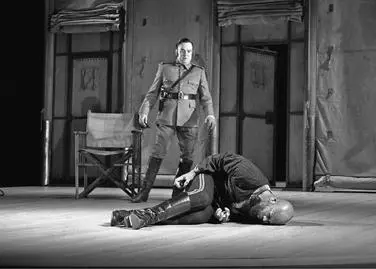 8. Richard McCabe’s Iago was deliberately cast to be older than Ray Fearon’s relatively young Othello in Michael Attenborough’s 1999 RSC production.
Интервал:
Закладка:
Похожие книги на «Othello»
Представляем Вашему вниманию похожие книги на «Othello» списком для выбора. Мы отобрали схожую по названию и смыслу литературу в надежде предоставить читателям больше вариантов отыскать новые, интересные, ещё непрочитанные произведения.




Обсуждение, отзывы о книге «Othello» и просто собственные мнения читателей. Оставьте ваши комментарии, напишите, что Вы думаете о произведении, его смысле или главных героях. Укажите что конкретно понравилось, а что нет, и почему Вы так считаете.