Уильям Шекспир - Othello
Здесь есть возможность читать онлайн «Уильям Шекспир - Othello» — ознакомительный отрывок электронной книги совершенно бесплатно, а после прочтения отрывка купить полную версию. В некоторых случаях можно слушать аудио, скачать через торрент в формате fb2 и присутствует краткое содержание. Жанр: Старинная литература, на английском языке. Описание произведения, (предисловие) а так же отзывы посетителей доступны на портале библиотеки ЛибКат.
- Название:Othello
- Автор:
- Жанр:
- Год:неизвестен
- ISBN:нет данных
- Рейтинг книги:4 / 5. Голосов: 1
-
Избранное:Добавить в избранное
- Отзывы:
-
Ваша оценка:
Othello: краткое содержание, описание и аннотация
Предлагаем к чтению аннотацию, описание, краткое содержание или предисловие (зависит от того, что написал сам автор книги «Othello»). Если вы не нашли необходимую информацию о книге — напишите в комментариях, мы постараемся отыскать её.
Othello — читать онлайн ознакомительный отрывок
Ниже представлен текст книги, разбитый по страницам. Система сохранения места последней прочитанной страницы, позволяет с удобством читать онлайн бесплатно книгу «Othello», без необходимости каждый раз заново искать на чём Вы остановились. Поставьте закладку, и сможете в любой момент перейти на страницу, на которой закончили чтение.
Интервал:
Закладка:
Does Iago lie to the audience? Are we really supposed to believe his accusations about both Othello and Cassio cuckolding him? Also with regard to Iago: his language is full of sexual imagery throughout the play. How much of a clue to his character does that give you?TN: The question of yours I feel impelled to start with is whether or not we are “supposed to believe” Iago’s accusations about being cuckolded by Othello and Cassio; in my view, this question comes closest to discovering and defining what Shakespeare is exploring. Shakespeare frequently chose a “theme” on and around which he would compose a complex dramatic debate, after having selected a “story” which could provide him with his necessary range of opportunities. So Romeo and Juliet is his play about “Love,” which involves Shakespeare in an equal and necessary exploration of “Hate” and the interconnection of these feelings. Hamlet is his play about “Death”—from a ghost returning to address the living, to a bourn from which no traveler returns, to suicide, to a grave littered with decomposing skulls—but it’s a discussion which involves Shakespeare in an exploration too of the will to live, and resolutions of how to live with the knowledge of mortality.In this way, Othello is self-evidently Shakespeare’s play about “Jealousy” but that subject draws him to an equal and necessary investigation of the concept of “Trust.” “Honest” Iago is trusted by his commander, his colleagues, by Rodorigo, by Desdemona and, with misgivings, by Emilia. Iago’s scheme is to stir Othello into jealousy, to increase that jealousy to such an extreme that there can only be violent consequences. But in Shakespeare’s play about jealousy, the most jealous character is not Othello, but Iago.“Honest” Iago is jealous of the Moor, jealous of Cassio for achieving the promotion Iago hoped for, and jealous of the physical sublimation that marriage has given Desdemona and Othello. His jealousy finds expression in suspicion, bile, and contempt, and accordingly he plays with the idea that both the men he hates have slept with his wife.Very early on in his writing career, Shakespeare discovered the energy and frisson that derives from a character intent on wickedness, sharing his (or her) intentions directly with the audience. Aaron and Tamora share with us their hidden malevolence, Richard III lets us delightedly into his darkly comic view of life, and so on throughout the canon until King Lear , where Edmund capitalizes on engaging our sympathy and support for “bastards.” But the most daring and outrageous use of this device is in the writing of Iago; Shakespeare invites us to see the surrounding world through Iago’s eyes, and therefore to find his willingness to confide in us alluring, funny, and a kind of privilege. We are aware that we are in a dangerous relationship, that we are spending time with somebody whose magnetism is thrilling but who is requiring us to compromise our sense of morality, increasingly with each implicating soliloquy.MA: Well, he puts both those accusations of cuckoldry as possibilities . I don’t think he swears that it’s happened. It is conjecture, and even if they haven’t, it suits him to believe that they have. So, no, I don’t think he lies to the audience. I think what he reveals to the audience is the scale of his insecurity. I think it’s obvious neither of those things has happened, but it’s not obvious to him . It is an imagined truth, but to the paranoid person there’s no difference between imagination and truth. I don’t think he’s lying, I think it suits his paranoia.The sexual imagery is probably the biggest clue of all. The play is about Iago’s jealousy. Like poison poured in the ear, he poisons Othello with language, with persuasion. He’s so clever with language, and it’s fascinating that as Othello turns, he starts talking like Iago: “goats and monkeys” and in the “brothel scene” [Act 4 Scene 2] when he talks about “a cistern for foul toads,” it could be Iago talking. 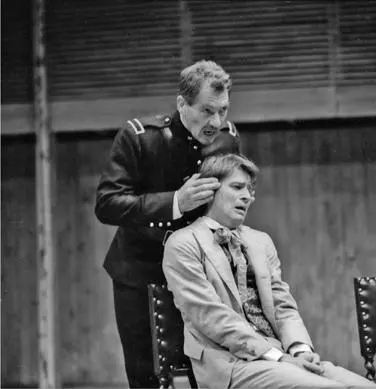 7. Ian McKellen as “Honest Iago” in Trevor Nunn’s 1989 production at The Other Place with Michael Grandage as Rodorigo.
But the reason I say that it is the most important clue is that I suspect Iago’s biggest insecurity is sexual, even bigger than his professional insecurity. Shakespeare couldn’t be clearer; we get the biggest, clearest window into his personality from Emilia. When she talks very emotionally in that key speech in Act 4 Scene 3 it’s clearly all about her relationship with Iago. We get a picture of a man who knocks her around, who’s cruel, who’s staggeringly jealous, and who is promiscuous with whores. In a way, he has the same kind of emotional immaturity as Othello, but he’s twenty times cleverer, more devious and more malicious. But the nature of jealousy, the springboard, the flower bed from which jealousy happens is clearly insecurity. We would know that. We become jealous in our own relationships because we’re insecure about ourselves. I think Iago’s sexual insecurity is absolutely huge. What his language portrays is a fascination with sex, but also disgust. He never talks about it beautifully. He talks about it in ugly, animalistic, bestial, purely sexual terms—he never talks about love. And that’s why I think it’s the biggest clue of all.
Since Paul Robeson played the part of Othello, race has been a big issue for the play, in terms of both casting and interpretation. Where did you stand on this?TN: Ours was the first RSC production, and possibly the first in England since Paul Robeson at Stratford, to cast a black artist in the title role. As director, I could not possibly have gone ahead with the production if I had failed to find the casting of an artist of color to play the central role. The days of the acceptability of white actors wearing black makeup had gone by the end of the 1970s, even though there were few candidates in those days who were qualified by experience or training to provide the authenticity that roles like Aaron and Othello so clearly demanded.I was very fortunate to encounter the magnificent Jamaican-born opera singer Willard White at Glyndebourne, when we worked together on Gershwin’s epoch-making and culture-defining Porgy and Bess . It was clear to me that Willard was as much an extraordinarily imaginative and daring actor as he was a uniquely mellifluous bass-baritone. So, yes, Paul Robeson revisited, though it wasn’t until after we had opened Othello that I realized that Robeson had actually been the last black artist to play the part in England. I reasoned with Willard that if he was ever to play Othello, it would have to be in the theater because Verdi’s account of the role makes him (unaccountably) a tenor, and Willard, as I said, is a glorious bass-baritone.MA: One of the things that I profoundly disagree with is Coleridge’s statement about Iago’s “ motiveless malignity.” I think what Shakespeare actually does is to provide so many motives—some of them fantastical, some of them made up, some of them paranoid, some of them real (like, for example, Cassio’s promotion)—that race becomes one of a number of factors. I think the play is not about Othello’s jealousy, but about Iago’s jealousy; the fact that this black chap has succeeded both sexually and professionally faster than he has is simply another element of that. Yes, Iago is a racist. Yes, Brabantio turns out to be a racist, having sat around the fireside happily with Desdemona and Othello. But it’s clearly not a fully racist society in Venice: they’re very proud of Othello. I suspect there’s a degree of making a virtue of necessity: he’s clearly the most able soldier and therefore they have to accept him, but there’s no sense of an incipient racism there; nor indeed from any of the other characters like Rodorigo or Cassio. I think the point about racism is how it fits with Iago’s make-up, personality, neuroses. One of the extraordinary things about Shakespeare’s writing is that he managed to grasp hold of several stereotypes—which we still wrestle with four hundred years later—and render them human. The Jew in Shylock, color in Othello, and indeed women; he expands and humanizes the whole notion of being a Shrew. And so while he does grasp the issue of racism, I don’t think it’s a play about racism.
Читать дальшеИнтервал:
Закладка:
Похожие книги на «Othello»
Представляем Вашему вниманию похожие книги на «Othello» списком для выбора. Мы отобрали схожую по названию и смыслу литературу в надежде предоставить читателям больше вариантов отыскать новые, интересные, ещё непрочитанные произведения.




Обсуждение, отзывы о книге «Othello» и просто собственные мнения читателей. Оставьте ваши комментарии, напишите, что Вы думаете о произведении, его смысле или главных героях. Укажите что конкретно понравилось, а что нет, и почему Вы так считаете.