Larry McMurtry - Comanche Moon
Здесь есть возможность читать онлайн «Larry McMurtry - Comanche Moon» весь текст электронной книги совершенно бесплатно (целиком полную версию без сокращений). В некоторых случаях можно слушать аудио, скачать через торрент в формате fb2 и присутствует краткое содержание. Жанр: Старинная литература, на английском языке. Описание произведения, (предисловие) а так же отзывы посетителей доступны на портале библиотеки ЛибКат.
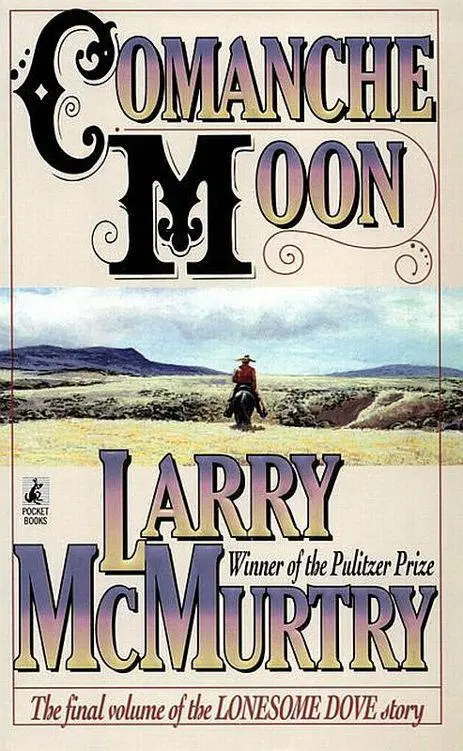
- Название:Comanche Moon
- Автор:
- Жанр:
- Год:неизвестен
- ISBN:нет данных
- Рейтинг книги:4 / 5. Голосов: 1
-
Избранное:Добавить в избранное
- Отзывы:
-
Ваша оценка:
Comanche Moon: краткое содержание, описание и аннотация
Предлагаем к чтению аннотацию, описание, краткое содержание или предисловие (зависит от того, что написал сам автор книги «Comanche Moon»). Если вы не нашли необходимую информацию о книге — напишите в комментариях, мы постараемся отыскать её.
Comanche Moon — читать онлайн бесплатно полную книгу (весь текст) целиком
Ниже представлен текст книги, разбитый по страницам. Система сохранения места последней прочитанной страницы, позволяет с удобством читать онлайн бесплатно книгу «Comanche Moon», без необходимости каждый раз заново искать на чём Вы остановились. Поставьте закладку, и сможете в любой момент перейти на страницу, на которой закончили чтение.
Интервал:
Закладка:
Scull saw the glint of sun on glass and realized Ahumado was watching him through binoculars, no doubt taken from some murdered officer or traveller. This knowledge perked him up.
Contempt or no contempt, at least he had caught the old man's interest. Scull had a spectator now; he meant to give the man on the ground a good show.
When Scull searched the pockets of Tudwal's filthy garments he found a small tool that he had missed when searching the clothes for bullets. The tool was a file of the sort used to improve the sights on a rifle or cut the head off a nail. It wasn't much, but it was something. Although the cage he swung in had a solid bottom, there were cracks in it. Scull took great care not to drop his file--z long as he had it there were ways he could employ his mind.
He could keep a calendar by scratching lines on the rock of the cliff, and he immediately began to do so.
Scull knew a bit of geology. He had heard Mr. Lyell lecture on his first visit to America and had even sat with the great man at a luncheon in Washington. It occurred to him there might be fossils or other geological vestiges in the stony cliff behind him--vestiges he could investigate. To make sure that he didn't drop the file he unthreaded another cord from his pants leg and used it to secure the little tool, tying one end of the thread to the file and the other end to a bar of the cage.
Fortunately he was small enough to get his legs through the bars of the cage--wiggling them vigorously was the best he could do by way of exercise. It amused him to consider what Ahumado must think, watching him wiggle his legs. He had caught a curious prisoner this time, one a little more resourceful than the miscreant peasants he had been wont to cage.
If his diet was limited, Scull told himself, at least his view was magnificent. In the morning he could see the mist lift off the distant peak as the red sun rose. The nights, though chilly, produced a fine starlight. Scull had not made much progress in astronomy, but he did know his constellations, and they were there to be viewed, in sharp and peaceful clarity, every night.
The fourth day was cloudy--it sprinkled in the morning, which was welcome; it allowed Scull to wash himself. But a mist ensued so thick that he could not see the ground, a fact which dampened his spirits considerably. He liked to look down, observe the life of the camp, and watch Ahumado watch him. It was a competition they were in, the Bostonian and the Mayan, as he saw it. He needed to observe his opponent every day. Now and then, through the mist, he would see one of the great vultures sail by. One vulture flew so close that he saw the bird turn its head and look at him--the bird's old eye reminded him in that instance of Ahumado's. The resemblance was so sharp that it spooked Scull, for a moment. It was as if the old Mayan had turned himself into a bird and flown by to taunt him.
Scull felt sour all day, sour and discouraged. For all his skill at catching birds, his calendar keeping, his feet wiggling, he was still hung in a cage off a cliff, with no way down. The contest wasn't for a day or a week; it was for as long as he could convince himself it was worth it to hang in a cage and eat raw birds, at the whim of an old man who sat on a blanket, far below.
The next day, though, was one of brilliant sunlight and Scull's spirits improved. He spent much of the morning in close inspection of the cliff above him. They had lowered him some seventy feet, he judged, and the rope that held the cage seemed sound. But the ascent, if he decided to try one, was sheer. He could saw the bindings of the cage with his precious file and break out; but if he chose the climb he knew he had better do it quickly, while he still had his strength. In a week or two poor diet and cramped quarters would weaken him to such an extent that he could never make the climb, or escape the dark men and their machetes if he did.
For most of the day Scull weighed his chances.
He studied the cliff face; he looked down at Ahumado. In the afternoon he saw some young women filing out of camp with laundry on their heads, making for a little stream not far from camp. Some vaqueros were there, watering their horses. The young women took the laundry far upstream from the men and the horses. Now and then Scull would hear a rill of laughter as the young women pounded the clothes on the wet rocks. The vaqueros mounted and rode away. As soon as they were gone the women began to sing as they worked. Scull could only faintly catch the melody, but the sight of the young women cheered him, nonetheless. It was a fine joke, that his adventuring had finally got him hung off a cliff in Mexico, but it didn't stop the laughter of women, or their flirtations with men.
As the day waned Scull fingered his file, wondering how long it would take him to file through the bindings of the cage, if he chose to try the climb. While he was looking up and down, considering, he saw a brilliant flash of color coming toward the cage; the brilliancy turned out to be the red-and-green plumage of a large parrot, which flew past his cage and turned its head, for a moment, to look at him. Again, Scull was startled--the parrot's eye reminded him of Ahumado's. The impression was so strong that he dropped his file, but fortunately the string he had attached it to saved it.
Later, when the sun was down and the canyon lit by strong starlight, Scull decided he must be having altitude visions. He knew from his experiences in the Alps that high air could make a man giddy, and prone to false conclusions. The parrot and the vulture were just birds. No dove and no pigeon had lighted on his cage that day--Scull put it down to his jumpiness, his indecision, his nerves. He knew he had better get his thoughts under control and regain some calm or the fowl of the air would avoid him and he would starve.
The next morning he fixed his mind on a task, which was to remember his Homer. He took his file and began to scratch a Greek ^w on the surface of the rock behind him. By noon he had completed a hexameter. All day he worked on, scratching Greek into the rock. The giddiness left his head, and the nervousness his limbs.
"Hard and clear," he told himself. "Hard and clear." The rock was not easy to work. Scull had to press the file hard to give the Greek letters the graceful shape they deserved. His fingers cramped, from gripping the file so hard; now and then he had to stop and flex them.
Below, old Ahumado was watching him through the binoculars. In the stream the girls were spreading wet clothes again. Scull's nerves no longer put off the birds. In the afternoon he caught two pigeons and a dove.
"That takes care of the larder," he told himself, but he did not pause long enough to hang the birds or pluck them.
By evening the great ^ws were there, each letter as distinct as Scull could make it, ^ws hard and clear, to remind him that brave men had battled before:
OI DE MEGA FRONEONTES EPI PTOLEMOIO GEFURAS EIATO PANNUANDIOI, PURA DE SFISI KAIETO POLLA.
WS Do OT EN OURANWI ASTRA FAEINWHN AMFI SELWHNWHN FAINET ARIPREPEA, OTE That EPLETO NWHNEMOS AITHWHR EK That EFANEN PASAI SKOPIAI KAI PRWONES AKROI KAI NAPAI OURANOTHEN Do AR UPERRAGWH ASPETOS AITHWHR, PANTA DE EIDETAI ASTRA, GEGWHTHE DE TE FRENA POIMWHN TOSSA MESWHGU NEWN WHDE XANTHOIO ROAWN TRWWN KAIONTWN PURA FAINETO ILIOTHI PRO.
ANDILI AR EN PEDIWI PURA KAIETO, PAR DE EKASTWI EIATO PENTWHKONTA SELAI PUROS AITHOMENOIO.
IPPOI DE KRI LEUKON EREPTOMENOI KAI OLURAS, ESTAOTES PAR OANDESFIN, EUTHRONON WHW MIMNON.
It was Homer enough for one day, Scull felt.
He had put the ^ws of a Greek on the face of a cliff in Mexico. It was a victory, of sorts, over the high air and the old dark man.
The ^ws had calmed him--the fowl of the air had come back to perch on his cage. Another night or two, maybe he would file through the rawhide bindings and climb the rope. This night, though, he curled up against the chill and slept, while, far below, the Mexican campfires glittered, bright as the campfires of old Troy.
Читать дальшеИнтервал:
Закладка:
Похожие книги на «Comanche Moon»
Представляем Вашему вниманию похожие книги на «Comanche Moon» списком для выбора. Мы отобрали схожую по названию и смыслу литературу в надежде предоставить читателям больше вариантов отыскать новые, интересные, ещё непрочитанные произведения.





Обсуждение, отзывы о книге «Comanche Moon» и просто собственные мнения читателей. Оставьте ваши комментарии, напишите, что Вы думаете о произведении, его смысле или главных героях. Укажите что конкретно понравилось, а что нет, и почему Вы так считаете.