Philippa Gregory - The Constant Princess
Здесь есть возможность читать онлайн «Philippa Gregory - The Constant Princess» — ознакомительный отрывок электронной книги совершенно бесплатно, а после прочтения отрывка купить полную версию. В некоторых случаях можно слушать аудио, скачать через торрент в формате fb2 и присутствует краткое содержание. Жанр: Старинная литература, на английском языке. Описание произведения, (предисловие) а так же отзывы посетителей доступны на портале библиотеки ЛибКат.
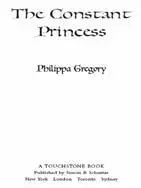
- Название:The Constant Princess
- Автор:
- Жанр:
- Год:неизвестен
- ISBN:нет данных
- Рейтинг книги:4 / 5. Голосов: 1
-
Избранное:Добавить в избранное
- Отзывы:
-
Ваша оценка:
The Constant Princess: краткое содержание, описание и аннотация
Предлагаем к чтению аннотацию, описание, краткое содержание или предисловие (зависит от того, что написал сам автор книги «The Constant Princess»). Если вы не нашли необходимую информацию о книге — напишите в комментариях, мы постараемся отыскать её.
Thus, bestselling author Philippa Gregory introduces one of her most unforgettable heroines: Katherine of Aragon. Known to history as the Queen who was pushed off her throne by Anne Boleyn, here is a Katherine the world has forgotten: the enchanting princess that all England loved. First married to Henry VIII's older brother, Arthur, Katherine's passion turns their arranged marriage into a love match; but when Arthur dies, the merciless English court and her ambitious parents -- the crusading King and Queen of Spain -- have to find a new role for the widow. Ultimately, it is Katherine herself who takes control of her own life by telling the most audacious lie in English history, leading her to the very pinnacle of power in England.
Set in the rich beauty of Moorish Spain and the glamour of the Tudor court, The Constant Princess presents a woman whose constancy helps her endure betrayal, poverty, and despair, until the inevitable moment when she steps into the role she has prepared for all her life: Henry VIII's Queen, Regent, and commander of the English army in their greatest victory against Scotland.
From Publishers Weekly
As youngest daughter to the Spanish monarchs and crusaders King Ferdinand and Queen Isabella, Catalina, princess of Wales and of Spain, was promised to the English Prince Arthur when she was three. She leaves Spain at 15 to fulfill her destiny as queen of England, where she finds true love with Arthur (after some initial sourness) as they plot the future of their kingdom together. Arthur dies young, however, leaving Catalina a widow and ineligible for the throne. Before his death, he extracts a promise from his wife to marry his younger brother Henry in order to become queen anyway, have children and rule as they had planned, a situation that can only be if Catalina denies that Arthur was ever her lover. Gregory's latest (after Earthly Joys) compellingly dramatizes how Catalina uses her faith, her cunning and her utter belief in destiny to reclaim her rightful title. By alternating tight third-person narration with Catalina's unguarded thoughts and gripping dialogue, the author presents a thorough, sympathetic portrait of her heroine and her transformation into Queen Katherine. Gregory's skill for creating suspense pulls the reader along despite the historical novel's foregone conclusion.
The Constant Princess — читать онлайн ознакомительный отрывок
Ниже представлен текст книги, разбитый по страницам. Система сохранения места последней прочитанной страницы, позволяет с удобством читать онлайн бесплатно книгу «The Constant Princess», без необходимости каждый раз заново искать на чём Вы остановились. Поставьте закладку, и сможете в любой момент перейти на страницу, на которой закончили чтение.
Интервал:
Закладка:
But before him now was a girl who had been hammered by unhappiness into a fine maturity. This Catalina was thinner, and paler, but with a new spiritual beauty, honed by hardship. He drew his breath. This Catalina was a young woman with a queenly presence. She had become through grief not only Arthur’s widow but her mother’s daughter. This was a princess from the line that had defeated the most powerful enemy of Christendom. This was the very bone of the bone and blood of the blood of Isabella of Castile. She was cool, she was hard. He hoped very much that she was not going to be difficult.
De Puebla gave her a smile that he meant to be reassuring and saw her scrutinize him with no answering warmth in her face. She gave him her hand and then she sat in a straight-backed wooden chair before the fire. “You may sit,” she said graciously, gesturing him to a lower chair, farther away.
He bowed again, and sat.
“Do you have any messages for me?”
“Of sympathy, from the king and Queen Elizabeth and from My Lady the King’s Mother, and from myself, of course. They will invite you to court when you have recovered from your journey and are out of mourning.”
“How long am I to be in mourning?” Catalina inquired.
“My Lady the King’s Mother has said that you should be in seclusion for a month after the burial. But since you were not at court during that time, she has ruled that you will stay here until she commands you to return to London. She is concerned for your health….”
He paused, hoping that she would volunteer whether or not she was with child, but she let the silence stretch.
He thought he would ask her directly. “Infanta—”
“You should call me princess,” she interrupted. “I am the Princess of Wales.”
He hesitated, thrown off course. “Dowager Princess,” he corrected her quietly.
Catalina nodded. “Of course. It is understood. Do you have any letters from Spain?”
He bowed and gave her the letter he was carrying in the hidden pocket in his sleeve. She did not snatch it from him like a child and open it, then and there. She nodded her head in thanks and held it.
“Do you not want to open it now? Do you not want to reply?”
“When I have written my reply, I will send for you,” she said simply, asserting her power over him. “I shall send for you when I want you.”
“Certainly, Your Grace.” He smoothed the velvet nap of his black breeches to hide his irritation but inwardly he thought it an impertinence that the Infanta, now a widow, should command where before the Princess of Wales had politely requested. He thought he perhaps did not like this new, finer Catalina, after all.
“And have you heard from Their Majesties in Spain?” she asked. “Have they advised you as to their wishes?”
“Yes,” he said, wondering how much he should tell her. “Of course, Queen Isabella is anxious that you are not unwell. She asked me to inquire after your health and to report to her.”
A secretive shadow crossed Catalina’s face. “I shall write to the queen my mother and tell her my news,” she said.
“She was anxious to know…” he began, probing for the answer to the greatest question: Was there an heir? Was the princess with child?
“I shall confide in no one but my mother.”
“We cannot proceed to the settlement of your jointure and your arrangements until we know,” he said bluntly. “It makes a difference to everything.”
She did not flare up as he had thought she would do. She inclined her head, she had herself under tight control. “I shall write to my mother,” she repeated, as if his advice did not much matter.
He saw he would get nothing more from her. But at least the chaplain had told him she could be with child, and he should know. The king would be glad to know that there was at least a possibility of an heir. At any rate she had not denied it. There might be capital to make from her silence. “Then I will leave you to read your letter.” He bowed.
She made a casual gesture of dismissal and turned to look at the flames of the little summertime fire. He bowed again and, since she was not looking at him, scrutinized her figure. She had no bloom of early pregnancy, but some women took it badly in the first months. Her pallor could be caused by morning sickness. It was impossible for a man to tell. He would have to rely on the confessor’s opinion and pass it on with a caution.
I open my mother’s letter with hands that are trembling so much that I can hardly break the seals. The first thing I see is the shortness of the letter, only one page.
“Oh, Madre,” I breathe. “No more?”
Perhaps she was in haste, but I am bitterly hurt to see that she has written so briefly! If she knew how much I want to hear her voice she would have written at twice the length. As God is my witness, I don’t think I can do this without her; I am only sixteen and a half, I need my mother.
I read the short letter through once, and then, almost incredulously, I read it through again.
It is not a letter from a loving mother to her daughter. It is not a letter from a woman to her favorite child, and that child on the very edge of despair. Coldly, powerfully, she has written a letter from a queen to a princess. She writes of nothing but business. We could be a pair of merchants concluding a sale.
She says that I am to stay in whatever house is provided for me until I have had my next course and I know that I am not with child. If that is the case I am to command Dr. de Puebla to demand my jointure as Dowager Princess of Wales and as soon as I have the full money and not before (underlined so there can be no mistake), I am to take ship for Spain.
If, on the other hand, God is gracious, and I am with child, then I am to assure Dr. de Puebla that the money for my dowry will be paid in cash and at once, he is to secure me my allowance as Dowager Princess of Wales, and I am to rest and hope for a boy.
I am to write to her at once and tell her if I think I am with child. I am to write to her as soon as I am certain, one way or the other, and I am to confide also in Dr. de Puebla and to maintain myself under the chaperonage of Doña Elvira.
I fold the letter carefully, matching the edges one to another as if tidiness matters very much. I think that if she knew of the despair that laps at the edges of my mind like a river of darkness, she would have written to me more kindly. If she knew how very alone I am, how grieved I am, how much I miss him, she would not write to me of settlements and jointures and titles. If she knew how much I loved him and how I cannot bear to live without him, she would write and tell me that she loves me, that I am to go home to her at once, without delay.
I tuck the letter into the pocket at my waist, and I stand up, as if reporting for duty. I am not a child anymore. I will not cry for my mother. I see that I am not in the especial care of God since he could let Arthur die. I see that I am not in the especial love of my mother, since she can leave me alone, in a strange land.
She is not only a mother, she is Queen of Spain, and she has to ensure that she has a grandson or, failing a grandson, a watertight treaty. I am not just a young woman who has lost the man she loves. I am a Princess of Spain and I have to produce a grandson or, failing that, a watertight treaty. And, in addition, I am now bound by a promise. I have promised that I will be Princess of Wales again, and Queen of England. I have promised this to the young man to whom I promised everything. I will perform it for him, whatever anyone else wants.
The Spanish ambassador did not report at once to Their Majesties of Spain. Instead, playing his usual double game, he took the chaplain’s opinion first to the King of England.
Читать дальшеИнтервал:
Закладка:
Похожие книги на «The Constant Princess»
Представляем Вашему вниманию похожие книги на «The Constant Princess» списком для выбора. Мы отобрали схожую по названию и смыслу литературу в надежде предоставить читателям больше вариантов отыскать новые, интересные, ещё непрочитанные произведения.






Обсуждение, отзывы о книге «The Constant Princess» и просто собственные мнения читателей. Оставьте ваши комментарии, напишите, что Вы думаете о произведении, его смысле или главных героях. Укажите что конкретно понравилось, а что нет, и почему Вы так считаете.