Jack Whyte - The Eagles' Brood
Здесь есть возможность читать онлайн «Jack Whyte - The Eagles' Brood» весь текст электронной книги совершенно бесплатно (целиком полную версию без сокращений). В некоторых случаях можно слушать аудио, скачать через торрент в формате fb2 и присутствует краткое содержание. Жанр: Старинная литература, на английском языке. Описание произведения, (предисловие) а так же отзывы посетителей доступны на портале библиотеки ЛибКат.
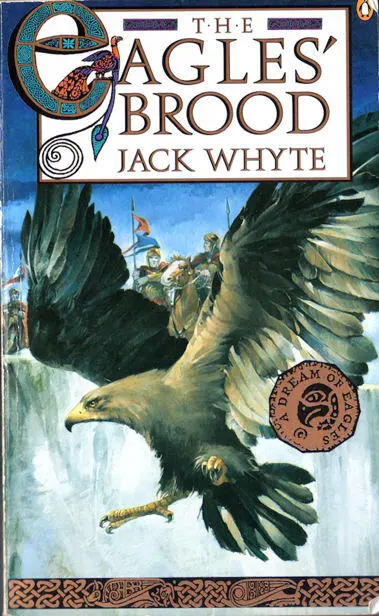
- Название:The Eagles' Brood
- Автор:
- Жанр:
- Год:неизвестен
- ISBN:нет данных
- Рейтинг книги:4 / 5. Голосов: 1
-
Избранное:Добавить в избранное
- Отзывы:
-
Ваша оценка:
The Eagles' Brood: краткое содержание, описание и аннотация
Предлагаем к чтению аннотацию, описание, краткое содержание или предисловие (зависит от того, что написал сам автор книги «The Eagles' Brood»). Если вы не нашли необходимую информацию о книге — напишите в комментариях, мы постараемся отыскать её.
In the author's The Skystone (1996), set in the last years of the Roman occupation of fifth-century Britain, the sword Excalibur was forged, presaging the reign of King Arthur years later. This time, the narrator, grand-nephew of the forger of the sword, is none other than that (traditionally) eerie being, Merlin the sorcerer--sanitized here to the most high-minded of soldiers who survives wars, betrayal, and a tragic love affair. Caius Merlyn Britannicus, born in a.d. 401, is the son of the Commander in Chief of the forces of the fortress/town of Camulod, a community of Romans and Britons. Merlyn's best friend from boyhood is his cousin Uther Pendragon, a mighty warrior and the son of a Celtic king, though with a terrible temper that can show itself off the fields of war. Torturing Merlyn is the suspicion that it might have been Uther who brutally beat the waif whom Merlyn will name Cassandra after she violently resists Uther's sexual games. The deaf and dumb Cassandra (her real identity will be a surprise) is healed and then secluded, eventually becoming Merlyn's wife until her savage death. There are wars and invasions, waged principally by King Lot of Cornwall, wars that bring awful innovations like poisoned arrows. There are also theological conflicts, since the free-will doctrines of Pelagius are condemned as heretical by the Church. Merlyn's trek to a seminal debate of theologians is marked by skirmishes--he rescues the warrior/bishop Germanus at one point--and by the discovery of a half-brother. All ends with the deaths of those fierce antagonists Lot and Uther, and with Merlyn holding up Uther's baby son by Lot's dead queen, a baby who hasthe deep golden eyes of . . . a mighty bird of prey . . . a King perhaps, to wield Excalibur.'' With plenty of hacking and stabbing, pontifications, dogged sex, and a few anachronistic mind-sets: another dipperful from the fertile Arthurian well, sans magic but brimful of action.
The Eagles' Brood — читать онлайн бесплатно полную книгу (весь текст) целиком
Ниже представлен текст книги, разбитый по страницам. Система сохранения места последней прочитанной страницы, позволяет с удобством читать онлайн бесплатно книгу «The Eagles' Brood», без необходимости каждый раз заново искать на чём Вы остановились. Поставьте закладку, и сможете в любой момент перейти на страницу, на которой закончили чтение.
Интервал:
Закладка:
I had to smile. "Aunt Luceiia will be impressed."
He barked his abrupt laugh, his sense of humour reasserting itself briefly. "Aye, she will. I tell you, Caius, the arrogance of these men astounds me. From where I look at it, everything they are doing flies in the face of the gentle, humane Christ that I was taught to worship and revere."
"Aye." I cleared my throat. "So what have you decided, Father?"
He looked at me sidelong, angling his mount closer to mine.
"I believe that the decision I made years ago to follow the ideas of Pelagius was the correct decision. These zealots make Pelagianism sound like Onanism. I see it as the only sane and decent way a responsible, proud man can live his life...with free will and the integrity of his personal belief. If I am wrong, then I will bear the consequences when I die. In the meantime, I shall live my life according to the dictates of my conscience, and I will suffer no person under my jurisdiction to be maligned, harassed or victimized for his— or her!—beliefs.
"These seven priests will leave our lands tomorrow under escort. I will not threaten them. If they come back, they will be made to leave again. And again, until they grow old and tired." He sighed. "I have lived more than fifty years to be told l am condemned as a heretic. And I am told this by a ragged, unwashed man who offends my nostrils and my sensibilities... I choose to live the way I have always lived—perhaps as a heretic, perhaps not. But I can at least stand the smell of myself. If it is mortally sinful to bathe, to laugh, to enjoy life in moderation and to honour women, then I fear I must continue to live in what is seen as sin. I am too old to change."
I felt a surge of pride and love for this man who had sired me.
"These priests are misguided. But they are also dangerous. There is a massive struggle going on for dominance in this world, Caius. These people are the proselytes of the power-mongers. If the newly named Pope comes here from Rome in person to convince me I am wrong, I will listen to him, but he must bring more reasonable arguments than his minions bring. Let's go home. I have some priests to talk to."
It never crossed my mind, then or at any other time, that my father might be wrong. My grandfather and Publius Varrus had lived their lives as they did, models of probity both, in natural nobility and dignity, and they had trained my father. And so it came about that when the boy who was to be my charge came under my influence, I taught him in the old ways of Ancient Rome, Republican Rome, and in the ways of old Bishop Alaric and Pelagius, and in the ways of my father's and his father's Camulod, which was not the way of new Rome. The boy I taught learned cleanliness, simple Godliness, discipline and the life of a warrior. He learned to enjoy the goodness of life, to enjoy and appreciate the goodness and the strength of woman, and to take for granted the inherent nobility and goodness of man.
XVII
At the tenth hour of the following morning, I witnessed what was probably the most portentous event that ever occurred in the Great Council Hall of Camulod, an occasion that, to my mind at least, unquestionably dwarfed all of the glories to come in the days of Arthur's reign, and indubitably influenced all of them. It was a gathering—almost a ceremonial—that, though small in itself, was to influence the course of life in the province of Britain for ever.
My father had summoned a plenary meeting of the Council and augmented the company with the full officer complement of the garrison, including the ten senior members of the Centuria, the warrant officers. All military personnel were instructed to attend in full parade uniform, so it was a brilliant and colourful assembly. Extra seating had been brought into the Council Hall to accommodate the unusual number of people in attendance, and the circle of fifty or so men took up almost the entire circumference of the Hall, leaving the centre empty, with an open segment at the back of the circle to allow the group of priests to enter.
Everyone was punctual. My father began by outlining the situation for the benefit of the partially informed and the totally uninformed, of whom there were very few. He followed his outline with the announcement that he had arrived at a unilateral decision on what to do, and that his decision would be binding upon everyone in the Colony for the ensuing twenty-four-hour period, at the end of which he would be prepared to listen to arguments and to accommodate compromise in response to intelligent and informed opposition. Until that time, however, his decision and the enforcement of it would be absolute.
He had invited their attendance here today, he went on, to witness the delivery of his decision to the visiting priests so that no one, whether in the Council or on the staff of the garrison, could claim to have been unaware of developments. Having said all of this, he ordered the priests to be brought into the assembly under escort.
There was a loud murmur of comment and speculation at this order, which my father chose to ignore, and the noise grew and was sustained during the interval that followed. I noticed that my father took care in the meantime to allow no eye contact between himself and any member of the assembly. Someone called his name, but he ignored the summons, turning and beckoning me. I walked across and leant towards him.
"I only regret that Uther has not returned. Of all the people here, he is the one with the greatest right to have been consulted in this matter."
"Don't let his absence concern you too much, Father," I said with a small smile. "We both know Uther well enough to know that he will have no quarrel with your findings, unless it be on the grounds of too much restraint. Had he been here and subjected to the abuse you had to face, these priests might have been sorry men today."
As I returned to my seat, there came a sudden hush, spreading inward from the entrance to the hall, and we looked up to see the seven priests being brought forward into the open circle. Centurion Popilius himself advanced ahead of the six-man escort party who herded the priests to the centre of die circle and then came to a halt. The silence in the room was absolute and my father, who, like everyone else in the Hall, was seated, remained sitting as he spoke into it.
"Thank you, Centurion Popilius. You may dismiss your men, but ask them to remain outside. You yourself may join us. There is a seat for you." Popilius saluted and did the General's bidding, instructing his soldiers to remain within hail. While the escort were leaving the hall I gazed in frank curiosity at the priests who stood before us.
They were all young, and all were dressed in ragged, dirty black cassocks bound at the waist with plain rope. It was to this fact that I at first attributed the strange aura of uniformity I sensed about them. It took me some time to redefine that initial reaction. There was a sameness, certainly, but it had nothing to do with what they wore; it was in their eyes, and it was almost indescribable. The word that first occurred to me was wildness, but as this confrontation continued I replaced that with arrogance, then disdain, then intolerance, and finally fanaticism—although I had never heard the expression prior to my father's use of it the day before.
Whatever that expression in their eyes signified, I found it disconcerting to die point of being almost frightening. Then I remembered the name of the Hebrew fanatics of biblical times, the followers of Simon Zelotes, the Zealots, the men who would gladly die for their own, steeped-in-blood beliefs. You could tell simply by looking at these men that they believed, deep in their souls, that they were the masters here and we were all their inferiors. There was no deference or civility apparent in the demeanour of any of them. They looked around them at the assembly with sneers of defiance on their faces, and then their leader took one long step forward and addressed my father in a loud, hectoring tone that no one in the assembly hall could fail to hear.
Читать дальшеИнтервал:
Закладка:
Похожие книги на «The Eagles' Brood»
Представляем Вашему вниманию похожие книги на «The Eagles' Brood» списком для выбора. Мы отобрали схожую по названию и смыслу литературу в надежде предоставить читателям больше вариантов отыскать новые, интересные, ещё непрочитанные произведения.







Обсуждение, отзывы о книге «The Eagles' Brood» и просто собственные мнения читателей. Оставьте ваши комментарии, напишите, что Вы думаете о произведении, его смысле или главных героях. Укажите что конкретно понравилось, а что нет, и почему Вы так считаете.