Jack Whyte - The Eagles' Brood
Здесь есть возможность читать онлайн «Jack Whyte - The Eagles' Brood» весь текст электронной книги совершенно бесплатно (целиком полную версию без сокращений). В некоторых случаях можно слушать аудио, скачать через торрент в формате fb2 и присутствует краткое содержание. Жанр: Старинная литература, на английском языке. Описание произведения, (предисловие) а так же отзывы посетителей доступны на портале библиотеки ЛибКат.
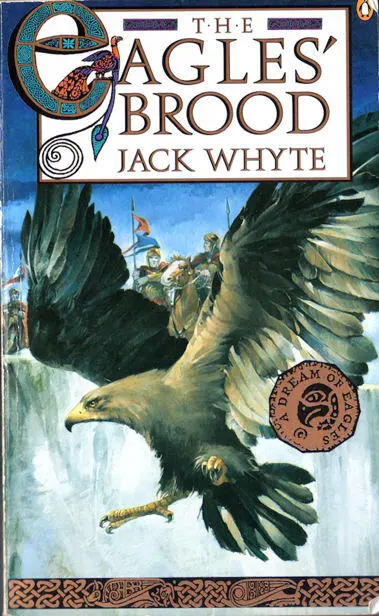
- Название:The Eagles' Brood
- Автор:
- Жанр:
- Год:неизвестен
- ISBN:нет данных
- Рейтинг книги:4 / 5. Голосов: 1
-
Избранное:Добавить в избранное
- Отзывы:
-
Ваша оценка:
The Eagles' Brood: краткое содержание, описание и аннотация
Предлагаем к чтению аннотацию, описание, краткое содержание или предисловие (зависит от того, что написал сам автор книги «The Eagles' Brood»). Если вы не нашли необходимую информацию о книге — напишите в комментариях, мы постараемся отыскать её.
In the author's The Skystone (1996), set in the last years of the Roman occupation of fifth-century Britain, the sword Excalibur was forged, presaging the reign of King Arthur years later. This time, the narrator, grand-nephew of the forger of the sword, is none other than that (traditionally) eerie being, Merlin the sorcerer--sanitized here to the most high-minded of soldiers who survives wars, betrayal, and a tragic love affair. Caius Merlyn Britannicus, born in a.d. 401, is the son of the Commander in Chief of the forces of the fortress/town of Camulod, a community of Romans and Britons. Merlyn's best friend from boyhood is his cousin Uther Pendragon, a mighty warrior and the son of a Celtic king, though with a terrible temper that can show itself off the fields of war. Torturing Merlyn is the suspicion that it might have been Uther who brutally beat the waif whom Merlyn will name Cassandra after she violently resists Uther's sexual games. The deaf and dumb Cassandra (her real identity will be a surprise) is healed and then secluded, eventually becoming Merlyn's wife until her savage death. There are wars and invasions, waged principally by King Lot of Cornwall, wars that bring awful innovations like poisoned arrows. There are also theological conflicts, since the free-will doctrines of Pelagius are condemned as heretical by the Church. Merlyn's trek to a seminal debate of theologians is marked by skirmishes--he rescues the warrior/bishop Germanus at one point--and by the discovery of a half-brother. All ends with the deaths of those fierce antagonists Lot and Uther, and with Merlyn holding up Uther's baby son by Lot's dead queen, a baby who hasthe deep golden eyes of . . . a mighty bird of prey . . . a King perhaps, to wield Excalibur.'' With plenty of hacking and stabbing, pontifications, dogged sex, and a few anachronistic mind-sets: another dipperful from the fertile Arthurian well, sans magic but brimful of action.
The Eagles' Brood — читать онлайн бесплатно полную книгу (весь текст) целиком
Ниже представлен текст книги, разбитый по страницам. Система сохранения места последней прочитанной страницы, позволяет с удобством читать онлайн бесплатно книгу «The Eagles' Brood», без необходимости каждый раз заново искать на чём Вы остановились. Поставьте закладку, и сможете в любой момент перейти на страницу, на которой закончили чтение.
Интервал:
Закладка:
"You think I am any different? But I can see the fault for which he was condemned. He dared to stand up against Augustine of Hippo. Pelagius is a humanist, Caius. He believes in the dignity of man, in personal responsibility, in freedom of choice and freedom of will! He stands condemned out of his own mouth, because his teachings undermine the priests themselves. Give a man the right to talk to God on his own terms, to bear God in his own heart and deal with Him injustice on his own behalf, and you negate the need for priests! That's why Pelagius is excommunicate!
"Bishop Alaric and his people have taught the way of Christ to us in Britain. They preach love and infinite mercy, and that nothing—no sin—is unforgivable. But now the men of God in Rome have ruled that Pelagius is unforgivable. They have damned him for daring to differ with their views. That is politics, Caius; there is no love of God involved here. In their lust for power over men, these bishops have condemned much of the populace of the entire world to eternal damnation, unless the world repents and does things the way these bishops want them to be done. That involves changing their beliefs! It may not sound like much when said aloud like that, but when I start to think of what's involved here, it frightens me to the depths of my soul." His voice tailed off into silence.
"But can they do this, Father? Are these bishops that powerful?"
"Who is to gainsay them? They call themselves the Fathers of the Church. They speak, they claim, with the full authority of God Himself and of His Holy Saints."
"Including Paul of Tarsus?"
"Including Paul of Tarsus."
"There's more to this than meets the eye, Father—my eye, at least. What is so important about Paul?"
"Women." My father spoke the word with hard emphasis. "Of all evangelists, Paul is the misogynist, the woman hater. Now, it seems there is a move afoot—not just afoot, but far advanced—to lend far greater credence to his words than in the past."
"How can that be done? What do you mean?"
He drew in a sharp breath. "It has become the style among the churchmen in Rome, it seems, to denigrate women in general. It's a fashion that has been growing since the pederasts and homosexuals achieved their vaunted equality under the Caesars, and it grew even more strongly after some of the Roman women of the great families began speculating in company stocks and in real estate development. But it has grown beyond belief recently. Women are being perceived nowadays in Rome, mainly through the machinations of these churchmen, as the Devil's spawn and servants, dedicated to the damnation of men."
I had never heard my father speak so eloquently or forcefully about a non-military subject. I was astounded. "You must be joking, Father! You are, aren't you?"
He looked directly at me. "No, Cay, I am not. The current mode among the new breed of churchmen is to condemn women, more and more virulently."
"But why?"
"How would I know that? Because they are convenient, I suppose. The Church in Rome has been predominantly a male hierarchy since the earliest times. Women have never prospered in the Church. Perhaps the Elders now seek to crystallize their hegemony. I don't know the underlying reasons, Caius, but that is the way it is." He paused, piercing me with his eyes. "You don't really believe what I am telling you, do you?"
I had to shake my head, for in truth I could not bring myself to believe that he was right. That he was serious and believed himself to have the right of it, I had no doubt, but my sanity demanded that he be mistaken.
"Shake your head all you like, Caius, but disabuse yourself. It is the truth. These things are happening, and they have come to Camulod. That disgraceful debacle in the dining hall last night was proof of it."
"What debacle? What are you talking about?"
"How can you not know? We almost had a riot here last night over this question. How could you be unaware of it?"
"I was away last night. I returned this morning, met with you and have been on the run ever since. What is going on?"
"Good God, Cay! You have to stay more aware of what's going on. I spent three hours this afternoon talking with priests of both factions—our British ones and their Roman ones—Pelagian and orthodox, as these zealots would have it! They have, among diem, issued me—and all of us—with an ultimatum: salvation or damnation, on the terms of the Church in Rome, without any recourse to trial. That is what's going on!"
I was bewildered and admitted it. "I'm sorry, Father. I had no idea. Have we a choice?"
He snapped open his mouth to shout at me, I could see it in his face, and then subsided, looking down at the table top in front of him.
I continued speaking. "I mean, what are we to do? It sounds as though the battle lines between these two schools of thought are clearly drawn. Are we in a position to debate them?"
He sighed, a long-drawn and distressing sound. "I don't know, Cay. I simply do not know. The only thing I do know with any certainty is that this whole question has sprung up suddenly, although it has been fermenting for years. I believe it is the biggest and the most vexatious question any of us will face in our lifetime, or in the lifetimes of our children. How are we to proceed from this day on in the way we live our lives and worship our God?" He was silent again for a short space, and then continued, "I wish my father were still alive. His was a mind fashioned for abstractions like this. Mine is not. How can I take this question to the Council? It would tie all of us up in argument for years. If we accept the dictates of the Pope in Rome and the Bishop of Hippo, we must—and I have to emphasize the imperative—we must abandon completely all of the rules we have been taught to live by until now. That involves the certain condemnation of Bishop Alaric and his kind, who adopted the teachings of Pelagius in good faith. But on a far- more subtle level, it involves the surrender of our will to the dictates of the men in Rome, and that is what Pelagius was against from the beginning. His contention and his fear were that the so-called men of God were taking unto themselves the attributes of God. They were taking the teachings of the Christ Himself and interpreting them to suit their own requirements. And Pelagius was right, Cay! He was right! And they have proved him right by excommunicating him. They have condemned him to eternity without salvation. The Christ whose faith they follow would never condone such extreme punishment. Yet these men, who live in Rome in luxury, I'm told, have taken to themselves the power to tell all others how to live, and to condemn them to perdition if they do not obey." He stopped, and drew another deep breath.
"Pelagius was simple in his teachings. There is nothing anti-Christ in him. He teaches us that we must choose between the laws of God and the ways of licentiousness. He says it rests in us to choose to follow the Christ or to spurn him. He tells us we are made in God's image, with the innate ability to aspire to joining God's heavenly host. That innate ability is at the centre of this controversy. Our will is free, as was the will of him we call Satan. The temptations we face are the same as Lucifer's. But Pelagius gives us hope in ourselves, and dignity, and a sense of worth."
I was fascinated by this new view of my father. I listened, spellbound, as he went on.
"The followers of Augustine of Hippo, on the other hand, deny us that sense of worth. We are born in sin, they say, already doomed to our fate, unless we subjugate ourselves to their ways, begging their intercession with the Divine to give us grace." He was waxing angry again, outrage swelling in his face. He slammed his hand down on the table top and drew himself to his full height. "Do you have anything of great importance to look to now?"
Читать дальшеИнтервал:
Закладка:
Похожие книги на «The Eagles' Brood»
Представляем Вашему вниманию похожие книги на «The Eagles' Brood» списком для выбора. Мы отобрали схожую по названию и смыслу литературу в надежде предоставить читателям больше вариантов отыскать новые, интересные, ещё непрочитанные произведения.







Обсуждение, отзывы о книге «The Eagles' Brood» и просто собственные мнения читателей. Оставьте ваши комментарии, напишите, что Вы думаете о произведении, его смысле или главных героях. Укажите что конкретно понравилось, а что нет, и почему Вы так считаете.