Jack Whyte - The Lance Thrower
Здесь есть возможность читать онлайн «Jack Whyte - The Lance Thrower» весь текст электронной книги совершенно бесплатно (целиком полную версию без сокращений). В некоторых случаях можно слушать аудио, скачать через торрент в формате fb2 и присутствует краткое содержание. Жанр: Старинная литература, на английском языке. Описание произведения, (предисловие) а так же отзывы посетителей доступны на портале библиотеки ЛибКат.
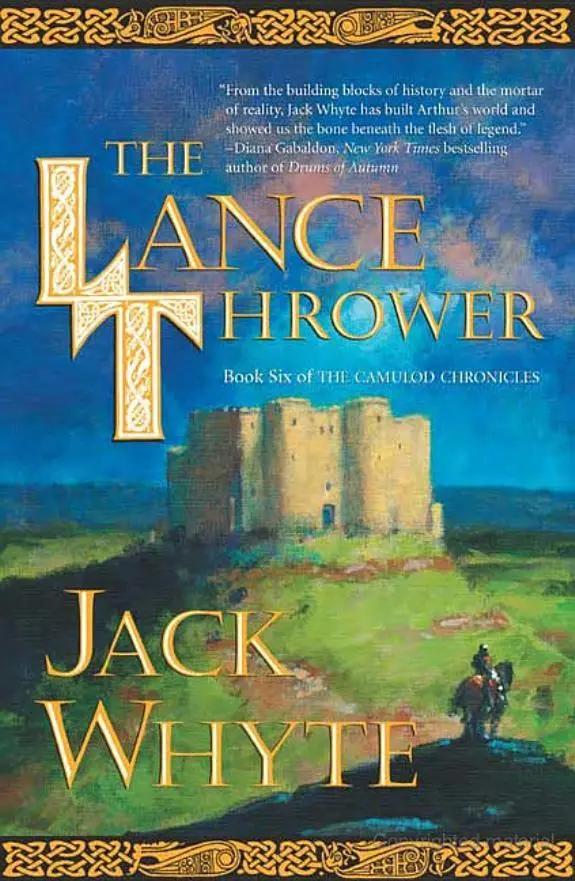
- Название:The Lance Thrower
- Автор:
- Жанр:
- Год:неизвестен
- ISBN:нет данных
- Рейтинг книги:5 / 5. Голосов: 1
-
Избранное:Добавить в избранное
- Отзывы:
-
Ваша оценка:
The Lance Thrower: краткое содержание, описание и аннотация
Предлагаем к чтению аннотацию, описание, краткое содержание или предисловие (зависит от того, что написал сам автор книги «The Lance Thrower»). Если вы не нашли необходимую информацию о книге — напишите в комментариях, мы постараемся отыскать её.
Clothar is a young man of promise. He has been sent from the wreckage of Gaul to one of the few schools remaining, where logic and rhetoric are taught along with battle techniques that will allow him to survive in the cruel new world where the veneer of civilization is held together by barbarism. He is sent by his mentor on a journey to aid another young man: Arthur Pendragon. He is a man who wants to replace barbarism with law, and keep those who work only for destruction at bay. He is seen, as the last great hope for all that is good.
Clothar is drawn to this man, and together they build a dream too perfect to last--and, with a special woman, they share a love that will nearly destroy them all...
The name of Clothar may be unknown to modern readers, for tales change in the telling through centuries. But any reader will surely know this heroic young man as well as they know the man who became his king. Hundreds of years later, chronicles call Clothar, the Lance Thrower, by a much more common name.
That of Lancelot.
The Lance Thrower — читать онлайн бесплатно полную книгу (весь текст) целиком
Ниже представлен текст книги, разбитый по страницам. Система сохранения места последней прочитанной страницы, позволяет с удобством читать онлайн бесплатно книгу «The Lance Thrower», без необходимости каждый раз заново искать на чём Вы остановились. Поставьте закладку, и сможете в любой момент перейти на страницу, на которой закончили чтение.
Интервал:
Закладка:
“From the first time your father set eyes on Medroc in his fine plumage, he dreamed of someday becoming one of the Emperor’s Guard. The lad’s career was clearly laid out, all the way from basic training under Cousin Medroc’s watchful eye, to a solid and rewarding position as an officer in the Household Guard, thanks to his family’s influence. It was all cut-and-dried and carefully arranged.”
He looked at me, making sure that I was listening closely before continuing. “But there’s a lesson there, lad, concerning your father and his cousin that you should keep in mind from this time on: the trouble with things that are too neatly cut-and-dried is that they often break when a strong wind comes up, because they’re too dry to bend. Your father had been in the Household Guard for less than a year, still a snotty-nosed trainee recruit, when Medroc got himself killed during a garrison mutiny in the far south of Gaul, near the border with Iberia.”
“Iberia? What was he doing there? Was he traveling with the Emperor?”
“No, but he was traveling for the Emperor, carrying urgent dispatches from Honorius himself to the legate commanding in southern Gaul, and he arrived in a mountain town along his route just in time to get himself and his men safely bedded down for the night and soundly to sleep before the garrison mutinied. The garrison commander, who from all later reports was a complete pig, was assassinated in the darkest hour of the night, along with all his officers, and Medroc awoke shortly after that to find himself being dragged out of bed. He was a witness to their mutiny, and they knew him to be a loyal and trusted officer of the Emperor, because they opened and read the dispatches he was carrying. They killed him right there, probably before he really understood what was happening to him. Of the twenty troopers in his escort, two were lucky enough to escape that night and survived to raise the alarm. So that was the end of Cousin Medroc, and of your father’s dreams of an illustrious career in the personal service of the Emperor.
“Medroc’s death went unnoticed for a long time, as far as I can tell, lost sight of in the confusion and upheaval of the campaign against the mutineers. It was a hard campaign, too. I remember it because it was my first. I had been in the army for several years by then, but that was the first time I had ever been called upon to fight, and it was the only time I ever had to fight against our own, Roman soldiers just like us. We had no idea what had driven them to mutiny, or if, under the same conditions, we might have been tempted to join them. Fighting them was not a pleasant experience, from that viewpoint alone.
“But besides that, the success of the mutiny from the outset had attracted malcontents and deserters from all over southern Gaul, so that what had started out as a town garrison with an arguably legitimate grievance soon grew to something else entirely, approaching the size of an army … a rabble, certainly, but strong in numbers. Strong enough to defeat the first few units sent out to contain them and put the mutiny down. They won those opening actions easily, because the men sent out against them underestimated almost everything about them. But those early, easy victories were the worst things that could have happened to them. They grew too confident after that. They honestly thought they could win in mutiny, the damn fools—even proclaimed one of their own as Emperor just before we brought them to battle after six weeks of floundering around in mud and rain. That was it. We killed every last one of them, one way or another. Them that survived the fighting died the way mutineers always die, some of them flogged to death, some hanged, and others beheaded. The four ringleaders, soon identified by turncoats desperate to save their own lives, were crucified … the only modern army crucifixions I’ve ever heard of.”
Chulderic fell silent after that, and I had the good sense to say nothing and simply wait for him to start talking again.
“At any rate,” he began, finally, “by the time the dust settled after all that, the faithful Medroc had been forgotten, long since replaced by some other talented and brilliant young man who doubtless looked just as fine in his parade armor, and Medroc’s protégé, young Childebertus, had become just another faceless trainee with no influence and not even seniority to protect him. It didn’t take him long to discover that his relationship with Medroc had been resented by more than a few of his fellows, and his life within the Household Guard became very unpleasant very quickly.
“A call went out around that time for volunteers for a new, highly mobile cavalry force to be stationed on the Rhine river, where the difficulty of keeping invaders out had not grown easier in three hundred years. The new force was to be an elite one, and well paid, to compensate for the danger and hardship involved in what they had to do. Your father had always loved horses and was a natural cavalryman. He recognized salvation when he saw it, and he became one of the very first applicants for the new force. Within months of that he was here in Gaul, transferred out of the Emperor’s Guard and into the new cavalry division. That’s where he met me and the King, although Ban was only Ban of Benwick at that time.” He broke off and looked at me again, his brow creased in thought. “Did Ban already tell you all this?”
I nodded. “Yes, Magister … some of it, anyway.”
“Then what the blazes did he want me to talk to you about if you already know what I’m supposed to tell you?” This was more like the Chulderic I knew, snappish and impatient with anything he saw as being trivial or time wasting, but he said no more after that first outburst, and I dared to speak up once more.
“About how my parents died, Magister—I asked the King last night to tell me and he would not, because he had not been there to see it for himself. But he told me you had witnessed all of it, and he said you were far more able than he to tell me the truth of what happened.”
“Hmm.” There was no sign of impatience in the old man now. He stuck out his lower lip and gazed into the distance across the lake. “He was wrong, then. I was nearby, but I was not there. Had I been there, I would not be here today.” He straightened his back and stood up. “Come, ride with me again while I try to find words for you.”
Chulderic and, I remounted and made our way down the slope, veering more and more to the left as we descended, so that by the time we regained level ground we were far from where we had begun our climb to the summit. Once again we rode in silence, traversing a landscape of grassland scattered with clumps of scrub willows, alder, and hawthorn while Chulderic searched his mind for memories he could describe. And then, without sign or warning, he began again.
“We had barely left the army life behind us when Childebertus first met your mother. I remember that clearly. It must have been within the first few weeks of our liberty.
“We were on the road home, I remember, but we were barely out of the German territories, headed south toward Benwick and moving at our own pace, still full of the heady feelings of freedom after so many years of regimentation and routine, and Ban had just finished telling us a story that none of us believed. He told us he had been betrothed, years earlier and at his father’s insistence, to an unknown woman. We thought he was gulling us, trying to hoodwink us for his own ends, and when we pressed him for more details, calling him a liar and a lout—which we could do because we were his friends—he admitted that he had been thirteen and she a mere infant at the time. But he swore he had never even seen her, so he could not say if she had one head or two, and we all had a good laugh over his foolishness. He could see we were still unconvinced, nevertheless, and so he told us she was the daughter of one of his father’s oldest allies, a king called Garth of Ganis, who ruled over a federation of clans among the Salians, the northern Franks, in the rich lands to the south of the Rhine delta. Her name was Vivienne of Ganis, and he swore to us that before leaving home to come on this campaign, he had renewed his pledge to marry her, sight unseen and for the good of his people, when he returned victorious from the wars. Well, he was returning now, he said, and curious to see what kind of burden he had been saddled with to please his father, and so he was going to visit her father’s place, Ganis, on the way south, since we would be riding close by it, to the eastward.
Читать дальшеИнтервал:
Закладка:
Похожие книги на «The Lance Thrower»
Представляем Вашему вниманию похожие книги на «The Lance Thrower» списком для выбора. Мы отобрали схожую по названию и смыслу литературу в надежде предоставить читателям больше вариантов отыскать новые, интересные, ещё непрочитанные произведения.







Обсуждение, отзывы о книге «The Lance Thrower» и просто собственные мнения читателей. Оставьте ваши комментарии, напишите, что Вы думаете о произведении, его смысле или главных героях. Укажите что конкретно понравилось, а что нет, и почему Вы так считаете.