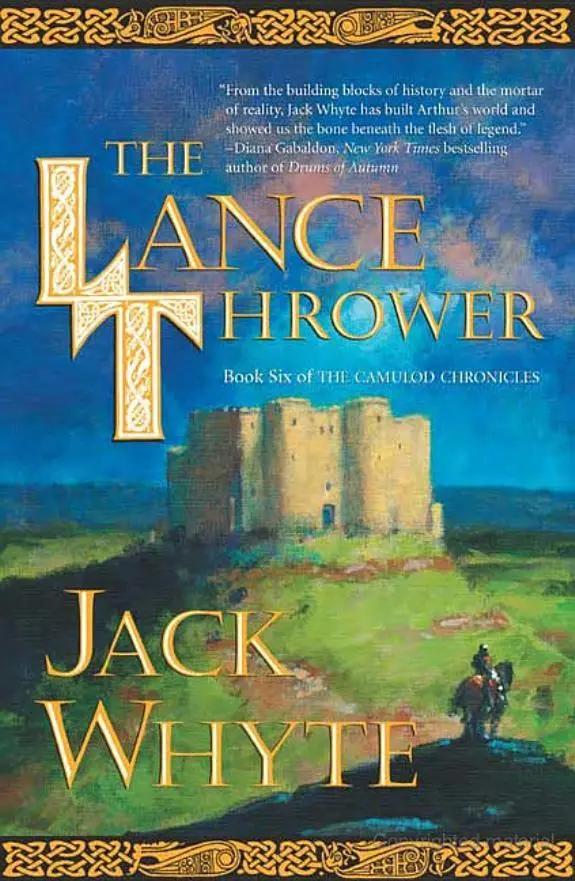
Jack Whyte - The Lance Thrower
Здесь есть возможность читать онлайн «Jack Whyte - The Lance Thrower» весь текст электронной книги совершенно бесплатно (целиком полную версию без сокращений). В некоторых случаях можно слушать аудио, скачать через торрент в формате fb2 и присутствует краткое содержание. Жанр: Старинная литература, на английском языке. Описание произведения, (предисловие) а так же отзывы посетителей доступны на портале библиотеки ЛибКат.
- Название:The Lance Thrower
- Автор:
- Жанр:
- Год:неизвестен
- ISBN:нет данных
- Рейтинг книги:5 / 5. Голосов: 1
-
Избранное:Добавить в избранное
- Отзывы:
-
Ваша оценка:
The Lance Thrower: краткое содержание, описание и аннотация
Предлагаем к чтению аннотацию, описание, краткое содержание или предисловие (зависит от того, что написал сам автор книги «The Lance Thrower»). Если вы не нашли необходимую информацию о книге — напишите в комментариях, мы постараемся отыскать её.
Clothar is a young man of promise. He has been sent from the wreckage of Gaul to one of the few schools remaining, where logic and rhetoric are taught along with battle techniques that will allow him to survive in the cruel new world where the veneer of civilization is held together by barbarism. He is sent by his mentor on a journey to aid another young man: Arthur Pendragon. He is a man who wants to replace barbarism with law, and keep those who work only for destruction at bay. He is seen, as the last great hope for all that is good.
Clothar is drawn to this man, and together they build a dream too perfect to last--and, with a special woman, they share a love that will nearly destroy them all...
The name of Clothar may be unknown to modern readers, for tales change in the telling through centuries. But any reader will surely know this heroic young man as well as they know the man who became his king. Hundreds of years later, chronicles call Clothar, the Lance Thrower, by a much more common name.
That of Lancelot.
The Lance Thrower — читать онлайн бесплатно полную книгу (весь текст) целиком
Ниже представлен текст книги, разбитый по страницам. Система сохранения места последней прочитанной страницы, позволяет с удобством читать онлайн бесплатно книгу «The Lance Thrower», без необходимости каждый раз заново искать на чём Вы остановились. Поставьте закладку, и сможете в любой момент перейти на страницу, на которой закончили чтение.
Интервал:
Закладка:
The Lady Demea, a devout Christian, had heard about the miracles attributed to Saint Alban, all of them centered around his shrine in Verulamium, and had prevailed upon her doting husband to bring her here, where she could beg the saint in person to intercede for her in Heaven and bless her with a pregnancy. That Demea was fully confident her prayers would be answered was evident to anyone with eyes to see, and the manner in which she and her husband conducted themselves made it plain that they were giving Heaven every opportunity to bless their endeavors. Thus, it was evidently not his beautiful young wife who was the cause of Symmachus’s distemper.
It was his daughters, I believed—or one of them, the elder of the two—who cost him sleepless nights and justified, in his mind at least, his continuing disapproval of me. The daughter’s name was Cynthia—again a Roman name, or perhaps even Hellenic—but she was obviously not, by her very coloring, the daughter of Demea. Cynthia’s real mother, a black-haired, blue-eyed woman from the far northern lands beyond Hadrian’s great wall, had died years earlier, giving birth to her second daughter when Cynthia was only four years old. Cynthia was now almost sixteen, breathtakingly lovely and desirable and making not the slightest attempt to conceal her attraction to me.
It made no difference to Symmachus that I went to great pains to distance myself from his daughter and avoid her company. He saw nothing of that. In truth, while I acknowledged Cynthia’s great physical and facial beauty, I experienced no attraction to her beyond the first few days of knowing her, and she herself had given me the reason to feel the way I did.
Young Bors had fallen in love with her from the moment he set eyes on her, and he was utterly incapable of hiding his infatuation. I know how true that is because I was there when he saw her for the first time and I almost laughed aloud at the spectacular transformation that came over him: his eyes went wide and then almost glazed over and his mouth fell agape and it seemed to me that he forgot how to move. He simply stood there, gazing at her slack jawed and openmouthed, incapable of speech or movement.
Of course, Cynthia saw it immediately. Unfortunately, however, her recognition of his stunned submission to her beauty brought out her worst attributes. Where I took pains immediately to dissemble and conceal my delight in my young servant’s reaction to her beauty, Cynthia proceeded from the first to exploit it ruthlessly, treating Bors shamefully and using him imperiously and cruelly, keeping him dancing attendance on her and accepting his every adoring look as no more than her due while she deliberately spurned him, belittling him and insulting him.
Her behavior, uncalled for and excessive as it was, upset me deeply because it impressed me as being quite natural and unfeigned. I found it repellent that she should be so quick to cause my young associate pain, for no reason other than his natural attraction to her beauty. Bors was my servant, and although I strove to keep our relationship as one of master to apprentice, I had found him to be a willing worker and a conscientious student, as well as a naturally friendly and enthusiastic soul—his truculence and sullen behavior had vanished within hours of our setting foot upon the road to Britain. He had done absolutely nothing to earn Cynthia’s displeasure, but she poured wrath and disdain about his head in equal and unstinting measure, treating him far less kindly than most people treat animals, and I soon found myself harboring a deep feeling of dislike for her that I was never able to disguise completely.
Cynthia, of course, believing entirely in her own allure and fascination, was never able to bring herself to believe that I could be genuinely immune to her attractions, so that the more I attempted to avoid her and discourage her, the more determined she became to enslave me with her charms and to bend me to her will. Unfortunately, thanks to my education and my many talks with Bishop Germanus concerning women and the rules governing a decent man’s behavior toward them, I was never quite able to bring myself to tell her how deeply she had taught me to dislike her, or how her treatment of Bors repulsed me. That would have been too cruel, by my own assessment at that time, although it occurred to me not long afterward that had she been male and my own age I would have thrashed her soundly for her hectoring cruelty and ordered her to stay well clear of me until she had learned how to control the baseness of her nature.
This, then, was the reason for the tension between the two of us all the time, and that was what her father reacted to with such hostility. His reading of the situation was wrong, of course, but I could hardly come right out and add insult to his imagined injuries by telling him that I found his firstborn daughter ill natured, morally unattractive, and generally unpleasant and that I would far rather spend time with her quieter, far less aggressive and offensive twelve-year-old sister, whom she called the Brat. And so Symmachus distrusted me because he felt I lusted for his daughter, and I resigned myself to being spoken to through Perceval at every turn.
Symmachus was a warrior, however, and he had heard tales of Camulod, and he wanted to know if it was feasible that Merlyn Britannicus and Camulod might consider an alliance with himself and his people in Deva. His question caused a long, uncomfortable silence because none of us was qualified to answer it with anything resembling authority, although I felt that the distance between the two locations alone—almost two hundred miles—would render impossible the kind of arrangement that the king was thinking of. I said as much, and although he seemed to accept the logic of my explanation after examining it for a short time, I could tell that Symmachus was not too happy with me for having stated the obvious and created difficulties for whatever it was he had been considering. Once again, however, I kept silent, venturing no more opinions and showing no more signs of curiosity.
Symmachus and his party had been on the point of leaving for home when the weather broke in mid-December, effectively stranding them in Verulamium for several more months, and so it was that we came to know him to the extent that we did. Although I found him less than comfortable to be around, I had no such difficulties with his companions, who were in fact his family’s bodyguard. I came to know several of them very well, and my friends and I spent many pleasant hours with them among the woods, learning to hunt as they did in deep snow. They, in their turn, were fascinated with the spears given to me by Tiberias Cato. The Cambrians had never seen their like, but were unimpressed by the information that no one else had, either. They were quite convinced that somewhere along the edges of one of their northern mountain lakes they would soon find reeds long enough and strong enough to dry and shape into light, strong, durable spear shafts like mine. I made no effort to convince them otherwise, for they simply would not have believed that people had already scoured the reaches of the Empire looking for such things.
They were particularly fascinated by the technique I used to throw the weapons, and by the accuracy I managed to achieve, although they pretended to be overly concerned about the amount of time I spent practicing. They were correct in that. I did spend inordinately large amounts of time practicing that winter, but there was little else to do most of the time. When the weather was too cold and the snow too deep to do much outside, I converted the largest hall in the basilica into a practice arena, piling all the cots and tables and benches up against one long wall and throwing my spears from one end of the vast hall to the other. The distance was slightly less than forty paces, which was ample room for practicing throwing with accuracy, and I had ranged a series of tables and benches of differing heights across one end of the room so that I could make my way from one side to the other, jumping or stepping from one level to another and throwing from any of them as I went. At the far end, I had mounted a series of five boards to serve as targets, each of them painted with pitch in approximately the size and shape of a man. My watchers were amazed that I could announce my targets from any throwing height, specifying the area I would hit—head, chest, thigh, and the like—and then hit accurately from thirty to forty paces distant eight times out of any ten. That, to them, was magical. To me, it was the result of incessant hours of brutal, unrelenting work.
Читать дальшеИнтервал:
Закладка:
Похожие книги на «The Lance Thrower»
Представляем Вашему вниманию похожие книги на «The Lance Thrower» списком для выбора. Мы отобрали схожую по названию и смыслу литературу в надежде предоставить читателям больше вариантов отыскать новые, интересные, ещё непрочитанные произведения.









Обсуждение, отзывы о книге «The Lance Thrower» и просто собственные мнения читателей. Оставьте ваши комментарии, напишите, что Вы думаете о произведении, его смысле или главных героях. Укажите что конкретно понравилось, а что нет, и почему Вы так считаете.