Bernard Cornwell - Stonehenge
Здесь есть возможность читать онлайн «Bernard Cornwell - Stonehenge» — ознакомительный отрывок электронной книги совершенно бесплатно, а после прочтения отрывка купить полную версию. В некоторых случаях можно слушать аудио, скачать через торрент в формате fb2 и присутствует краткое содержание. Жанр: Старинная литература, на русском языке. Описание произведения, (предисловие) а так же отзывы посетителей доступны на портале библиотеки ЛибКат.
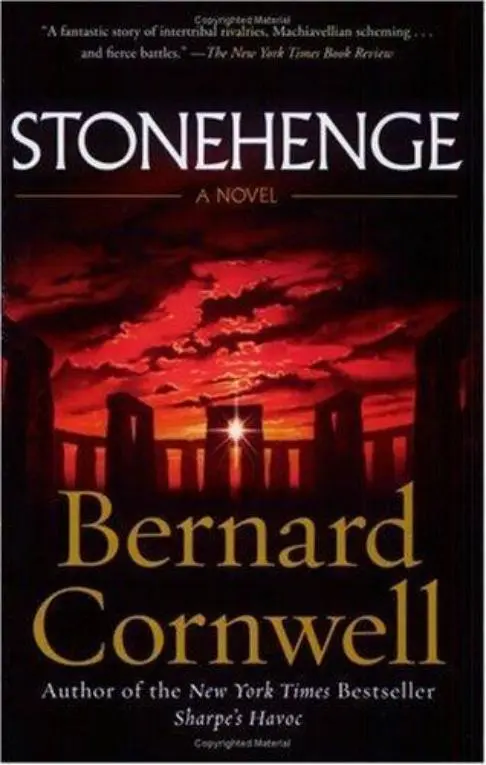
- Название:Stonehenge
- Автор:
- Жанр:
- Год:неизвестен
- ISBN:нет данных
- Рейтинг книги:3 / 5. Голосов: 1
-
Избранное:Добавить в избранное
- Отзывы:
-
Ваша оценка:
Stonehenge: краткое содержание, описание и аннотация
Предлагаем к чтению аннотацию, описание, краткое содержание или предисловие (зависит от того, что написал сам автор книги «Stonehenge»). Если вы не нашли необходимую информацию о книге — напишите в комментариях, мы постараемся отыскать её.
Stonehenge — читать онлайн ознакомительный отрывок
Ниже представлен текст книги, разбитый по страницам. Система сохранения места последней прочитанной страницы, позволяет с удобством читать онлайн бесплатно книгу «Stonehenge», без необходимости каждый раз заново искать на чём Вы остановились. Поставьте закладку, и сможете в любой момент перейти на страницу, на которой закончили чтение.
Интервал:
Закладка:
'I was.'
'She still lives,' the man said defiantly. He had a scar on his face from where an arrow had struck his cheek during the battle that had destroyed Cathallo's power.
'I hope she still lives,' Saban answered.
'You hope so?' The man was puzzled.
'As you said, I was her friend. And if she does still live,' Saban said firmly, 'then you would do well to keep silent unless you want more of Ratharryn's spearmen searching the forests for her.'
Another of the men played a short tune on a flute made from the bone of a crane's leg. 'They can search all they like,' he said when he had finished, 'but they will never find her. Nor her child.'
The first man, whose name was Vennar, poked the fire to prompt a thick flurry of sparks, then gave Saban a sidelong glance. 'Are you not afraid to be here with us?'
'If I was afraid,' Saban said, 'I would not be here.'
'You need not be afraid,' Vennar said very quietly. 'Derrewyn says you are not to be killed.'
Saban smiled. All summer he had suspected that Derrewyn was close and that, unknown to Cathallo's conquerors, she kept in touch with her tribe. He was touched, too, that she had ordered his life spared. 'But if you try to stop the stones from reaching Ratharryn,' he said, 'then I shall fight you, and you will have to kill me.'
Vennar shook his head. 'If we do not move the stones,' he said, 'someone else will.'
'Besides,' the flute player added, 'our women would fear Lahanna's anger if you were to die.'
'Lahanna's anger?' Saban asked, puzzled. Ratharryn's vengeance, maybe, but surely not Lahanna's anger?
Vennar frowned. 'Some of our women say that Aurenna is Lahanna herself.'
'She is beautiful,' the second man said wistfully.
'And Slaol would not take her life,' Vennar said. 'Is that not true?'
'She is not Lahanna,' Saban said firmly, fearful what Derrewyn might do if she heard such a tale.
'The women say she is,' Vennar insisted, and Saban could tell from his tone that Vennar was not sure what to believe for he was torn between his old loyalty to Derrewyn and his awe of Aurenna. Saban doubted that Aurenna herself would have encouraged such a rumour, but he wondered if Camaban had. It seemed likely. The folk of Cathallo had lost a sorceress, and what better to replace a sorceress than a goddess? 'Didn't the Outfolk worship her as a goddess?' Vennar demanded.
'She is a woman,' Saban insisted, 'just a woman.'
'So was Sannas,' Vennar said.
'Your brother claims to be Slaol,' the flute player said, 'so why shouldn't Aurenna be Lahanna?' But Saban would not talk of it any more. He slept instead, or rather he wrapped himself in his cloak and watched the brilliant stars that lay so thick beyond the shimmering smoke and he began to wonder if Aurenna was indeed turning into a goddess. Her beauty did not fade, her serenity was never broken and her confidence was unshakeable.
It took eleven days to move the first stone to Ratharryn, and once it was there Vennar and his men took the oxen and the sledge back to Cathallo to load another stone, while Saban stayed at the Sky Temple. The first stone was one of the smallest, destined to form a thirtieth part of the sky ring lifted on its pillars. Camaban had marked the ring on the ground by scratching a pair of concentric circles, and he now insisted that the stone be placed on that band. The stone has to be shaped,' Camaban told Saban, 'so that its outer edge curves to match the bigger circle, and its inner edge curves to match the smaller.'
Saban stared at the lump of stone. It was bulbous, protruding far over the two scratched lines, yet Camaban insisted that it be smoothed into a small segment of a wide circle. 'All the thirty stones of the sky ring must be the same length,' Camaban went on enthusiastically, 'but you're not to blunt their ends.' He took a lump of chalk and drew on the stone's slab-like surface. 'One end is to have a tongue and in the other end you'll carve a slot, so that the tongue of one stone fits into the slot of the next stone all around the ring.'
A man might as easily carve the sun, Saban thought, or wipe the sea-bed dry with thistledown, or count the leaves of a forest. And there were not just the sky ring's stones to shape, but the thirty stones that would lift it so high into the air, and the fifteen huge stones of the sun house, which would stand even higher. Camaban had worked out the dimensions of each stone and cut willow-sticks to record the measurements. Saban kept the sticks in a hut he made close to the temple. That hut became his home now. He had slaves to bring him firewood and to fetch water and to cook food, and more slaves to shape the first six stones, which had all arrived by midwinter.
The six grey boulders, like all the stones that came from Cathallo's hills, were slabs. Their top and bottom surfaces were parallel and nearly flat, and all the stones were of much the same thickness, so to make a pillar or a lintel it was only necessary to chip away the slab until its corners were square and its sides matched the lengths of the willow wands in Saban's hut. But the stone was cruelly hard, much harder than the boulders from Sarmennyn, and at first Saban's slaves merely broke their stone hammers on it, so Saban found harder stones. The stone hammers were skull-sized balls that the slaves lifted and dropped, lifted and dropped, and each blow ground away a patch of dust and stone splinters, so that, patch by patch, splinter by splinter, dust-grain by dust-grain, the stones were sculpted. The slaves learned as they worked. It was quicker, they discovered, to grind shallow trenches down the face of the stone, then to knock away the ridges left between. Some of the stones came with a dull brown line traceable in their grey faces and Saban found that the discoloration betrayed a weakness in the boulders that could sometimes be exploited if it ran where excess stone was to be removed. A dozen hammers dropped together on one side of the brown line could sometimes shear a great lump away, but if that failed Saban would set a fire down the length of the stain, feed the fire till it raged, then feed it again with a trickle of pig's fat which carried the searing heat down to the stone's surface. He would let the fat sizzle and flare until the rock was almost red hot and then his workers would dash cold water onto the fire and as often as not the stone would crack down the line of the stain. Sometimes the boulders were already cracked and the slaves could drive wedges into the split and hammer the rock apart or, on the coldest nights, fill the cracks with water and let it freeze so that the water spirits, trapped in the ice, would break the rock apart to escape. Yet most of the stones had to be shaped by sheer hard work, by repetitive grinding, by continuous blows, and the crash of the hammers and the grating of the grind-stones never stopped. Even in his dreams Saban heard the scrape and crack and screech of stone on stone, and his skin turned as grey as the boulders and his hair and beard were filled with the gritty dust.
Eight stones came the second year, and eleven the third, and Saban had to find more workers to grind and hammer and split and burn the stone, and more workers required still more slaves to bring food and water to the temple, and Camaban now had war parties permanently roaming up and down the land in search of captives. He led some of those war bands himself. He wore a sword now and had a bronze-plated tunic and a close-fitting cap made of bronze panels that had been cunningly riveted into the shape of a bowl. Men reckoned him as great a warrior as Lengar and a better sorcerer than Sannas, because those whom his spears could not defeat, his reputation could scare into submission.
Yet no sorcery could shape the stones and Camaban, between his raiding forays, grew ever more impatient with the slow progress. He would watch the slaves singing as they worked and the sound angered him. 'Work them harder!'
Читать дальшеИнтервал:
Закладка:
Похожие книги на «Stonehenge»
Представляем Вашему вниманию похожие книги на «Stonehenge» списком для выбора. Мы отобрали схожую по названию и смыслу литературу в надежде предоставить читателям больше вариантов отыскать новые, интересные, ещё непрочитанные произведения.






Обсуждение, отзывы о книге «Stonehenge» и просто собственные мнения читателей. Оставьте ваши комментарии, напишите, что Вы думаете о произведении, его смысле или главных героях. Укажите что конкретно понравилось, а что нет, и почему Вы так считаете.