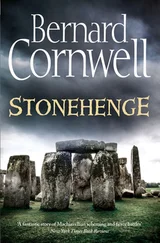
Bernard Cornwell - Stonehenge
Здесь есть возможность читать онлайн «Bernard Cornwell - Stonehenge» — ознакомительный отрывок электронной книги совершенно бесплатно, а после прочтения отрывка купить полную версию. В некоторых случаях можно слушать аудио, скачать через торрент в формате fb2 и присутствует краткое содержание. Жанр: Старинная литература, на русском языке. Описание произведения, (предисловие) а так же отзывы посетителей доступны на портале библиотеки ЛибКат.

- Название:Stonehenge
- Автор:
- Жанр:
- Год:неизвестен
- ISBN:нет данных
- Рейтинг книги:3 / 5. Голосов: 1
-
Избранное:Добавить в избранное
- Отзывы:
-
Ваша оценка:
Stonehenge: краткое содержание, описание и аннотация
Предлагаем к чтению аннотацию, описание, краткое содержание или предисловие (зависит от того, что написал сам автор книги «Stonehenge»). Если вы не нашли необходимую информацию о книге — напишите в комментариях, мы постараемся отыскать её.
Stonehenge — читать онлайн ознакомительный отрывок
Ниже представлен текст книги, разбитый по страницам. Система сохранения места последней прочитанной страницы, позволяет с удобством читать онлайн бесплатно книгу «Stonehenge», без необходимости каждый раз заново искать на чём Вы остановились. Поставьте закладку, и сможете в любой момент перейти на страницу, на которой закончили чтение.
Интервал:
Закладка:
She immediately pulled away. 'I will give you food,' she said coldly, 'and a place to sleep. And in the morning you can go.'
In the morning, he went.
—«»—«»—«»—
Lengar had already gone back to Ratharryn when Saban returned to Sul. 'He thought you'd run away,' Lewydd told Saban.
'You didn't tell him I was coming back?'
'I told him nothing. Why should I? But the sooner you're home in Sarmennyn, the better. He wants you dead.'
Saban touched the shape of the nutshell beneath his tunic, but said nothing of it. Would it work? Would he even need it? If he stayed in distant Sarmennyn he would never need face Lengar again and so he was glad when, on the day after his return from Cathallo, Kereval at last tore himself away from the hot spring in which he had been soaking himself, claiming that it cured the aches in his bones. The westwards sea journey home was much harder for the wind was against the boats and though the tides still carried them for half of the time, the voyage took much paddling and a whole day longer than the outward journey. At last, though, the boats turned about the headland and the crews sang as the tide carried them upriver to Kereval's settlement.
Next day Saban picked woad from a hillside and Aurenna infused it in water and, when the dye was ready, she placed a second killing tattoo on Saban's chest. She hammered the marks in with a comb, driving the dye deep, and while she worked Saban told her all that had happened in Sul and how he had taken Jegar's head to Derrewyn. Afterwards, while the blood dried on his chest, he and Aurenna sat by the river and she fingered the nutshell. 'Tell me about Derrewyn,' she said.
'She is thin now,' Saban said, 'and bitter.'
'Who can blame her?' Aurenna asked. She frowned at the nutshell. 'I don't like it. Loosing a curse can hurt the person who releases it.'
'It might keep me alive,' Saban said, taking it from her. 'I shall keep it till Lengar dies, then bury it.' He hung it about his neck. He dared not show it to Camaban for he feared his brother might use the charm to hurt Derrewyn, and so he kept it hidden. He also feared that Camaban would question him about his journey to Cathallo and call him a fool for having made it, but Camaban was preoccupied with finding a trader who could carry him to the island across the western sea. He eventually found some men who were making the voyage with a cargo of flints and so Camaban left Sarmennyn.
'I shall learn their priests' secrets,' he told Saban, 'and come back when it is time.'
'When is that?'
'Whenever I come back, of course,' Camaban said, stepping into the boat. One of the traders handed him a paddle, but Camaban contemptuously swatted it aside. 'I don't paddle,' he said, 'I sit and you paddle. Now take me.' He gripped the boat's gunwales and was carried downstream to the sea.
Ten boats for carrying the temple's pillars were now ready, all of them triple-hulled and tight-lashed, and they were towed upstream to where long grass grew around the growing piles of temple stones. The smaller stones, those about the height of a man, could be loaded two to a boat, but the largest needed a boat to themselves and Saban began by loading one of those huge boulders. At high tide one of the boats was hauled in to the river's edge and its stern was tied firmly to the bank. Saban levered up one end of the boulder, which still rested on its sledge, and slid a beam beneath it. He levered up the other end so three more beams could be placed under the stone, then forty men grasped the beams, heaved up and staggered towards the boat. The men had only a few paces to carry the vast weight, yet they became nervous when they stepped into the water and a dozen more men were needed to steady the stone. The men sweated, but inched onwards until the great stone was poised above the square timbers that spanned the three hulls. They lowered the stone and the boat settled so deep in the water that one hull grounded on the river-bed. Lewydd and a dozen men tugged the boat free and Saban saw how little freeboard the hull had, but Lewydd reckoned they would survive the journey to Ratharryn if Malkin, the weather god, was kind. He and a dozen men boarded the boat and paddled it downriver, followed on the bank by a horde of excited men.
It took three days to load the ten boats. Five of the craft carried large stones while the other five had a pair of smaller stones apiece, and once the stones were lashed to their beams the boats were all floated downstream. There were two places where the river ran shallow and men had to haul the boats across those places as though they were sledges, but in two days all the boats were safe at Aurenna's settlement where they were tethered to trees. At low tide the great hulls rested in the mud while at high they floated free to tug restlessly at their moorings.
They were waiting for the weather. It was already late in the summer, but Lewydd prayed at Malkin's shrine each morning then climbed the hills behind the settlement to peer westwards. He was waiting for the wind to die and the sea to settle, but the wind seemed relentless in those late summer days and the grey waves roared endlessly from the west to shatter white on the rocky coast.
The harvest was cut and then the rains started, blasting from the ocean in teeming downpours so that Saban had to empty the moored boats of rainwater every day. The skies stayed dark and he began to despair of ever moving the stones, but Lewydd never abandoned hope and his optimism was justified for one morning Saban woke to a strange calm. The day was warm, the winds had settled and the fishermen reckoned the fine weather would last. It often happened like this, they said, that, late in the year, just before the autumn brought howling gales, Malkin would send long days of blissful calm and so the ten boats were loaded with skins of fresh water and sacks of dried fish and baskets of the flat bread that was made on hot stones, and then Scathel splashed each boat with the blood of a freshly killed bullock and, at midday, with a dozen paddlers manning each craft, the first of the temple's stones went to sea.
There were plenty of men in the tribe who said the crews would never be seen again. In the heft of the sea, they claimed, the boats would swamp and the weight of the stones would drag them down to where the grey monsters of the deep waited. Saban and Aurenna walked to the coast and watched the ten boats, escorted by two slim fishing craft, turn around the headland and paddle out to sea. The pessimists were wrong. The ten boats rode the small waves easily and then the leather sails were hoisted above the stones, the paddles dug deep, and the small fleet rode the gentle wind and long tide eastwards.
Now all Saban could do was wait for Lewydd's return. He waited as the days shortened and as the wind rose and the air turned chill. Some days Saban and Aurenna would walk to the southern headland from where they would stare from the cliff's top to search for Lewydd's boats, but though they could see fishing boats with men standing and throwing their small nets, and though they saw plenty of traders' boats loaded with goods, they saw none of the triple-hulled boats that had carried the stones. Day by day the wind drove the sea harder, smashing water white on rock and lashing the wave crests to foam, and still Lewydd did not return. There were days when the fishermen would not go out because the water and the wind were too angry and on those days Saban feared for Lewydd.
The first frost came and after that the first snow. Aurenna was pregnant again and some mornings she woke weeping, though she always denied that her tears were for Lewydd. 'He lives,' she insisted, 'he lives.'
'Then why are you crying?'
'Because it is winter,' she said, 'and Erek dies in the winter and I am so close to him that I feel his pain.' She flinched when Saban touched her cheek. There were times when he felt she was distancing herself from him, moving closer to Erek. She would sit on her stone beside the river, her hands outstretched on either side, and claim to be listening to her god, and Saban, who heard no voices in his head, was jealous.
Читать дальшеИнтервал:
Закладка:
Похожие книги на «Stonehenge»
Представляем Вашему вниманию похожие книги на «Stonehenge» списком для выбора. Мы отобрали схожую по названию и смыслу литературу в надежде предоставить читателям больше вариантов отыскать новые, интересные, ещё непрочитанные произведения.











Обсуждение, отзывы о книге «Stonehenge» и просто собственные мнения читателей. Оставьте ваши комментарии, напишите, что Вы думаете о произведении, его смысле или главных героях. Укажите что конкретно понравилось, а что нет, и почему Вы так считаете.